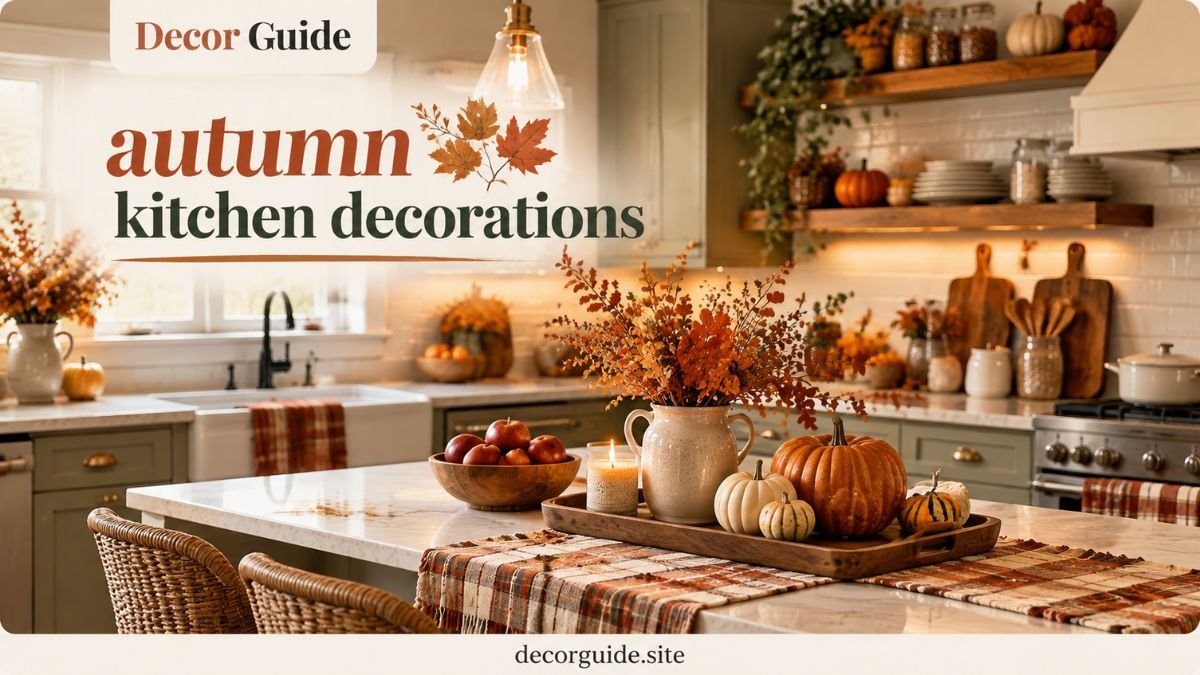
The easiest way to create an autumn kitchen is to add a few seasonal colors, natural textures, and useful decorative pieces rather than changing everything. Start with areas you already use, such as the kitchen counter, dining table, open shelves, island, or coffee station. Add pumpkins, fall leaves, wood, woven baskets, warm toned textiles, or seasonal dishes where they make sense. Keep everyday work surfaces clear and repeat a small group of colors throughout the room. This creates a seasonal look without making the kitchen feel crowded or difficult to use.
1. Choose an Autumn Color Palette First
Before buying or moving anything, decide which colors you want to see in the kitchen.
autumn kitchen decorations does not have to mean using orange everywhere. A restrained palette can look more natural and easier to live with.
Good combinations include:
- Warm beige with rust and cream
- Brown with muted orange
- Cream with olive or soft green
- Terracotta with natural wood
- Deep red with warm neutrals
- Tan with burnt orange and soft white
If your kitchen already has a strong cabinet or countertop color, use that as the starting point.
For example, a white kitchen can handle warm orange, wood, beige, and muted green accents. A kitchen with dark cabinets may look better with cream, natural wood, and lighter autumn accents instead of several dark colors.
The goal is not to make every object look seasonal. It is to create a visual connection between a few carefully selected pieces.
2. Start With the Kitchen Counter
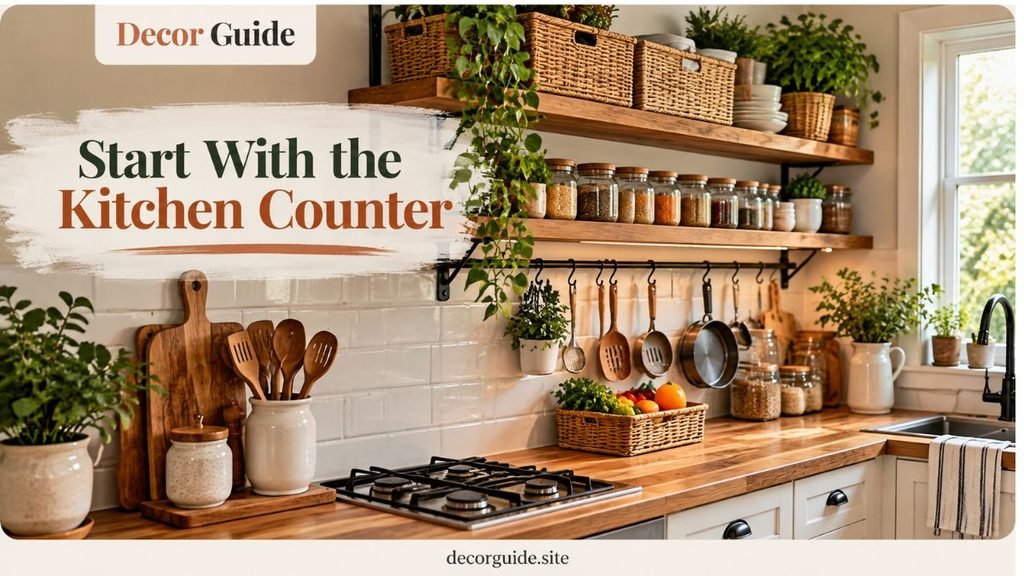
The counter is one of the easiest places to introduce autumn decor because it is naturally visible.
However, kitchen counters also need to remain practical.
Choose one small area instead of decorating the entire countertop. You could create a simple seasonal arrangement with:
- A small bowl of decorative pumpkins
- A wooden cutting board
- A ceramic vase
- A small branch with autumn colored leaves
- A woven container
- A seasonal kitchen towel nearby
Keep frequently used preparation areas open.
If you have limited counter space, use something that already serves a purpose. A wooden board can remain useful while also adding warmth. A fruit bowl can become part of the seasonal color scheme without becoming purely decorative.
This approach works especially well in smaller kitchens.
3. Create a Simple Fall Kitchen Table
If your kitchen has a dining table, breakfast table, or small eating area, use it as a seasonal focal point.
You do not need an elaborate centerpiece.
Try placing a tray in the middle of the table and adding two or three elements with different heights. For example, a low bowl can sit beside a small vase and a candle holder.
Natural textures can make the arrangement feel warmer:
- Wood
- Ceramic
- Woven materials
- Linen
- Dried branches
- Natural leaves
Keep the arrangement low enough that people can still see across the table.
For a small table, skip a large centerpiece and use one seasonal bowl or vase instead. The smaller arrangement will leave more room for everyday meals.
4. Add Autumn Kitchen Towels
Kitchen towels are one of the easiest seasonal changes because they take almost no storage space.
Instead of choosing a towel covered with multiple seasonal graphics, consider simple patterns or colors that work with the rest of your kitchen.
Look for combinations such as:
- Cream and rust
- Brown and beige
- Olive and tan
- Warm plaid
- Simple leaf patterns
Place one where it is useful rather than hanging several towels around the room.
A seasonal towel works best as a supporting detail. It does not need to become the main feature of the kitchen.
5. Decorate Open Shelves for Fall
Open shelving provides a natural place for autumn kitchen decorations, but it can quickly become visually busy.
Start by removing a few existing objects rather than simply adding more.
Then group items by color or material.
For example, one shelf might combine:
- Cream colored plates
- A wooden bowl
- A small ceramic vase
- A muted autumn accent
Another shelf could focus on everyday dishes with one seasonal item.
Open vs. Closed Storage
Open shelving is useful when you want seasonal pieces to be visible and easy to change. Closed cabinets are better for keeping everyday kitchen supplies out of sight.
If your shelves already look crowded, do not force more decorations into them. Store seasonal pieces in a cabinet or basket and rotate them throughout the year.
This keeps the kitchen organized while still allowing seasonal changes.
6. Bring in Natural Autumn Textures
Color is only part of the autumn look. Texture can make a bigger difference than adding more seasonal objects.
Consider materials such as:
- Natural wood
- Woven baskets
- Linen
- Ceramic
- Stoneware
- Dried branches
- Textured fabrics
A wooden bowl beside a cream ceramic vase can create a warm seasonal feeling without using obvious fall decorations.
This is especially useful if you prefer a modern kitchen. You can make the room feel seasonal without turning it into a themed display.
7. Use Pumpkins Carefully
Pumpkins are one of the most recognizable autumn decorations, but more is not necessarily better.
Choose a few pumpkins in different sizes or finishes and place them in areas that make sense.
For example:
- One or two on an open shelf
- A small group on a kitchen island
- A few inside a decorative bowl
- Small pumpkins beside a vase
If your kitchen is small, use miniature decorative pumpkins rather than filling valuable counter space with large pieces.
You can also choose neutral pumpkin colors if bright orange does not work with your existing kitchen.
The best choice depends on your room. A white or neutral kitchen may benefit from warm orange accents, while a colorful kitchen may look better with restrained autumn tones.
8. Decorate a Kitchen Island Without Losing Workspace
A kitchen island can become the center of your autumn decorating, but it is also one of the most useful work surfaces in the room.
Keep most of the island available for cooking and preparation.
One simple arrangement can be enough. A tray containing a bowl, vase, or small seasonal accent gives you a defined decorating zone.
A tray is particularly useful because you can move the entire arrangement when you need the island for food preparation.
If your island also functions as a dining area, keep decorations away from the seating side.
9. Make a Small Autumn Coffee Station
If you have a coffee or beverage station, it can become a natural seasonal display.
Start with the items you already use every day. Then add one or two autumn details.
For example, you could combine:
- Everyday mugs
- A wooden tray
- A small seasonal sign
- A warm toned towel
- A small bowl or vase
Avoid adding decorations that make the station difficult to use.
A seasonal mug can be more useful than a decorative object because it contributes to the theme while still serving a purpose.
10. Add Autumn Decor Around the Sink
The sink area can also receive a small seasonal update.
Because this is a high use area, keep decorations simple.
A warm toned hand towel, a small container, or a natural looking plant can add seasonal character without blocking the sink.
Avoid placing fragile decorations directly beside areas where they can easily get wet.
The same rule applies to the soap area: choose practical pieces first and seasonal details second.
11. Use a Seasonal Fruit Bowl
A fruit bowl can become part of your autumn kitchen without requiring dedicated seasonal storage.
Choose fruits that naturally complement your kitchen’s color palette, then pair the bowl with nearby wood or ceramic pieces.
The important point is to keep the arrangement functional.
You do not need to fill a bowl with decorative objects just because it is autumn. If the bowl normally holds fruit, let it continue doing that job.
This is one of the simplest ways to make seasonal decorating feel natural.
12. Add Warm Lighting
Lighting can change how autumn colors look in the kitchen.
If your kitchen already has good lighting, you may only need a small decorative light in a suitable area.
A warm looking lamp can work on a nearby shelf or dining area if there is enough space and it does not interfere with food preparation.
You can also create a warmer feeling through surrounding decor. Wood, cream ceramics, woven textures, and muted colors can make the room feel softer even without changing the main lighting.
Avoid adding lights simply for decoration if cords or fixtures will interfere with normal kitchen activities.
13. Decorate the Walls With Restraint
Kitchen walls are another opportunity for seasonal decor.
You could use:
- A framed botanical print
- Simple autumn artwork
- A seasonal kitchen print
- A small arrangement of natural looking elements
If you already have wall art, consider temporarily replacing one piece instead of adding another.
This keeps the room from becoming overloaded.
A small kitchen especially benefits from fewer visual elements. One well placed piece can have more impact than several small signs competing for attention.
14. Use Baskets for Both Storage and Style
Baskets are useful when you want autumn decor to support kitchen organization.
Use them to group items that would otherwise look scattered.
Depending on the kitchen, a basket could hold:
- Kitchen towels
- Extra napkins
- Everyday utensils
- Packaged snacks
- Baking supplies
A natural woven basket can introduce texture while keeping small items organized.
This is more practical than buying decorative storage that has no clear purpose.
15. Give Your Baking Area an Autumn Feel
If you bake regularly, your baking area can naturally become part of your autumn kitchen.
Keep frequently used tools accessible and add only a few seasonal touches.
A wooden rolling pin, ceramic mixing bowl, cutting board, or neutral container can contribute to a warm seasonal look without being specifically labeled as autumn decor.
You can also place a small seasonal accent near the baking area rather than turning the whole space into a display.
The key is to decorate around your routine instead of disrupting it.
16. Autumn Decorations for Small Kitchens
Small kitchens require a different approach.
Every decorative item takes up space that could otherwise be used for cooking, storing, or preparing food.
Try these ideas:
Use Vertical Space
Walls and open shelves can hold seasonal decor without taking up valuable counter space.
Decorate One Zone
Choose one location, such as a shelf, corner of the counter, or small dining area.
Use Functional Decor
Choose items that have a job, such as towels, bowls, trays, mugs, or baskets.
Rotate Instead of Add
Remove a few everyday decorative objects before introducing autumn pieces.
This prevents the kitchen from becoming crowded.
Keep Work Surfaces Clear
A small seasonal arrangement is enough. You do not need decorations across every available surface.
17. Budget Friendly Autumn Kitchen Decorations
You do not need to buy a complete set of seasonal decorations.
Free Options
Start with things you already own.
Rearrange wooden bowls, ceramic dishes, neutral vases, baskets, and kitchen textiles into a warmer seasonal arrangement.
You can also move existing decor from another room if it fits the kitchen safely and practically.
Low Cost Options
If you want to add something new, focus on small pieces that can be reused in different arrangements.
Examples include:
- A seasonal kitchen towel
- A small bowl
- A simple vase
- A small decorative pumpkin
- A warm toned mug
Higher Cost Options
If you are already updating the kitchen, consider larger changes such as new lighting, stools, textiles, shelving, or decorative storage.
But do not make a permanent kitchen purchase solely because of a short seasonal trend.
Choose pieces that can work beyond autumn.
18. Common Autumn Kitchen Decorating Mistakes
Adding Too Much Orange
Orange can be effective as an accent, but using it on every surface can make the kitchen feel overly themed.
Use it selectively.
Blocking Work Areas
A beautiful centerpiece is not useful if you constantly have to move it while cooking.
Keep preparation zones clear.
Filling Every Shelf
Open shelving needs breathing room. Adding seasonal decor on top of existing objects often creates clutter.
Remove a few things first.
Mixing Too Many Themes
Pumpkins, signs, bright patterns, multiple colors, and unrelated decorative styles can compete with each other.
Choose a clear color and material direction.
Buying Before Editing
Look at what you already own before shopping.
You may already have enough neutral pieces to create a seasonal arrangement.
Ignoring Storage
Seasonal decor needs somewhere to live when autumn ends.
Choose items that are easy to store and avoid collecting more decorations than your storage can handle.
19. A Simple Step by Step Autumn Kitchen Decorating Method
If you want a straightforward process, use this order:
Step 1: Clear the surfaces.
Remove unnecessary items from counters, shelves, and the table.
Step 2: Choose your colors.
Pick two or three autumn friendly colors that work with the existing kitchen.
Step 3: Select one focal area.
Choose the island, table, shelf, coffee station, or counter corner.
Step 4: Add texture.
Introduce wood, woven materials, linen, or ceramic pieces.
Step 5: Add one seasonal feature.
Use pumpkins, autumn leaves, a seasonal print, or another simple accent.
Step 6: Add useful textiles.
A towel, runner, or other practical item can reinforce the seasonal palette.
Step 7: Check the work areas.
Make sure cooking, cleaning, and food preparation remain easy.
Step 8: Remove one thing if the room feels crowded.
Seasonal decorating works better when every piece has space around it.
20. How to Keep Autumn Kitchen Decor Looking Organized
The difference between seasonal decorating and clutter often comes down to editing.
Before finishing, look at the kitchen from the doorway.
Ask:
- Is there a clear focal point?
- Are the main work areas usable?
- Do the colors work together?
- Are the shelves overcrowded?
- Does every decorative item need to stay?
- Can the seasonal pieces be stored easily later?
If the answer to the last question is no, reconsider the item before keeping it.
A well organized kitchen does not need many decorations. It needs a few elements that work with the room instead of fighting against it.
FAQs About Autumn Kitchen Decorations
What are the best colors for autumn kitchen decorations?
Warm neutrals, rust, muted orange, brown, cream, terracotta, and soft green can all work well. Choose colors that complement your existing cabinets, counters, flooring, and appliances.
How can I decorate my kitchen for autumn without making it cluttered?
Choose one or two focal areas and remove some existing decorative pieces before adding seasonal items. Keep counters and food preparation areas as clear as possible.
What can I use instead of pumpkins for autumn kitchen decor?
Try wood, woven baskets, ceramic pieces, autumn colored textiles, botanical artwork, dried branches, warm toned dishes, or a seasonal fruit display.
How can I decorate a small kitchen for autumn?
Use vertical space, open shelving, one small counter arrangement, and functional pieces such as towels, mugs, bowls, or baskets. Rotating existing decor is also useful because it avoids adding unnecessary clutter.
Can I use autumn decor in a modern kitchen?
Yes. Keep the look simple by using natural materials, muted colors, clean shapes, and a small number of seasonal accents rather than highly themed decorations.
How should I store autumn kitchen decorations after the season?
Group seasonal items together in a labeled storage container or designated cabinet area. Before storing them, remove damaged or unused pieces so the collection does not grow unnecessarily.