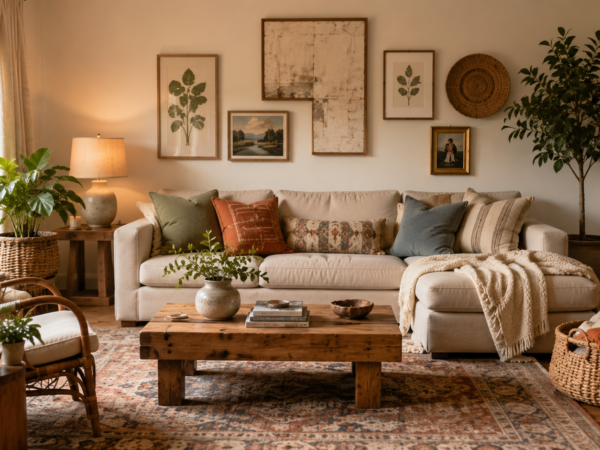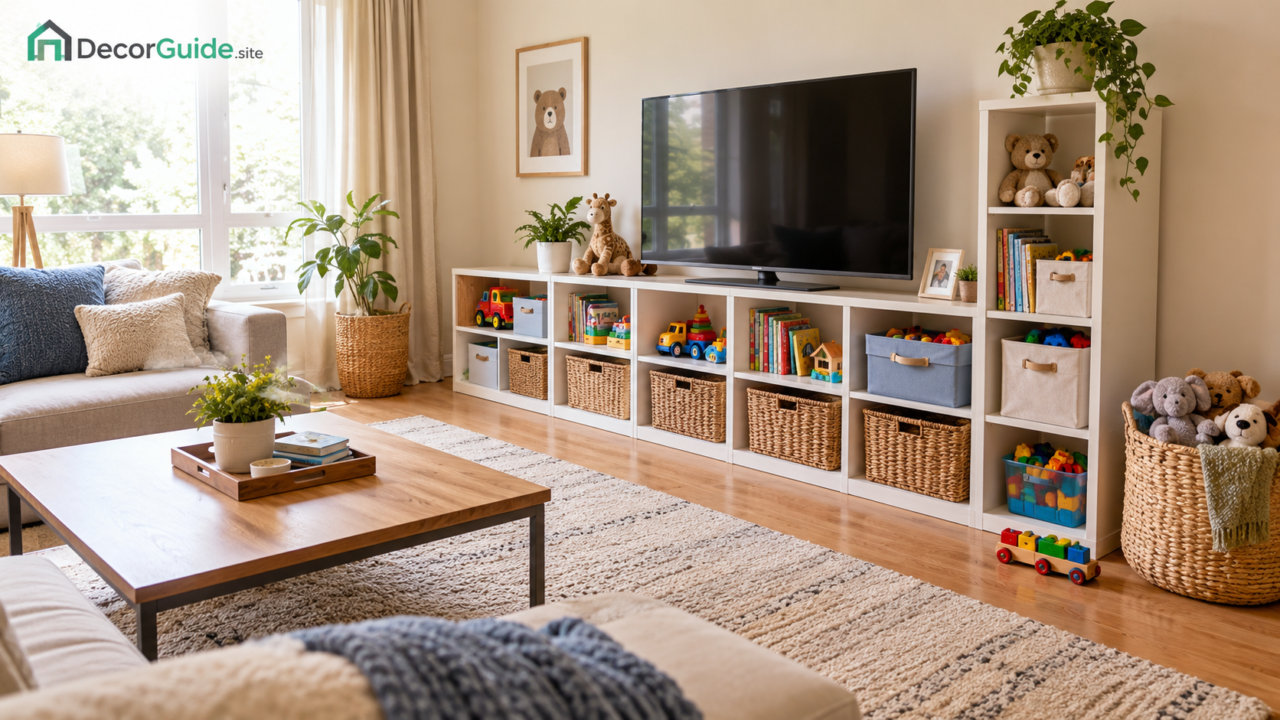
The best toy storage for living room spaces should make toys easy for children to reach while keeping the room comfortable and organized for adults. Start by sorting toys into categories, removing items that are no longer used, and choosing storage based on the amount and type of toys you actually have. Baskets, storage cubes, cabinets, ottomans, shelves, and furniture with hidden compartments can all work well. The right choice depends on your available floor space, the size of the toys, how often they are used, and how much of the storage you want visible.
1. Start by Sorting the Toys
Before buying storage, look at what you already have.
Trying to organize every toy without sorting first usually creates another problem: you end up filling storage containers with toys that children no longer use.
Take everything out and separate it into simple groups.
For example:
- Building toys
- Dolls and figures
- Cars and vehicles
- Books
- Puzzles
- Art supplies
- Stuffed animals
- Board games
- Pretend play toys
- Outdoor toys
- Frequently used toys
- Toys that are rarely used
You do not need a complicated labeling system. The goal is to understand what needs to be stored.
Remove Toys That No Longer Belong
Set aside broken toys, incomplete sets, age inappropriate toys, and things your child has clearly outgrown.
For toys that are still useful but rarely played with, consider keeping them somewhere other than the main living room.
This immediately reduces the amount of storage you need.
2. Decide How Much Should Be Visible
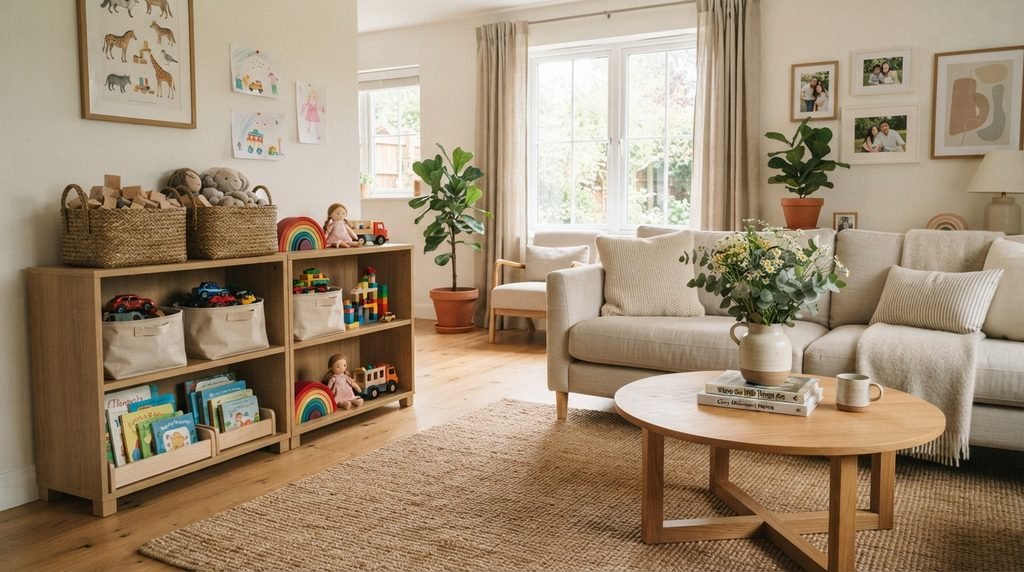
One of the most important decisions is whether you want toys displayed openly or hidden away.
Open storage makes it easier for children to see and access their toys. Closed storage gives the living room a cleaner appearance.
Neither option is automatically better.
Think about how your family actually uses the room.
If children play in the living room every day, some open storage can make cleanup easier. If the room is also used for entertaining guests, closed storage can help you quickly make the space look tidy.
3. Use Baskets for Fast Cleanup
Baskets are one of the simplest solutions for living room toys.
They are particularly useful for toys that do not need to be arranged individually.
For example, you might have one basket for stuffed animals and another for soft toys or frequently used play items.
The biggest advantage is speed. Children can put several toys into one container instead of carefully arranging every item.
Choose Baskets Based on the Toys
Think about the contents before choosing a basket.
A deep basket may work for stuffed animals, while smaller containers can be easier for little objects.
Avoid putting tiny toys into an extremely large basket if children will struggle to find what they want. They may end up emptying the entire container onto the floor.
4. Try Cube Storage for Flexible Organization
Cube style storage can work well when you have several different toy categories.
Individual compartments give each group a home without requiring a large collection of separate furniture pieces.
You can leave some compartments open and use bins in others.
For example:
- Open cube for books
- Bin for small cars
- Bin for building toys
- Open section for stuffed animals
- Closed container for puzzles
This creates a mix of visible and hidden storage.
Cube storage can also be useful when your toy collection changes frequently because you can reorganize the compartments as your child grows.
5. Use Closed Cabinets for a Cleaner Look
If your main goal is to keep the living room looking like an adult space, closed storage may be a better fit.
Cabinets can hide toys when they are not being used and reduce the visual clutter created by colorful objects.
They can also work well in a room where toy storage needs to blend with existing furniture.
Before choosing a cabinet, however, consider the toys that will go inside.
Large toys may need more open space, while small collections can work well in shelves or compartments.
Open vs. Closed Toy Storage
| Feature | Open Storage | Closed Storage |
|---|---|---|
| Toy access | Very easy | Requires opening doors or drawers |
| Visual appearance | Toys remain visible | Toys are hidden |
| Cleanup | Usually quick | Can create a cleaner look |
| Organization | Easy to see categories | Categories can be hidden |
| Best for | Frequently used toys | Occasional toys and tidy rooms |
A combination of both can often be more practical than choosing only one.
6. Consider an Ottoman With Storage
A storage ottoman can serve two purposes in a living room.
It can function as seating or a footrest while also providing a place to put toys away.
This is especially useful when floor space is limited and you do not want to add another large piece of furniture.
Use it for toys that are used regularly rather than filling it with everything your child owns.
The storage area should remain manageable enough that children can put items away without turning the entire container upside down.
7. Create a Dedicated Toy Corner
If toys are regularly spread across the whole living room, give them a defined area.
It does not need to be a separate playroom.
A small corner can include:
- A basket
- A low shelf
- A small toy cabinet
- A soft play mat
- A book container
The goal is to create a visual boundary between the play area and the rest of the room.
This makes cleanup easier because every toy has a general destination.
8. Use Low Storage for Children’s Everyday Toys
Storage should match the person using it.
If children are expected to put away their own toys, frequently used items should be easy for them to reach.
Low shelves and accessible baskets can make the process simpler.
Keep less frequently used or adult only items higher or inside closed storage.
This creates a basic system:
Easy access = everyday toys
Less accessible storage = occasional or supervised items
That distinction prevents children from having to search through several containers whenever they want to play.
9. Use Wall Space Carefully
When floor space is limited, look upward.
Wall mounted shelves can provide storage without taking up as much floor area.
They can be useful for books, small decorative items, or selected toys.
However, wall storage should be planned carefully in homes with young children. Furniture and storage units should be installed and secured appropriately, and heavier or unsuitable items should not be placed where children could easily pull them down.
For everyday toys, floor level storage may still be more practical.
10. Make Small Living Rooms Work Better
A small living room requires more careful selection because every storage piece takes up valuable space.
Instead of adding several containers, look for storage that performs more than one job.
A bench with storage, an ottoman with a compartment, or furniture with built in storage can reduce the number of separate pieces in the room.
Use Vertical Space
Tall furniture can sometimes provide more storage without spreading across the floor.
But do not choose something simply because it holds a lot.
The storage needs to be practical for the people using it.
If children cannot safely reach the upper sections, those areas are better suited to items that adults manage.
Keep the Floor Clear
In a small room, floor clutter becomes noticeable quickly.
Prioritize storage that keeps walkways clear.
A basket tucked beside an existing piece of furniture may be more useful than adding a large storage unit that makes the room harder to move around.
11. Give Small Toys Their Own Containers
Small toys are often the hardest to control.
Cars, blocks, figurines, craft pieces, and game components can easily become mixed together.
Use smaller containers inside larger storage when necessary.
For example, a larger cabinet can contain several smaller bins, with each bin assigned to one category.
This prevents the common problem of one large container becoming a mixed pile of unrelated toys.
12. Keep Books Separate From Toys
Books are technically children’s belongings, but they often work better with their own storage system.
A book basket, low shelf, or dedicated book section makes reading materials easier to find.
It also prevents books from being buried underneath toys.
If your living room already has a bookshelf, consider giving children a clearly defined section rather than creating another large piece of furniture.
13. Create a Simple Rotation System
You do not need to keep every toy available at the same time.
If your child has a large collection, store some less used toys separately and bring them out occasionally.
This can make the main toy area easier to manage.
A simple rotation might look like this:
- Keep everyday favorites accessible.
- Store less used toys separately.
- Occasionally switch some items.
- Return toys that are no longer interesting to storage.
- Remove broken or outgrown items during regular sorting.
The purpose is not to create a strict schedule. It is simply to prevent the living room from becoming the permanent storage location for every toy in the house.
14. Use Labels When They Actually Help
Labels can be useful when several containers look similar.
For example:
- Cars
- Blocks
- Dolls
- Art
- Puzzles
- Books
For younger children, pictures can sometimes be easier to understand than written words.
Labels are most useful when they help the family return items to the same place.
You do not need to label every single container.
15. Choose Storage According to Toy Type
Different toys need different storage.
For Stuffed Animals
Large baskets or open containers can work well because soft toys are easy to drop in and remove.
For Small Toys
Smaller bins or containers help prevent tiny items from disappearing in a large basket.
For Books
Low shelves or baskets make books easier to see and access.
For Puzzles and Games
Closed shelves, cabinets, or dedicated compartments can help keep pieces together.
For Large Toys
Measure the available space first and consider whether the item can be stored without blocking walkways.
The important point is simple: choose storage after identifying the items, not before.
Budget Friendly Toy Storage Ideas
You do not need expensive furniture to create a functional system.
Free: Declutter and Reuse Existing Space
The cheapest solution is often using what you already have.
Look around your living room for:
- Existing shelves
- Drawers
- Cabinets
- Baskets
- Empty containers
- Unused furniture compartments
You may discover that you already have enough storage but need a better organization system.
Low Cost: Baskets and Simple Bins
If you need additional containers, start with a small number rather than buying a complete set.
Choose containers based on the categories you identified during sorting.
There is no benefit in owning many empty looking storage bins while toys remain scattered elsewhere.
Mid Range: Cube Storage or Shelving
If you need more structured organization, cube storage and shelving can provide separate spaces for different toy categories.
These options are useful when the toy collection is large enough to justify dedicated furniture.
Higher Cost: Multi Use Furniture
If you are already planning to replace furniture, consider pieces that provide storage as part of their normal function.
Examples include:
- Storage ottomans
- Storage benches
- Cabinets
- Shelving units
- Coffee tables with storage compartments
This approach can be more space efficient than buying separate toy furniture.
Common Toy Storage Mistakes
Buying Storage Before Sorting
This is one of the easiest mistakes to make.
If you buy containers first, you may simply create more places to put unnecessary toys.
Sort first, then decide what storage is actually needed.
Using One Giant Container for Everything
One large container may look convenient, but mixed toy categories can become difficult to manage.
Children may need to empty the entire container to find one small item.
Separate frequently mixed categories when possible.
Keeping Everything Within Reach
Not every toy needs to be available all the time.
Items that require adult supervision or are used occasionally can be stored separately.
Ignoring the Existing Furniture
Before adding new furniture, check whether your current living room furniture has unused storage space.
Using existing space can reduce both clutter and cost.
Making the System Too Complicated
A storage system that requires many steps will be difficult to maintain.
If putting a toy away takes longer than getting it out, the system may not work well for everyday family life.
Keep the categories simple.
How to Maintain Your Toy Storage System
Good storage is not just about where toys go. It is also about keeping the system manageable.
Use a simple routine.
At the end of playtime, return toys to their general categories.
Once in a while, check whether certain toys are no longer being used.
Remove broken items and separate toys that children have outgrown.
If a storage container is constantly overflowing, do not immediately buy a bigger one. First ask whether the category contains too many items.
Storage problems are sometimes quantity problems rather than furniture problems.
A Simple Toy Storage Setup for Most Living Rooms
If you are starting from scratch, you can keep the system straightforward.
Begin with:
- One main storage area for everyday toys.
- A few categories based on how the toys are actually used.
- Open baskets for items that need quick cleanup.
- Closed storage for toys that are used less often.
- A separate book area if books are getting mixed with toys.
- A small rotation area for toys that are not currently in use.
Adjust the system after you use it for a while.
If a basket is always overflowing, change the category or reduce the contents. If a cabinet is difficult for children to use, move everyday toys to easier storage.
The best system is the one your family can maintain without constant effort.
Final Thoughts
The right toy storage for living room spaces should balance accessibility, appearance, available space, and the types of toys you actually own. Start by sorting and reducing the collection, then choose storage based on what remains.
Use baskets for quick cleanup, cubes for flexible categories, cabinets for a cleaner appearance, and multi purpose furniture when floor space is limited. In smaller rooms, focus on vertical space and furniture that performs more than one job.
Most importantly, keep the system simple. Children should know where everyday toys belong, and adults should be able to restore the room without reorganizing everything from scratch.
FAQs
How can I hide toys in a living room without buying new furniture?
Start by checking existing cabinets, drawers, baskets, ottomans, and shelves. You may be able to create a dedicated toy section within furniture you already own.
Should children’s toys be stored in the living room?
If children regularly play in the living room, keeping some everyday toys there can be practical. The amount of storage depends on how the room is used by the whole family.
How do I stop toys from spreading across the entire living room?
Create one clearly defined toy area and give common toy categories specific storage locations. Keeping everyday toys easy to put away can make cleanup simpler.
What should I do with toys that my child rarely plays with?
Separate them from everyday toys and store them elsewhere for a while. If they continue to be unused and are no longer appropriate, consider passing them on or removing them from the collection.
How can I organize toys when siblings share one living room?
Use broad categories that both children understand, while giving each child a small personal area for special belongings if needed.
How often should I reorganize living room toy storage?
There is no fixed schedule. Reorganize when categories stop working, storage becomes difficult to use, or the toy collection changes significantly.