Tacky living room decor usually comes from too many competing elements rather than one bad piece of furniture. A room can feel cluttered when colors, patterns, decorations, furniture, and lighting all demand attention at the same time. The easiest fix is to simplify first: remove unnecessary items, choose a clear color direction, improve furniture placement, and then add only decorations that support the room. You do not need to throw everything away. A thoughtful edit can make the same living room feel calmer, cleaner, and more put together.
What Makes Living Room Decor Look Tacky?
“Tacky” is subjective, so there is no single rule that applies to every home. A bold color, unusual artwork, or dramatic furniture can work beautifully when the rest of the room supports it.
The problem usually appears when several strong choices compete with each other.
Common causes include:
- Too many decorative objects in one area
- Several unrelated colors competing for attention
- Excessive matching furniture and accessories
- Too many patterns used together
- Decorations that do not relate to the room
- Furniture pushed against walls without considering the seating arrangement
- Visible clutter on tables, shelves, and floors
- Poor or overly harsh lighting
- Fake looking or unnecessary decorative items
- Too much furniture for the available space
- Wall art placed without considering the furniture below it
- A lack of empty space
The goal is not to make your living room boring. It is to create enough visual order that your favorite pieces can actually stand out.
Step 1: Remove Everything That Does Not Need to Be There
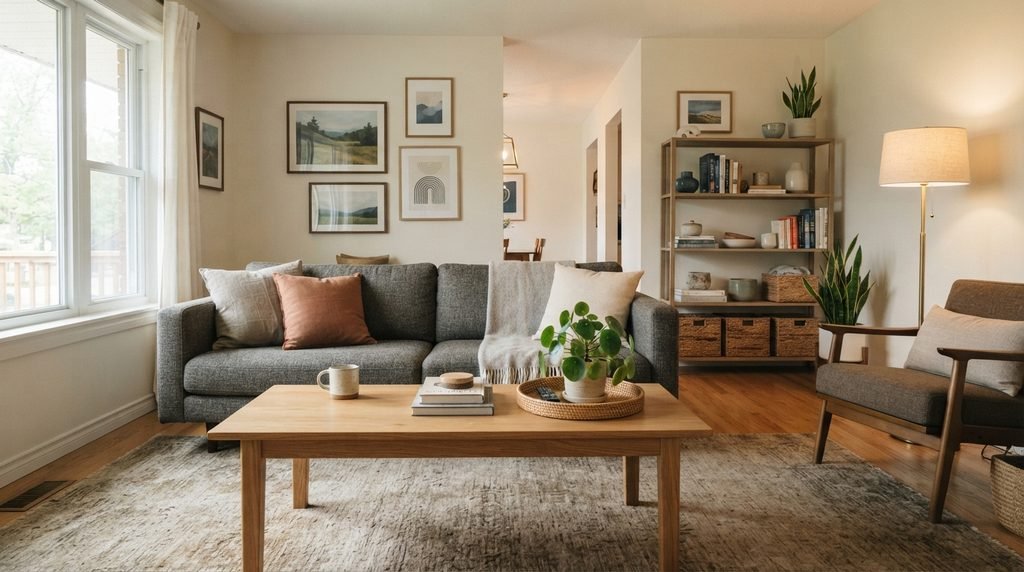
Before buying anything, start with a clean up.
Walk around the living room and look at every visible item. Ask three simple questions:
- Do I use this?
- Do I genuinely like it?
- Does it belong in this room?
If the answer is no to all three, move it out.
Do not immediately throw things away. Create temporary groups such as:
- Keep
- Move to another room
- Store
- Donate
- Repair or decide later
This first step can change the appearance of the room without spending anything.
Pay special attention to coffee tables, TV units, bookshelves, side tables, window areas, and the floor. These places collect small objects that individually seem harmless but collectively create visual noise.
Start With Flat Surfaces
A crowded coffee table can make an entire living room feel messy.
Instead of covering the surface with candles, ornaments, remotes, books, small plants, and other accessories, keep only a few useful or meaningful pieces.
The same rule applies to shelves and side tables.
Empty space is not wasted space. It gives the eye somewhere to rest.
Step 2: Choose a Clear Color Direction
You do not need to repaint your whole room.
Start by identifying the colors already present in your biggest items:
- Sofa
- Rug
- Curtains
- Flooring
- Walls
- Large furniture
Then look at the smaller decorations.
If you see many unrelated accent colors, decide which ones actually deserve to stay.
For example, if your room already has neutral furniture and warm wood, you might keep a limited set of warm accent colors instead of adding several unrelated bright shades.
This does not mean every object has to match.
A room often looks more natural when colors relate to one another without being identical.
Use Your Existing Pieces First
Put your accessories into groups based on color.
You may discover that some pieces already work together.
For example:
- Neutral pieces can create the base.
- Wood tones can add warmth.
- One accent color can provide contrast.
- Green from plants can add a natural element.
Rather than buying a new decoration to solve the problem, remove the colors that are creating competition.
Step 3: Fix the Furniture Layout
Sometimes the decor is not the main problem. The furniture arrangement is.
A living room can look awkward when:
- Seating is too far apart
- The coffee table is difficult to reach
- Walking paths are blocked
- Too much furniture is squeezed into a small area
- The TV dominates the entire room
- Every piece is pushed against a wall simply because there is empty wall space
Start by identifying the main purpose of the room.
Is it mainly for:
- Watching television?
- Talking with family?
- Reading?
- Entertaining guests?
- Several activities?
Arrange the seating around that purpose.
The sofa and chairs should create a useful conversation or activity area rather than looking like unrelated pieces placed around the room.
Do Not Add Furniture Just to Fill Space
An empty corner does not automatically need a chair, cabinet, plant stand, or decorative table.
Sometimes the best solution is to leave it empty.
Furniture should solve a functional need before it becomes decoration.
Step 4: Reduce Decorative Clutter
Decorative items become a problem when every available surface is treated as a display area.
Instead of asking, “What can I add here?” ask:
“What deserves to stay here?”
Look at collections of similar objects.
If you have several small ornaments, consider displaying only the pieces that have the strongest visual connection.
You can also group objects instead of spreading them across the room.
A small collection can look intentional when arranged together. The same items scattered randomly may look like clutter.
Step 5: Be Careful With Matching Sets
Matching furniture and accessories are not automatically bad.
The issue is excessive coordination.
When the sofa, curtains, cushions, rug, lamps, wall art, and accessories all use exactly the same pattern or color, the room can feel flat or overly planned.
A better approach is to create relationships rather than perfect matches.
For example, a cushion can pick up a color from artwork without having the exact same pattern. A rug can complement the sofa without being an identical shade.
This creates connection while allowing individual pieces to have their own character.
Step 6: Control Patterns
Patterns can add personality, but several competing patterns can quickly make a room feel busy.
Look at:
- Curtains
- Cushions
- Rugs
- Upholstery
- Wallpaper
- Artwork
- Decorative throws
If multiple areas contain bold patterns, decide which one should be the main visual feature.
The remaining pieces can be quieter.
Mix Patterns With Restraint
If you want patterned decor, vary the scale and visual strength rather than using several equally loud patterns.
For example, one strong patterned rug can become the main feature while cushions and curtains remain simpler.
You do not need to remove every pattern. You need to give patterns room to work.
Step 7: Rethink the Walls
Bare walls are not automatically a problem, and covered walls are not automatically stylish.
The goal is to choose wall decor that fits the size and arrangement of the room.
Common mistakes include:
- Hanging tiny artwork on a large empty wall
- Placing artwork too high
- Filling every wall with decorations
- Using unrelated pieces with no visual connection
- Adding signs or decorative text that does not suit the room
Before hanging anything, place the artwork temporarily where you think it should go.
Step back and look at it with the furniture.
The wall should feel connected to the room below it rather than functioning as a separate display.
Step 8: Improve the Lighting
Lighting has a major effect on how colors, furniture, and decorations appear.
A room can feel uninviting when it depends entirely on one harsh overhead light.
Instead, think about lighting at different levels.
You may have:
- Main ceiling lighting
- A floor lamp
- A table lamp
- Accent lighting
You do not need all of these.
The important point is to choose lighting according to how you actually use the room.
A reading corner needs useful light. A seating area may benefit from softer surrounding light. A decorative lamp should also have a practical purpose when possible.
Step 9: Hide Everyday Clutter
Remote controls, chargers, papers, toys, cables, and other everyday items can make an otherwise attractive room look unfinished.
This is where storage becomes more important than decoration.
First identify what needs to be stored.
For example:
| Items | Useful storage approach |
|---|---|
| Remotes | Small tray or drawer |
| Blankets | Basket or closed storage |
| Toys | Large accessible basket or cabinet |
| Books | Shelf or dedicated book storage |
| Cables | Cable management and a designated storage spot |
| Small accessories | Drawer or organized box |
Open vs. Closed Storage
Open storage makes frequently used items easy to reach and can display books or attractive objects. However, everything remains visible.
Closed storage hides visual clutter and can make a busy room feel calmer. The trade off is that you have to open a drawer or cabinet to access things.
Choose based on what you store, not simply on appearance.
If you need quick access to everyday items, open storage may be useful. If the main problem is visual clutter, closed storage can be more effective.
Step 10: Edit the Coffee Table
The coffee table often becomes the visual center of a living room.
Start by removing everything.
Clean the surface and return only the things that belong there.
You could use a simple arrangement such as:
- One tray for small useful items
- One book or a small stack of books
- One decorative object
The exact arrangement depends on your table and lifestyle.
If you regularly eat, work, or play games at the table, leave enough usable space.
A beautiful coffee table that cannot be used comfortably is not a successful storage or decorating solution.
Step 11: Make the TV Area Less Visually Heavy
The TV is naturally one of the strongest visual elements in many living rooms.
If the surrounding area is filled with unrelated decorations, the whole wall can feel chaotic.
Start by removing unnecessary objects.
Keep essential electronics organized and manage visible cables where possible.
If you have shelves around the TV, avoid filling every shelf.
Use a combination of:
- Books
- A few meaningful objects
- Storage baskets
- Empty space
The purpose is to make the area feel organized rather than creating another display wall.
Step 12: Add Texture Instead of More Decorations
If your room feels plain after removing clutter, do not immediately start buying small accessories.
Texture can add interest without creating visual noise.
Consider the materials already present:
- Wood
- Fabric
- Glass
- Metal
- Woven materials
- Ceramic
- Natural fibers
A textured throw, woven basket, or simple fabric cushion can sometimes add more depth than several small decorative objects.
The key is to add texture where it serves the room rather than adding another object simply because there is an empty spot.
Step 13: Use Plants Carefully
Plants can soften a living room, but adding too many can create another type of clutter.
Consider the actual space first.
A small living room may work better with one appropriately placed plant than several plants occupying corners, shelves, and tables.
Think about:
- Available floor space
- Natural light
- Maintenance
- Pets or children, if relevant
- Whether the plant has a practical place to live
Choose plants based on your home’s conditions rather than buying them only to fill empty spaces.
Budget Friendly Ways to Fix Tacky Decor
You can make meaningful changes without a shopping trip.
Free: Rearrange and Remove
Start with:
- Decluttering
- Rearranging furniture
- Removing excess accessories
- Grouping similar objects
- Moving items between rooms
- Clearing crowded surfaces
- Organizing existing storage
This should always be your first stage.
Low Cost: Small Supporting Changes
After editing the room, you may identify one or two areas that still need attention.
Depending on what is missing, you could consider:
- A simple storage basket
- A tray
- Cushion covers
- A useful lamp
- Basic cable management supplies
- A small piece of artwork
The important part is knowing what problem each item solves.
Higher Cost: Replace One Major Problem
If the room still feels wrong after editing, identify the largest issue.
It could be:
- An oversized piece of furniture
- A damaged rug
- Poor lighting
- Insufficient storage
- Curtains that do not work with the room
- Furniture that does not suit the space
Replace the biggest problem first instead of purchasing many small accessories.
Common Mistakes That Make a Living Room Look Tacky
Buying Decor Before Decluttering
New accessories cannot solve a room that already contains too much stuff.
Declutter first.
Trying to Match Everything
Perfectly coordinated furniture, fabrics, and accessories can make the room feel overly uniform.
Aim for visual connection rather than identical matching.
Filling Every Empty Corner
Empty space can be useful.
If a corner has no practical purpose, leaving it open may improve the room.
Using Too Many Small Decorations
Many tiny objects create more visual interruptions than a few carefully selected pieces.
Ignoring Storage
If everyday items have nowhere to go, they will eventually appear on tables, sofas, and floors.
Good organization is part of good decor.
Choosing Looks Over Function
A decorative object should not make a useful part of the room harder to use.
The living room still needs to function as a living room.
Following Trends Too Literally
A trend may look good in a particular room because of its architecture, size, lighting, and existing furniture.
Copying every element without considering your own space can produce an awkward result.
Small Living Room Tips
Small rooms need more editing because every visible item has a stronger effect.
Start by removing furniture that does not serve a clear purpose.
Then consider:
- Furniture with useful storage
- Fewer accessories
- Clear walking paths
- Less visual clutter
- Vertical storage where appropriate
- Closed storage for items you do not want displayed
- A limited color direction
- Mirrors or reflective surfaces when they suit the room
Avoid using too many large decorative objects to make the room feel finished.
In a small living room, one useful piece can often do the job of several decorative pieces.
A Simple 30 Minute Living Room Reset
If you want a quick starting point, follow this order.
First 5 minutes: Remove rubbish, dishes, laundry, and anything that belongs somewhere else.
Next 5 minutes: Clear the coffee table and side tables.
Next 5 minutes: Remove decorations that you do not like or that compete with each other.
Next 5 minutes: Look at the furniture arrangement. Check whether the main seating area works properly.
Next 5 minutes: Organize visible cables, remotes, blankets, books, and other everyday items.
Final 5 minutes: Step back and identify the one area that still looks visually heavy.
Do not start shopping yet.
Live with the simplified room for a while. You may find that the room needed less decor, not more.
How to Know When You Are Finished
A successful living room does not have to look empty.
You are looking for a room where:
- Furniture is easy to use
- Important items are easy to find
- Surfaces are not overloaded
- Colors have some connection
- Patterns do not compete everywhere
- Decorations have a reason to be there
- Storage handles everyday clutter
- There is some empty visual space
- The room still reflects your taste
The final test is simple: look around the room and ask whether your eyes immediately jump between too many unrelated things.
If they do, remove or simplify one more element.
Final Thoughts
Fixing tacky living room decor is usually an editing process rather than a shopping process. Remove what is unnecessary, simplify the color and pattern mix, improve the furniture layout, organize everyday items, and then add only what the room genuinely needs.
Start with free changes before spending money. Once the room is simplified, any new purchase becomes easier to judge because you can see exactly what is missing.
A well organized living room does not need to follow one decorating style. It simply needs enough balance, function, and breathing room for the pieces you actually want to keep.
FAQs
Can colorful living room decor still look stylish?
Yes. Strong colors can work when they are intentionally repeated or balanced with simpler surrounding elements. The issue is usually not color itself but too many unrelated visual elements.
Should I remove all decorative items from my living room?
No. Remove items that create clutter or do not contribute to the room. Keep meaningful, useful, or visually connected pieces.
Is minimalist decor the only way to avoid a tacky room?
No. A room can be layered, colorful, traditional, or eclectic and still feel organized. The important factors are balance, editing, and how the elements work together.
Should wall art match my sofa?
It does not need to match exactly. It can relate through color, texture, subject, or overall visual style.
Can an old sofa make a living room look tacky?
An old sofa does not automatically make a room look tacky. If it is comfortable and functional, you may be able to improve the room through layout, surrounding colors, lighting, textiles, and organization.
What should I do if my family disagrees about the decor?
Start with functional decisions everyone can agree on, such as clear walkways, useful storage, and comfortable seating. For purely decorative choices, give different areas of the room defined purposes so multiple preferences can coexist.