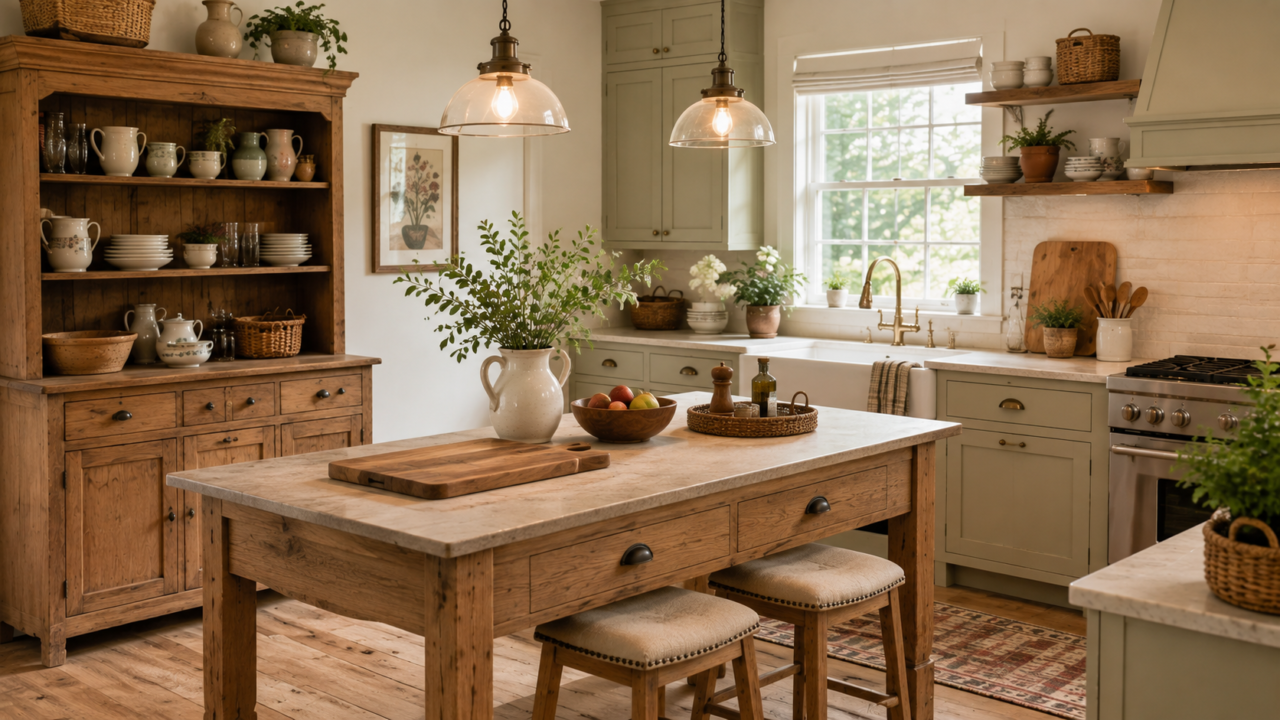
Farmhouse Kitchen Decor 25 Warm and Practical Ideas
Farmhouse kitchen decor works best when the kitchen feels useful first and decorative second. The style has roots in practical country homes, so its strongest features tend to be things that serve a purpose: sturdy tables, useful storage, natural materials, open shelves, simple lighting, hardworking sinks, and everyday dishes left within reach.That is also why a farmhouse kitchen does not need to look like an old farmhouse.
A modern kitchen can take on farmhouse character through a painted cabinet color, a wooden island, vintage style hardware, a few woven baskets, traditional lighting, or a freestanding piece of furniture. You can keep contemporary appliances and modern storage while adding enough warmth and texture to make the room feel relaxed.
Current farmhouse kitchens range from rustic and traditional to modern, European inspired, and more collected styles. Designers are also mixing vintage pieces with contemporary finishes rather than treating farmhouse design as a strict historical recreation.
The key is knowing which elements deserve attention and which ones are better left out.
What Makes a Kitchen Feel Like a Farmhouse Kitchen?
Farmhouse style is less about one particular finish and more about the relationship between materials, furniture, storage, and everyday life.
Natural wood, painted cabinetry, stone, simple textiles, traditional hardware, practical furniture, ceramics, and relaxed lighting all contribute to the look. Architectural details such as beams or paneling can strengthen it, but they are not mandatory.
Farmhouse kitchens also tend to feel less formal than highly contemporary kitchens. A wooden cutting board can remain visible. A few dishes can sit on an open shelf. A vintage table can serve as an island. A basket can hold kitchen towels or produce.
The room should look like people actually use it.
That does not mean clutter. The distinction is important. A useful object contributes to the kitchen’s character when it has a sensible home and does not interfere with cooking.
Start With the Kitchen’s Function Before Decorating
Before choosing accessories, look at how your kitchen works.
Where do you prepare food? Which cabinets hold the dishes? Where do you keep frequently used appliances? Does the island need to function as preparation space, seating, storage, or all three?
Kitchen planning guidance from the National Kitchen & Bath Association emphasizes activity centers, functional storage, seating, lighting, equipment, and electrical planning rather than treating appearance as the only concern.
This matters for farmhouse kitchens because open shelving, freestanding furniture, baskets, and decorative displays can easily become obstacles if they are added without considering workflow.
Start with function. Then decorate around it.
Farmhouse Kitchen Decor Ideas That Work in Real Homes
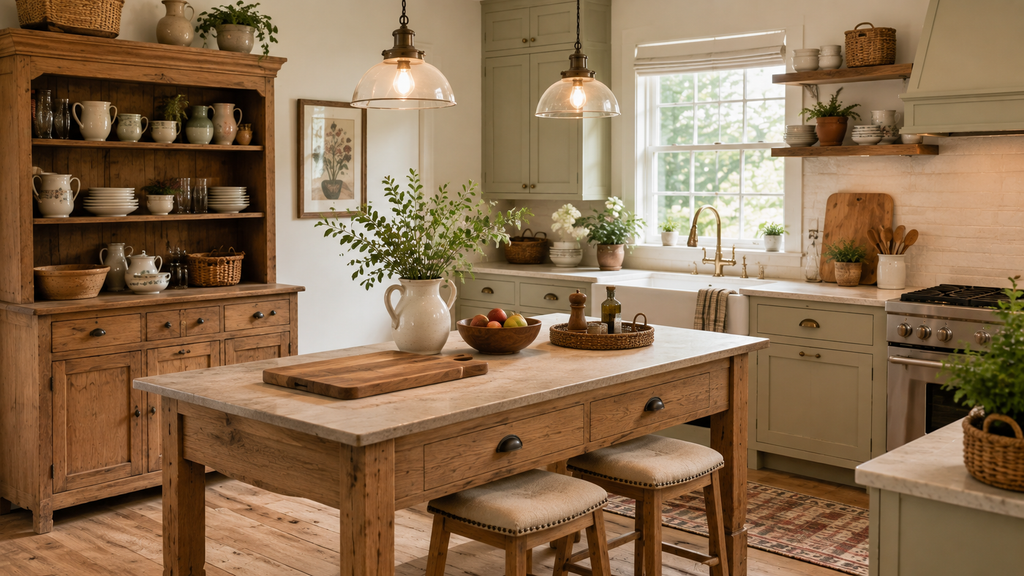
Choose Warm, Livable Colors
Farmhouse kitchens do not have to be white.
Cream, warm white, soft sage, muted blue, pale gray green, earthy beige, warm taupe, and deeper navy can all work beautifully.
House Beautiful’s recent farmhouse kitchen examples show everything from pale blue and hazy green to darker blue and natural wood, demonstrating that the style does not depend on one fixed color palette.
If the kitchen already has neutral cabinets, introduce color through:
- A painted island
- Curtains
- A runner
- Dining chairs
- Artwork
- Ceramic dishes
- A small piece of furniture
Using one main color and a restrained group of supporting tones usually looks more settled than introducing several unrelated accent colors.
Bring in Natural Wood
Wood gives farmhouse kitchens much of their warmth.
You might use it on an island, dining table, open shelves, stools, cutting boards, cabinet fronts, ceiling beams, or a freestanding hutch.
The wood does not have to be perfectly matched. A farmhouse kitchen can accommodate different wood tones when they are connected by the overall palette and repeated materials.
Natural wood also prevents a light kitchen from feeling overly sterile.
Use Painted Cabinets
Painted cabinets are particularly effective when you want farmhouse character without making the kitchen heavily rustic.
Cream, soft green, dusty blue, muted gray, or another subdued color can create a softer backdrop for wood and stone.
If your existing cabinets are structurally sound, repainting may change the appearance dramatically without replacing the entire kitchen.
And do not assume every cabinet needs to be painted. A painted perimeter with a natural wood island—or natural wood cabinetry with a painted island—can create useful contrast.
Add Simple, Traditional Hardware
Cabinet hardware is a small detail, but there are many of them, so the cumulative effect matters.
Simple knobs, cup pulls, traditional handles, or understated metal hardware can reinforce a farmhouse feel.
Choose hardware according to the cabinet style and the rest of the kitchen rather than treating it as an isolated decorative purchase.
The objective is subtle repetition, not hardware that demands attention.
Make the Island Feel Like Furniture
A farmhouse island does not need to look like a giant built in cabinet.
Furniture style islands can give the kitchen a more relaxed, collected appearance. A contrasting wood island, painted base, visible legs, or open shelving can make the center of the room feel more like a piece of furniture.
Recent farmhouse kitchen examples frequently use islands as visual anchors while combining wood with stone or other contemporary surfaces.
The practical question is what the island needs to do. If it is your primary preparation surface, avoid filling the countertop with decorative objects.
Try a Freestanding Work Table
A vintage table can sometimes do the job of an island while giving the kitchen much more character.
This works particularly well in older homes and smaller kitchens where a large permanent island would feel heavy.
A table can provide preparation space and, depending on its design, storage underneath. Country Living has highlighted kitchens where an antique table serves as the island, creating a useful connection between vintage furniture and everyday kitchen work.
Before bringing one home, consider its height, stability, condition, and whether it leaves enough room for people to move around it comfortably.
Use Open Shelving Selectively
Open shelves fit naturally into farmhouse kitchens because they allow dishes, ceramics, baskets, and cookbooks to become part of the room.
But open shelving works best when it is edited.
Use it for things you regularly reach for or genuinely enjoy seeing. A few stacks of plates, mugs, bowls, cookbooks, and one small plant may be enough.
Avoid turning every available wall into open storage. Closed cabinets are valuable for appliances, packaging, cleaning supplies, and other items that create visual noise.
Display Everyday Dishes
You do not need a collection of expensive antiques to make a farmhouse kitchen feel collected.
Everyday ceramic plates, bowls, pitchers, mugs, serving dishes, and glassware can provide plenty of visual interest.
Group similar pieces rather than arranging each item separately. Repetition of shape or color helps the display look intentional.
The same principle applies to a plate wall. A small group of plates can become artwork while still remaining connected to the kitchen’s function.
Add a Farmhouse Style Sink
A large, traditional looking sink can become an important visual feature in a farmhouse kitchen.
The familiar apron front or farmhouse style sink has strong associations with country kitchens, but the surrounding cabinetry and hardware determine whether the overall result feels traditional, modern, or somewhere between the two.
The sink should be selected according to the actual kitchen layout and daily requirements rather than simply because it looks appropriate.
Choose Practical Pendant Lighting
Lighting can change the character of the entire kitchen.
For a farmhouse look, consider pendants with simple metal shades, glass shades, lantern like forms, woven materials, or traditional silhouettes.
A statement fixture can provide personality above an island or dining area, while additional lighting handles the practical work of the room.
The Department of Energy notes that task and under cabinet lighting can be used alongside lower ambient lighting levels, while pendant fixtures can be useful over freestanding counters and similar work surfaces.
In other words, choose a beautiful fixture—but do not expect one decorative light to do every lighting job.
Layer in Woven Materials
Baskets, rattan, cane, jute like textures, and other woven materials can soften the harder surfaces of a kitchen.
Use them where they solve a real storage need:
- Produce storage
- Kitchen towels
- Serving pieces
- Pantry overflow
- Small appliances
- Table linens
A basket that has a job tends to look more natural than a collection of baskets placed around the room simply because they look farmhouse inspired.
Use Vintage or Antique Accents
One or two older pieces can give a new kitchen much more personality.
Consider:
- A wooden stool
- A vintage cutting board
- An old crock
- A small cabinet
- A traditional pitcher
- A framed piece of artwork
- An antique looking tray
- A collection of old fashioned dishes
The best pieces are those that either serve a purpose or have enough visual presence to justify the space they occupy.
Architectural Digest has featured farmhouse kitchens where vintage tables, stools, hardware, lighting, and other older elements are combined with newly renovated kitchens.
Add a Plate Wall
A plate wall is a classic farmhouse decorating idea because it turns ordinary kitchenware into a display.
It can work above a dining nook, on a narrow wall, beside a cabinet, or in another area that does not interfere with food preparation.
Keep the arrangement visually related. You might use plates with similar colors, related patterns, or varying shapes within a restrained palette.
The point is to create a collection rather than random wall decoration.
Bring in Simple Artwork
Farmhouse kitchens benefit from artwork that feels connected to food, nature, or the surrounding home.
Consider botanical prints, still lifes, landscapes, fruit illustrations, traditional sketches, or simple framed textiles.
Artwork can also provide the one stronger color that ties the rest of the kitchen together.
You do not need artwork on every empty wall. Leaving some walls quiet makes the pieces you do display more noticeable.
Use a Patterned Runner
A runner adds softness and pattern without requiring a permanent change to the kitchen.
Look for muted checks, stripes, faded traditional patterns, or simple natural tones.
Place it where it makes sense for the layout and traffic pattern. A decorative runner should not obstruct cabinet doors, drawers, or the areas where people normally work.
Introduce Greenery
A small plant, herb pot, or vase of branches can bring life to a farmhouse kitchen.
Keep the scale appropriate to the available counter or shelf space. A single substantial plant is usually easier to live with than several tiny pots scattered across the room.
If the kitchen receives suitable natural light, herbs can also have a practical role, but decorative greenery works just as well when growing conditions are not suitable for edible plants.
Mix Countertop Materials
Farmhouse kitchens do not need every surface to use the same material.
A wooden island countertop can be paired with a stone surface elsewhere, for example. The contrast can keep the room warm without making every surface feel rustic.
House Beautiful specifically highlights the use of butcher block style island surfaces alongside stone elsewhere in farmhouse kitchens.
The important thing is to give each material a reason to be there.
Make Storage Part of the Design
Good farmhouse kitchens often make storage feel like part of the architecture.
A freestanding hutch can hold dishes. Open shelves can handle frequently used bowls. Drawers can keep utensils organized. Baskets can contain loose items. A pantry can keep food packaging out of sight.
This combination of visible and hidden storage is particularly useful because farmhouse style looks best when there are attractive things to display but not everything is on display.
Current kitchen planning guidance also treats functional storage as a core design consideration rather than an afterthought.
Consider Beams or Wood Paneling
Exposed beams and wood paneling can add substantial farmhouse character, particularly in homes that already have architectural elements worth preserving.
If your kitchen has original beams, investigate whether they can remain visible rather than automatically covering them.
For newer construction, decorative wood treatments can be used selectively. One ceiling or wall detail may be enough.
The goal is warmth and texture—not turning every surface into wood.
Use Baskets Where They Actually Help
Baskets are useful farmhouse accessories because they combine storage with texture.
Use them for things that are awkward to organize in rigid containers or that benefit from being grouped together.
For example, a basket might hold kitchen linens or a few serving pieces. Another could sit on a lower shelf for less frequently used items.
If you cannot identify what the basket is supposed to contain, you probably do not need it.
How to Balance Rustic and Modern Elements
Modern farmhouse kitchens work because they do not try to hide every modern feature.
A contemporary refrigerator, induction cooktop, dishwasher, modern plumbing fixtures, or efficient storage system can coexist with wood, vintage furniture, traditional lighting, and country inspired accessories.
The trick is to establish visual connections.
For example:
Modern cabinets + farmhouse warmth:
Add wood stools, a vintage runner, traditional lighting, and ceramic display pieces.
Modern white kitchen + rustic character:
Introduce a wood island, woven storage, aged looking hardware, and simple artwork.
Older kitchen + modern function:
Preserve interesting cabinetry or architectural details while improving storage, lighting, appliances, and work areas.
This blend is consistent with current farmhouse design, where vintage finds and new furniture or accessories are frequently mixed rather than keeping everything from the same period.
Farmhouse Kitchen Decor for Small Kitchens
A small kitchen does not need all the usual farmhouse features.
You may not have room for a large island, freestanding hutch, multiple open shelves, and a dining table—and trying to squeeze all of them in can make the room harder to use.
Instead, choose a few high impact details.
A narrow wooden shelf can replace a large display cabinet. A small vintage table can provide both dining and preparation space. A patterned runner can establish the color palette. A single pendant can become the main decorative feature.
Use vertical space where practical, but keep frequently used items accessible.
Closed storage should handle the visually messy categories. Open storage should be reserved for items that are attractive, useful, or both.
In a small kitchen, empty space is part of the design.
Farmhouse Decorating Ideas on a Budget
You do not need a full renovation to create farmhouse character.
Start with what is already in the kitchen.
No cost approach:
Rearrange existing dishes, cutting boards, baskets, artwork, cookbooks, and furniture so that useful pieces become part of the visual design.
Low cost approach:
Change cabinet hardware, add a runner, introduce a few secondhand ceramics, or use a simple wooden shelf.
Moderate approach:
Add a freestanding cabinet, replace a light fixture, repaint cabinetry, or introduce a furniture style island.
Larger investment:
Consider changes to cabinetry, countertops, flooring, lighting infrastructure, or the overall layout.
Secondhand shopping can be particularly valuable for farmhouse interiors. A used wooden table or hutch can provide more character than several newly purchased decorative accessories.
The important thing is to shop for the gap in the kitchen rather than buying farmhouse objects simply because they fit the label.
Common Farmhouse Kitchen Decor Mistakes
Turning the Kitchen Into a Theme
Shiplap, cow prints, distressed signs, galvanized containers, rooster accessories, and rustic lettering do not all need to appear in one room.
Choose the elements that genuinely suit your home.
Making Everything Distressed
Farmhouse does not mean every surface needs to look worn.
Natural wood, simple painted cabinetry, clean stone, and new fixtures can create a convincing farmhouse kitchen when balanced with a few older or rustic pieces.
Overloading Open Shelves
If shelves become crowded, the kitchen can look messy rather than relaxed.
Keep some items hidden behind cabinet doors.
Sacrificing Counter Space
A decorative kitchen still needs room for cooking.
Do not cover the main preparation area with trays, jars, signs, plants, and decorative bowls.
Buying Furniture Without Checking the Layout
A beautiful antique table is not useful if it blocks a walkway or prevents drawers and doors from opening.
Measure the space and consider movement before purchasing large pieces.
Matching Everything Too Closely
A farmhouse kitchen often benefits from variation. A little contrast between wood, metal, ceramics, textiles, and stone can make the room feel collected.
A Simple Formula for Putting the Look Together
If the kitchen currently feels plain and you are not sure where to start, build the look in layers.
Start with the foundation:
Choose the cabinet color, dominant wood tone, and main countertop or backsplash materials.
Add one furniture like element:
This could be a wooden island, vintage table, hutch, or freestanding cabinet.
Choose one lighting statement:
A pendant or lantern style fixture can establish the mood.
Create one display area:
Use an open shelf, hutch, plate wall, or section of countertop.
Add useful texture:
Bring in a basket, wooden cutting board, runner, linen textile, or woven detail.
Finish with a few personal pieces:
A plant, artwork, ceramics, or vintage object can give the room personality.
Then stop.
Farmhouse kitchens are often strongest when they have enough restraint to let the furniture, materials, and useful objects speak for themselves.
Final Takeaway
Good farmhouse kitchen decor is not about making a kitchen look old. It is about creating a space that feels warm, practical, comfortable, and connected to everyday life.
Natural wood, painted cabinets, traditional hardware, furniture style islands, open shelving, woven storage, vintage pieces, useful dishes, simple artwork, and layered lighting can all contribute to the look. But none of them needs to dominate the entire room.
Start with the way your kitchen works. Keep the storage practical, protect the preparation areas, and choose decorative elements that have either a useful purpose or a clear visual reason for being there.
That approach gives you something better than a themed farmhouse kitchen: a kitchen that feels collected, welcoming, and genuinely lived in.
FAQ
1. What is farmhouse kitchen decor?
Farmhouse kitchen decor combines practical, comfortable design with natural materials, traditional details, simple furniture, useful storage, warm colors, and a relaxed country inspired feel.
2. What colors work best for a farmhouse kitchen?
Warm white, cream, sage green, muted blue, beige, taupe, soft gray green, and deeper navy can all work. The best palette depends on the amount of natural light and the materials already present.
3. Does a farmhouse kitchen have to be rustic?
No. Modern farmhouse kitchens can combine traditional details with contemporary cabinets, appliances, stone surfaces, and streamlined lighting. The balance between old and new is often what makes the style work.
4. How can I add farmhouse style without remodeling my kitchen?
Start with smaller changes such as cabinet hardware, a wooden cutting board, vintage dishes, woven baskets, a runner, artwork, traditional lighting, or a freestanding piece of furniture.
5. How do I make a small kitchen look farmhouse style?
Choose a few strong details instead of trying to include everything. A wood shelf, vintage style light, patterned runner, simple ceramics, or small furniture piece can establish the look without consuming valuable space.
6. Is open shelving necessary for farmhouse kitchens?
No. Open shelves can reinforce the style, but they are optional. Use them only where displaying and accessing dishes or other useful items makes sense. Closed cabinets are still important for controlling visual clutter.
7. Can I mix modern appliances with farmhouse decor?
Yes. Modern appliances can be surrounded by warm wood, traditional hardware, vintage furniture, simple lighting, and country inspired accessories. This creates a practical modern farmhouse kitchen rather than a historical reproduction.
8. How can I decorate a farmhouse kitchen on a budget?
Begin by rearranging what you already own, then consider secondhand furniture, vintage dishes, simple textiles, hardware changes, and small decorative additions before taking on larger renovations.
for more tips