A room can have expensive furniture and still look dated, crowded, or disconnected. The problem is often not the individual pieces but how they work together. Too many competing colors, oversized furniture, poor lighting, and decorative objects without a clear purpose can make a home feel visually busy.
Modern home decor works best when the room has a clear structure. Furniture has enough breathing room, colors relate to one another, storage keeps everyday clutter under control, and decorative pieces are selected intentionally rather than added simply to fill empty surfaces.
Modern style also does not have to mean an all white room with sharp furniture and almost nothing on display. Current interior design coverage is increasingly focused on warmth, personality, natural textures, and rooms that look genuinely lived in.
The goal, then, is not to make your home look like a showroom. It is to create a space with clean visual lines, useful furniture, comfortable materials, and enough personality to feel like yours.
What Modern Home Decor Really Means
Modern home decor is less about following a fixed list of furniture styles and more about creating visual clarity.
Clean lines, purposeful furniture, controlled color, open space, useful storage, and thoughtful lighting are common characteristics. But modern interiors can also include wood, textured fabrics, artwork, plants, vintage pieces, handmade objects, and stronger accent colors.
One useful distinction is between minimal and modern.
Minimalism generally focuses on reducing possessions and visual elements as much as possible. Modern decorating can be restrained without requiring you to own very little.
A family can have books, toys, photographs, collections, and practical household items while still having a modern interior. The difference is that those things have designated places and are arranged intentionally.
This is particularly important for a practical home living website: organization is part of the visual design. If the room has beautiful furniture but cables, papers, clothing, and miscellaneous objects are constantly left on visible surfaces, the modern aesthetic becomes difficult to maintain.
Start With the Room Before Buying Decor
The easiest way to make decorating more expensive than necessary is to start shopping before understanding the room.
Before buying cushions, artwork, lamps, baskets, or decorative accessories, look at what is already there.
Ask:
- Which furniture pieces need to stay?
- Which items are useful but visually distracting?
- Where does clutter accumulate?
- Is the furniture too large or too small for the room?
- Does the room have enough storage?
- Which areas naturally become focal points?
- Where does daylight enter?
- Which surfaces need to remain clear for everyday use?
This process can reveal that the room does not actually need more decor.
It may need fewer objects.
Build a visual foundation
Start with the largest elements: walls, flooring, sofa, bed, dining table, curtains, rugs, and major storage furniture.
These pieces occupy the most visual space, so they have a greater effect on the overall appearance than small accessories.
If the foundation is already busy, adding more decoration will usually make the room feel even less cohesive.
Instead, create a relatively calm base and then introduce personality through smaller elements.
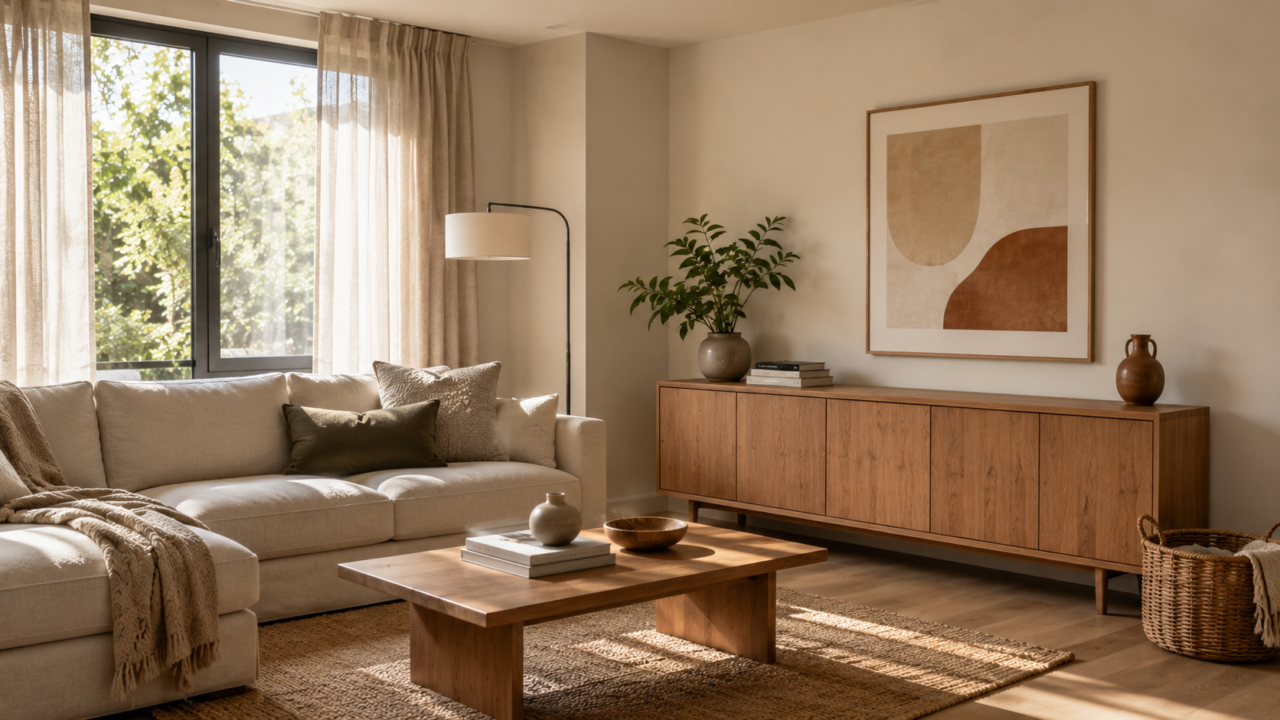
For example, a living room with a neutral sofa, simple rug, wood furniture, and restrained curtains gives you room to introduce artwork, books, a colored chair, patterned cushions, or a sculptural lamp without making every part of the room compete for attention.
Architectural Digest similarly recommends reducing excess and allowing a few important pieces to become focal points rather than filling a contemporary room with too many objects.
Choose a Modern Color Palette That Still Feels Comfortable
Color is one of the fastest ways to change how a room feels.
A modern palette does not have to be gray, white, and black. Warm neutrals, earthy greens, muted browns, clay tones, soft creams, and restrained darker accents can create a contemporary look while keeping the room comfortable.
A useful approach is to choose:
- One dominant background color
- One supporting color
- One or two accent colors
- A small number of material tones
The colors do not have to match perfectly. They simply need to relate.
For example, warm white walls can work with walnut toned furniture, muted green textiles, black lighting details, and natural woven accessories.
The result has more depth than using the same beige or gray everywhere.
Use contrast instead of matching everything
One common decorating mistake is trying to make every item match.
A modern room can actually look more considered when materials and shapes differ slightly.
Try combinations such as:
- Light walls with darker furniture
- Smooth surfaces with textured textiles
- Straight furniture with a rounded coffee table
- Neutral upholstery with one stronger artwork
- Wood alongside metal accents
- Soft curtains against a more structured piece of furniture
Contrast gives the eye somewhere to move.
At the same time, contrast should have limits. If every object introduces a completely different color, material, and shape, the room loses visual direction.
The current movement toward warmer and more personal interiors supports this broader interpretation of modern design. Vogue’s 2026 trend reporting, for example, describes a stronger interest in lived in and time worn aesthetics rather than constantly chasing newness.
Choose Furniture for Shape, Scale, and Function
Furniture usually has more influence on a room than decorative accessories.
A modern sofa placed awkwardly in a small living room will not become a better design simply because the cushions are stylish. Likewise, a beautiful dining table can make a room difficult to use if there is not enough practical circulation around it.
Consider three things before choosing major furniture:
Scale:
The furniture should make sense relative to the room.
Shape:
Clean, simple silhouettes often support a modern look, but not every piece needs to have sharp corners.
Function:
The furniture needs to support how the household actually uses the space.
A family living room may need durable seating, accessible storage, and a practical place for electronics. A bedroom may need bedside storage and space for clothing rather than a large decorative bench that rarely gets used.
Multi purpose furniture can be particularly useful in smaller homes. An ottoman with storage, a compact desk, or a console that also provides concealed storage can reduce the number of separate pieces required.
The key is not to buy furniture simply because it performs multiple functions. It should still work well for the room and be easy to use.
Use Lighting and Texture to Keep Modern Rooms From Feeling Cold
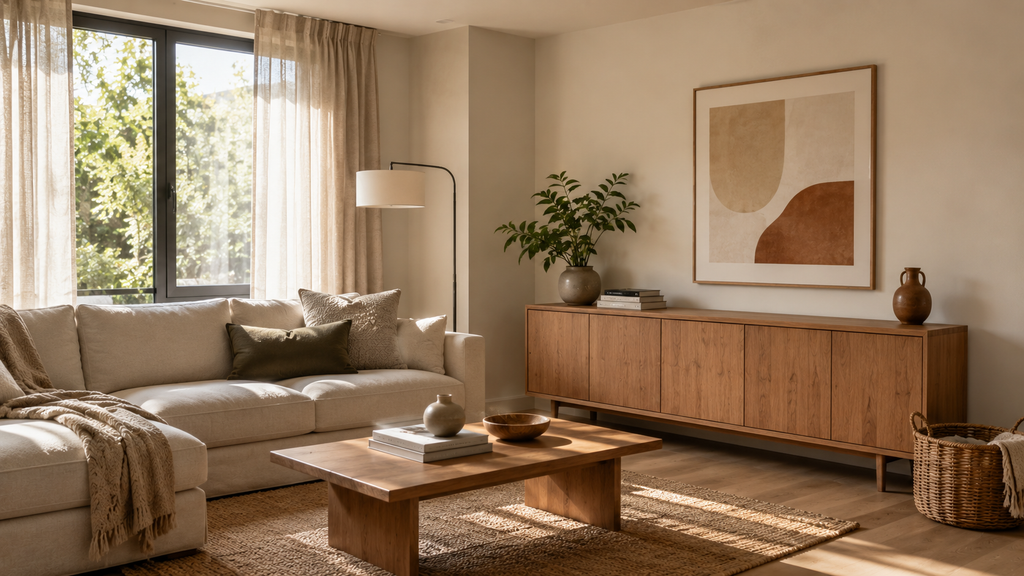
Modern rooms can sometimes feel flat when they rely only on overhead lighting and hard surfaces.
Lighting should be considered at different levels.
A room might use:
- General ceiling lighting
- A floor or table lamp
- Task lighting for reading or working
- Accent lighting for artwork or architectural features
This creates flexibility. A bright ceiling light may be useful while cleaning, while softer lamps can create a more relaxed atmosphere later.
Texture is equally important.
A room with smooth walls, hard flooring, glossy surfaces, and rigid furniture can feel visually severe. Adding textured curtains, upholstery, rugs, wood, ceramics, woven elements, or artwork can introduce variation without making the space cluttered.
The trick is to add texture rather than simply adding more objects.
A textured throw can contribute more to a room than several small decorative pieces scattered across a table.
Modern Home Decor Ideas for Each Main Room
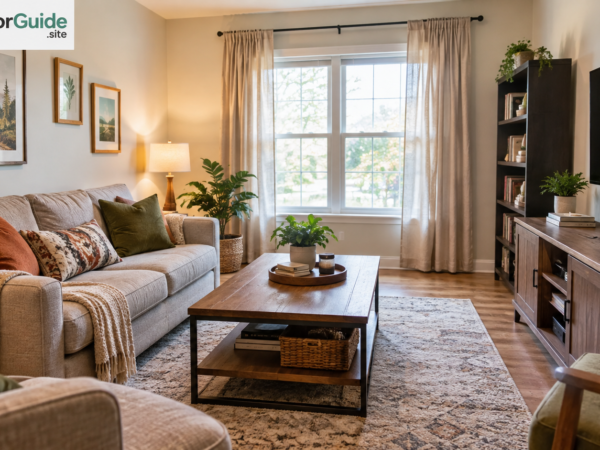
Living room
Start with the seating arrangement.
Rather than pushing every piece of furniture against a wall, consider whether the room would work better with the seating arranged around a central point such as a coffee table, rug, fireplace, or media unit.
Keep the coffee table useful. It can hold a few books or one decorative object, but it should still provide enough clear surface for everyday use.
For a modern living room:
- Choose a restrained base palette.
- Use one clear focal point.
- Keep cable management under control.
- Avoid overcrowding shelves.
- Mix soft and hard textures.
- Use closed storage for visually messy items.
- Leave some wall and floor space empty.
Books, photographs, artwork, and meaningful objects can prevent the room from becoming generic.
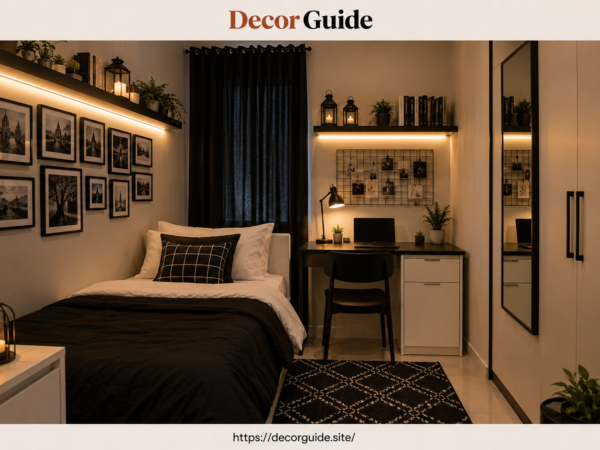
Bedroom
The bed is naturally the largest visual element, so start there.
Simple bedding in a restrained palette can establish the foundation. Then add texture through a throw, cushions, curtains, rug, or upholstered furniture.
Nightstands should not become storage dumps. Keep frequently used items accessible and relocate everything else.
For clothing and bedding, use the storage areas according to frequency of use. Everyday items should be easiest to reach. Seasonal or occasional items can occupy less accessible storage.
Under bed storage can be useful when appropriate, especially in a smaller bedroom, but it should not become a place where forgotten belongings accumulate.
Modern bedroom decor generally benefits from fewer visual interruptions. A clear floor, controlled bedside surfaces, and coordinated storage can make even a modest bedroom look more intentional.
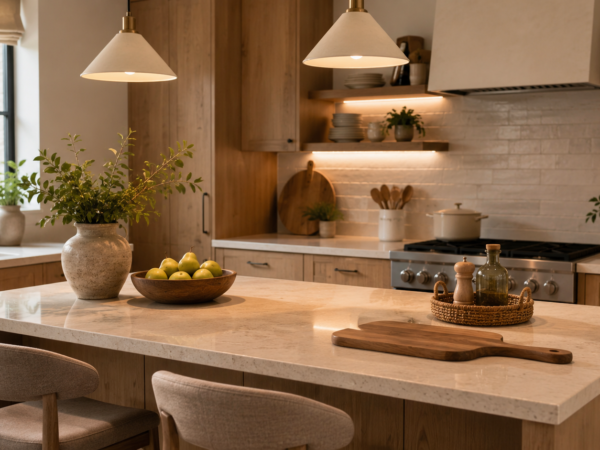
Kitchen and dining area
A modern kitchen does not need every countertop completely empty.
The better goal is to distinguish between items that are used daily and items that are merely taking up space.
Keep frequently used appliances accessible if moving them in and out of cabinets makes cooking unnecessarily inconvenient. Less used equipment can occupy deeper or higher storage.
For open shelving, use restraint. Shelves that contain every mug, appliance, packet, and miscellaneous item can quickly become visually noisy.
In the dining area, lighting can provide a strong focal point. A simple pendant or other well positioned fixture can visually define the table without requiring a large amount of additional decoration.
Entryway and home office
The entryway deserves attention because it is often where household clutter first appears.
A practical modern entryway might include a small surface for essentials, hooks or storage for frequently used items, and a designated place for shoes or bags.
The home office has a similar principle: keep the desktop for things that need to be there.
Documents, stationery, cables, and technology accessories should have designated storage rather than spreading across the entire workspace.
This is where organization and decor directly overlap. A visually calm desk is easier to work at and usually looks more polished as well.
Combine Decor With Better Organization
One of the most effective ways to improve modern home decor is to solve the clutter problem before buying decorative items.
Think about the room in zones.
For example, a living room might contain:
- A media zone
- A reading zone
- A conversation zone
- A children’s activity zone
- A storage zone
Each zone should have a clear purpose.
Storage should then be placed close to where the relevant items are used.
If children’s toys are constantly appearing in the living room, a storage basket or cabinet near the play area may be more useful than trying to force everything into a distant bedroom.
Similarly, blankets belong near the seating area, office supplies belong near the desk, and frequently used kitchen equipment should be stored where cooking happens.
This reduces the number of steps required to put things away.
Open versus closed storage
Open storage is useful when you want objects to be visible and accessible.
Closed storage is better for items that create visual clutter.
A balanced room often uses both.
Books, selected artwork, ceramics, or plants can occupy open shelving, while paperwork, electronics accessories, cleaning supplies, and miscellaneous household items can disappear behind doors or inside drawers.
The goal is not to hide everything. It is to control what the eye sees first.
How to Create a Modern Look on a Budget
You do not need to replace an entire room to update its appearance.
Start with the changes that have the greatest visual impact.
No cost changes
Before spending anything:
- Remove unnecessary objects.
- Rearrange furniture.
- Clear overcrowded surfaces.
- Group similar items.
- Move decor between rooms.
- Hide or organize visible cables.
- Remove furniture that blocks natural movement.
Sometimes the room looks dramatically different simply because there is more visual breathing room.
Low cost changes
If you have a small budget, focus on textiles, lighting, artwork, or one carefully chosen accent.
Changing curtains, bedding, cushions, lampshades, or artwork can alter the room without replacing major furniture.
Moderate cost improvements
If the furniture arrangement works but storage does not, improving storage can have a larger long term impact than purchasing decorative accessories.
A better console, shelving unit, cabinet, or wardrobe system can make the room easier to maintain every day.
Higher investment changes
For larger budgets, consider changes to built in storage, flooring, lighting fixtures, cabinetry, or major furniture.
These should be planned carefully because they are harder to change later.
A good rule is to solve functional problems before making aesthetic investments.
Common Modern Decorating Mistakes to Avoid
Making everything white.
White can create a clean foundation, but too much of it can make a room feel flat or impersonal. Texture and controlled contrast can add depth.
Buying matching furniture sets.
A perfectly matched room can sometimes look less personal. Complementary pieces usually offer more flexibility.
Overusing decorative objects.
Empty space is part of the composition. Not every shelf or tabletop needs something on it.
Ignoring scale.
A tiny rug under large furniture or an oversized lamp in a compact room can make the proportions feel awkward.
Choosing appearance over function.
If a storage cabinet is difficult to open, a chair is uncomfortable, or a table is constantly covered with necessary household items, the room is not working well.
Following trends too literally.
A trend can provide inspiration, but it should not determine every decision in your home.
Forgetting maintenance.
A room that looks beautiful on installation day but is difficult to clean or organize will be harder to maintain.
Current design commentary increasingly emphasizes individuality and functionality over spaces that simply photograph well.
How to Keep Modern Decor Personal and Livable
A modern home should not look like it belongs to nobody.
Personal objects are what prevent a restrained interior from becoming generic.
Display things that have genuine meaning: artwork you enjoy, books you actually read, family photographs, travel objects, handmade pieces, or furniture with history.
The important point is editing.
You do not need to display everything you own at once.
Rotate decorative objects occasionally. Keep collections grouped rather than scattering individual pieces throughout the house. Give meaningful objects enough visual space to be noticed.
A current interior does not need to look newly purchased. In fact, contemporary design coverage increasingly favors rooms with personality, history, texture, and signs of real life.
That makes modern decorating more flexible. You can combine new furniture with older pieces, contemporary lighting with traditional artwork, or clean lined storage with handmade accessories.
A Simple Process for Updating Your Home
If the entire house needs attention, do not attempt to redesign everything simultaneously.
Start with one room.
First, remove what does not belong.
Relocate, donate, sell, recycle, or dispose of items according to their condition and usefulness.
Next, establish the furniture layout.
Make sure the room functions before worrying about accessories.
Then choose the color direction.
Look at existing flooring, furniture, curtains, and architectural features before deciding what to change.
Add lighting.
Identify where the room needs general, task, and softer accent lighting.
Improve storage.
Solve recurring clutter rather than simply hiding it temporarily.
Add texture.
Use rugs, curtains, upholstery, wood, ceramics, artwork, or other elements that create visual variation.
Finish with decoration.
Only after the room works should you decide what additional objects deserve a place.
This order prevents a common mistake: buying decorative pieces first and then trying to make the room function around them.
Conclusion
Modern home decor is most successful when appearance and everyday life support each other.
Clean lines, restrained colors, useful furniture, thoughtful lighting, organized storage, and carefully selected accessories can create a contemporary interior without making the home feel cold or overly minimal.
You also do not need to replace everything. Start with the room’s biggest problems, remove unnecessary visual noise, improve the layout, and then introduce a small number of pieces that add texture, character, or function.
The strongest modern interiors are not necessarily the emptiest ones. They are the ones where everything visible has a reason to be there, and the room still feels comfortable enough to be lived in.
FAQ
What is modern home decor?
Modern home decor generally emphasizes clean lines, purposeful furniture, controlled color, functional layouts, and visual simplicity. It can include warm materials, artwork, plants, vintage pieces, and personal objects rather than being strictly minimalist.
How can I make my home look modern without buying new furniture?
Start by decluttering visible surfaces, rearranging furniture, improving lighting, organizing cables, editing decorative objects, and creating more visual space. You can also update textiles or artwork rather than replacing major furniture.
What colors work well for modern home decor?
Warm whites, creams, taupes, soft grays, earthy browns, muted greens, clay tones, and controlled darker accents can all work. The best palette depends on the existing furniture, lighting, flooring, and architecture.
Does modern decor have to be minimalist?
No. Modern decor can be highly personal and still include books, artwork, collections, photographs, and practical household items. The important distinction is intentional arrangement rather than extreme reduction.
How do I make a modern room feel warmer?
Add texture and material variation. Wood, rugs, curtains, upholstered furniture, ceramics, artwork, and softer lighting can make a room feel more comfortable without sacrificing its modern appearance.
Is matching furniture necessary for a modern home?
No. Furniture can differ while still looking cohesive. Similar proportions, related colors, complementary materials, and consistent visual weight can create unity without requiring a matching set.
How can I decorate a small home in a modern style?
Prioritize furniture that fits the room, maintain clear pathways, use vertical or closed storage where appropriate, avoid overcrowding surfaces, and choose pieces that perform useful functions. Keeping the visual palette controlled can also help the room feel more coherent.
What is the biggest mistake with modern home decor?
Treating modern style as a shopping checklist. Buying more furniture and accessories can actually make a room less modern if the underlying problems are poor layout, excessive clutter, insufficient storage, or inconsistent proportions.