A small master bedroom can become difficult to arrange when a bed, clothing storage, nightstands, lighting, and personal belongings all need to fit into the same limited floor area. The problem usually isn’t that the room lacks potential. It is that every piece of furniture takes up valuable space, and a few poor layout decisions can make the entire bedroom feel cramped.
The best small master bedroom ideas begin with function rather than decoration. Before buying new furniture or adding accessories, decide how you want to move through the room, where the bed should go, what needs to remain accessible, and which belongings actually need to stay in the bedroom.
With the right approach, a small primary bedroom can feel comfortable, organized, and visually spacious without removing everything you own or spending a fortune on a makeover.
Start With the Right Layout
The layout is one of the biggest factors affecting how spacious a small bedroom feels.
Start by identifying the room’s fixed features: doors, windows, closets, heating or cooling units, outlets, and built in storage. These features determine where furniture can realistically go.
The bed should normally be planned first because it is the largest and most important piece in the room. Once its position is established, arrange the remaining furniture around it.
Before moving heavy furniture, try several arrangements on paper or with a simple digital room planner. You can also temporarily mark furniture footprints on the floor to understand how much walking space each arrangement leaves.
Think about three things:
- Can you enter and leave the room comfortably?
- Can closet and bedroom doors open without hitting furniture?
- Can you reach the bed, storage, and lighting easily?
A beautiful arrangement that makes everyday movement difficult isn’t a successful small bedroom layout.
Don’t Automatically Push Everything Against the Wall
Putting every piece of furniture against a wall may seem like the obvious way to maximize space. Sometimes it works, but not always.
A poorly positioned dresser or nightstand can create awkward gaps that are difficult to clean and don’t provide meaningful storage. In some rooms, concentrating furniture along one wall creates a more useful circulation area.
The goal isn’t to keep every square inch occupied. Empty space is part of good small-room design.
Choose Furniture That Earns Its Space
When floor space is limited, every piece of furniture should have a clear purpose.
Instead of asking, “What furniture does a bedroom normally have?” ask, “What does this bedroom actually need?”
For example, you may need:
- A bed
- One or two small nightstands
- Clothing storage
- A mirror
- Lighting
- A small seating area, if space allows
You may not need a large bench at the foot of the bed, oversized decorative cabinets, or multiple occasional tables.
This is especially important in a master bedroom shared by two people. Two people’s belongings can quickly turn a small room into a storage area.
Make the Bed the Main Priority
The bed should be comfortable and easy to access before you worry about decorative furniture.
If your current bed frame has a bulky profile, consider whether a visually lighter design would work better. A simpler frame can make the room feel less visually heavy even when the actual floor area remains unchanged.
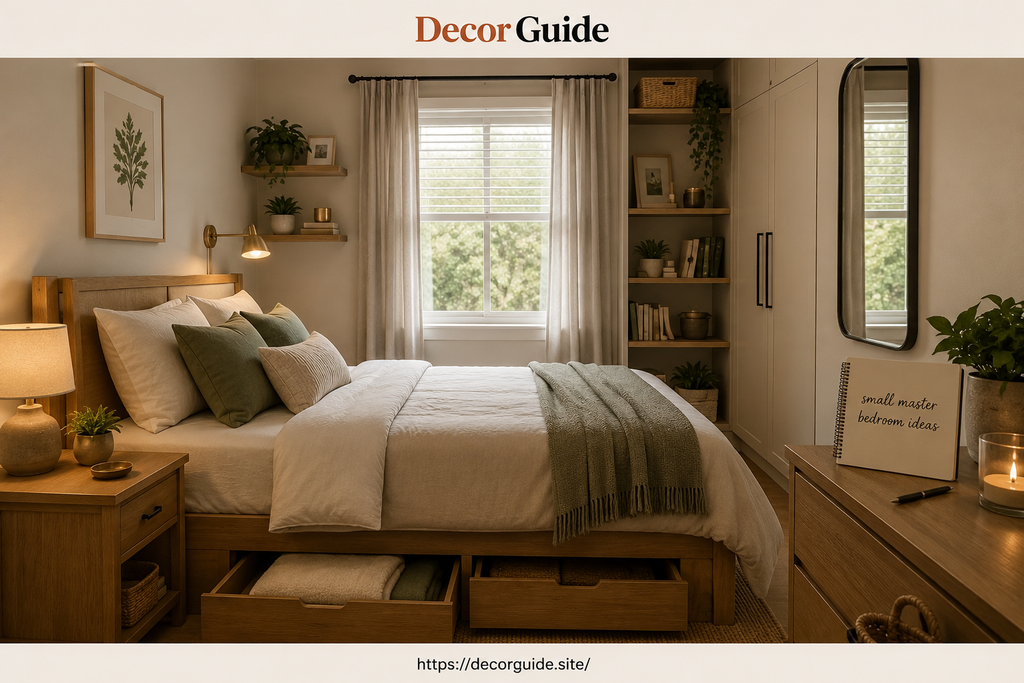
A bed with useful space underneath can also provide an opportunity for storing less frequently used items. However, avoid filling every open area with boxes simply because space is available. Storage should remain organized and accessible.
Use Nightstands and Storage Strategically
A large nightstand may look attractive in a spacious bedroom but can consume valuable walking space in a small one.
Choose nightstands according to what you actually need beside the bed. If you only need a lamp, phone, book, and a few personal items, a compact table or narrow cabinet may be enough.
Wall mounted shelves can sometimes replace traditional nightstands, particularly when floor space is extremely limited.
The important question is not whether floating furniture is fashionable. It is whether it solves a real space problem in your room.
Use Vertical Space Instead of Filling the Floor
One of the most useful principles for small bedrooms is to look upward.
Walls provide storage and display opportunities without taking up the same floor area as another piece of furniture.
Consider:
- Tall wardrobes
- Wall mounted shelves
- Vertical bookcases
- Hooks for frequently used accessories
- Wall mounted lighting
- High storage for seasonal items
- Tall mirrors
Vertical storage is especially useful when your bedroom has limited closet capacity.
However, don’t cover every available wall with shelves. Too much open storage can make a small room look busy.
A better approach is to use vertical space selectively and keep frequently used belongings within comfortable reach.
Add Storage Without Making the Bedroom Feel Crowded
Storage is often the hardest part of a small master bedroom.
The first step should not be buying organizers. Declutter before organizing.
Separate your belongings into practical categories:
- Frequently used
- Occasionally used
- Seasonal
- Sentimental
- Items that belong elsewhere
- Items that are broken or no longer useful
This reduces the amount of storage you actually need.
For clothing, keep everyday pieces in the easiest to reach areas. Seasonal clothing can be moved to less accessible storage when appropriate.
Under bed storage can work well for items that aren’t needed every day. Keep categories together rather than creating several random boxes. For example, spare bedding should have one designated location instead of being divided across multiple containers.
Open vs. Closed Storage
Both open and closed storage have advantages.
Open storage makes belongings easy to see and access, but visible objects contribute to visual clutter.
Closed storage hides belongings and creates a calmer appearance, but items can become forgotten if the system is poorly organized.
For a small bedroom, a combination often works best: closed storage for visually messy categories and open storage for attractive or frequently used items.
The best storage solution is the one that makes it easy to put something away and find it later.
Make a Small Master Bedroom Feel Larger With Color and Light
You don’t have to paint a small bedroom completely white to make it feel spacious.
Light, restrained colors can help create an airy appearance, but the bigger principle is visual continuity. When walls, bedding, curtains, and larger furniture pieces work together rather than competing for attention, the room can feel calmer.
You can introduce contrast through smaller elements such as:
- Artwork
- Pillows
- Throws
- Bedside accessories
- Rugs
- Decorative objects
Lighting also plays an important role.
A single bright ceiling fixture may illuminate the room, but layered lighting can make it feel more comfortable and functional. Consider combining general room lighting with bedside lighting and softer accent lighting where appropriate.
Wall mounted bedside lights can be particularly useful in small rooms because they provide illumination without requiring a large lamp base on the nightstand.
The bedroom should also support sleep. The Sleep Foundation recommends paying attention to factors such as light, noise, temperature, and bedding when creating a sleep friendly bedroom environment.
Use Decor to Add Personality Without Visual Clutter
A small bedroom shouldn’t have to look empty to feel organized.
The trick is choosing fewer decorative elements and giving each one enough visual space.
Instead of displaying ten small objects on a dresser, you might choose one larger piece of artwork, a plant, or a carefully arranged group of objects.
Mirrors can also be useful decor elements because they reflect light and can make the room feel more open. Their placement matters, though. A mirror should have a useful location rather than simply being added because the room is small.
Textiles are another easy way to add personality.
A coordinated duvet, curtains, rug, and cushions can create visual consistency without requiring additional furniture.
If your bedroom already has several patterns, choose simpler bedding or curtains. If the furniture is plain, you can introduce interest through texture or artwork.
Small Master Bedroom Ideas on a Budget
You don’t need to replace the entire bedroom to make it work better.
Start with no cost changes.
No Cost Improvements
- Remove furniture that doesn’t serve a purpose.
- Rearrange the existing furniture.
- Clear the top of dressers and nightstands.
- Move items that belong in another room.
- Rotate seasonal clothing.
- Reorganize the closet.
- Remove unnecessary decorative objects.
These changes can sometimes make a bigger difference than buying another storage product.
Low Cost Improvements
If the layout is already working, consider smaller upgrades such as:
- Matching storage boxes
- Simple wall hooks
- A narrow shelf
- New pillow covers
- Better bedside lighting
- A mirror
- Coordinated bedding
The key is to solve a specific problem before purchasing something.
Moderate Improvements
If your furniture is genuinely too large for the room, replacing one oversized piece can be more effective than adding multiple organizers.
For example, a bulky dresser that blocks circulation may be the real problem. Replacing it with a more appropriately sized storage solution can improve both functionality and appearance.
Common Mistakes to Avoid
Buying Storage Before Decluttering
More containers won’t solve the problem if the bedroom contains items you don’t use.
First reduce unnecessary belongings, then determine what storage remains necessary.
Choosing Furniture Based Only on Appearance
A beautiful dresser that barely fits may create more problems than it solves.
Always consider dimensions, door clearance, drawer access, and walking paths before purchasing furniture.
Filling Every Wall
A small bedroom needs visual breathing room.
Using every wall for shelves, artwork, mirrors, and cabinets can make the room feel smaller rather than larger.
Using Too Many Small Decorative Items
Several small objects can create more visual noise than one carefully selected feature.
Group accessories intentionally and leave some surfaces relatively clear.
Ignoring the Bedside Area
The space around the bed needs to work well because it is used every day.
If you cannot comfortably reach a lamp, place a phone down, or access essential items, reconsider the nightstand setup.
Forgetting Furniture Safety
If your bedroom is accessible to young children, unstable furniture deserves particular attention. The U.S. Consumer Product Safety Commission recommends anchoring furniture such as dressers, bookcases, and other potentially unstable pieces to help prevent tip over incidents.
Check the manufacturer’s instructions and use appropriate anchoring hardware rather than improvising a mounting method.
A Simple Plan for Redesigning Your Small Bedroom
If you’re overwhelmed by the number of possible changes, work in this order.
Step 1: Empty unnecessary items.
Remove things that don’t belong in the bedroom or aren’t being used.
Step 2: Measure the room.
Record the usable wall lengths and identify doors, windows, closets, and other fixed features.
Step 3: Position the bed.
Choose a location that supports comfortable movement and access.
Step 4: Add essential storage.
Prioritize clothing, bedding, and everyday belongings.
Step 5: Look upward.
Use appropriate wall space for shelves, lighting, mirrors, or other practical solutions.
Step 6: Improve lighting.
Add bedside or task lighting where needed.
Step 7: Simplify surfaces.
Remove unnecessary objects from dressers, nightstands, and shelves.
Step 8: Add personality.
Finish with artwork, textiles, plants, or a few meaningful decorative pieces.
This sequence prevents a common mistake: decorating a room before solving the functional problems.
The Best Small Master Bedroom Ideas Are Practical First
A small master bedroom doesn’t need dozens of clever products to work well. In most cases, the biggest improvement comes from making better decisions about what occupies the available space.
Start with the bed and circulation. Reduce furniture that doesn’t earn its place. Use vertical and under bed storage where appropriate. Keep everyday items accessible and less used belongings out of prime locations. Then use color, lighting, textiles, and decor to give the room personality.
Most importantly, don’t measure success by how much furniture you manage to fit inside the room. A successful small bedroom gives you enough space to sleep, move, dress, store your belongings, and relax without constantly working around clutter.
FAQ
How can I make a small master bedroom look bigger?
Use a simple furniture layout, keep walking areas clear, reduce visual clutter, and use light and coordinated colors. Mirrors and appropriately placed lighting can also help create a more open visual effect.
What furniture should I put in a small master bedroom?
Prioritize the bed, necessary clothing storage, compact bedside storage, and lighting. Add other furniture only if there is enough space for comfortable movement.
How do I organize a small master bedroom?
Start by removing items that don’t belong or aren’t useful. Then categorize what remains, keep frequently used items accessible, and use vertical or under bed storage for belongings that don’t need to stay in prime locations.
Are floating shelves good for small bedrooms?
They can be useful when you need storage without adding floor furniture. However, they should solve a genuine storage need rather than simply filling an empty wall.
How can couples share a small master bedroom?
Start by giving both people practical storage and bedside access. Divide closet or drawer areas logically, remove duplicate items where appropriate, and make sure frequently used belongings remain accessible to both people.
Should I use a large rug in a small bedroom?
The right rug can help visually connect the bed and surrounding furniture, but its size and placement should suit the room. Avoid choosing a rug that interferes with doors or creates awkward walking areas.
What should I remove from a small bedroom first?
Start with broken items, belongings that belong elsewhere, unused duplicates, and decorative objects that don’t contribute to the room. This creates space before you make any storage purchases.