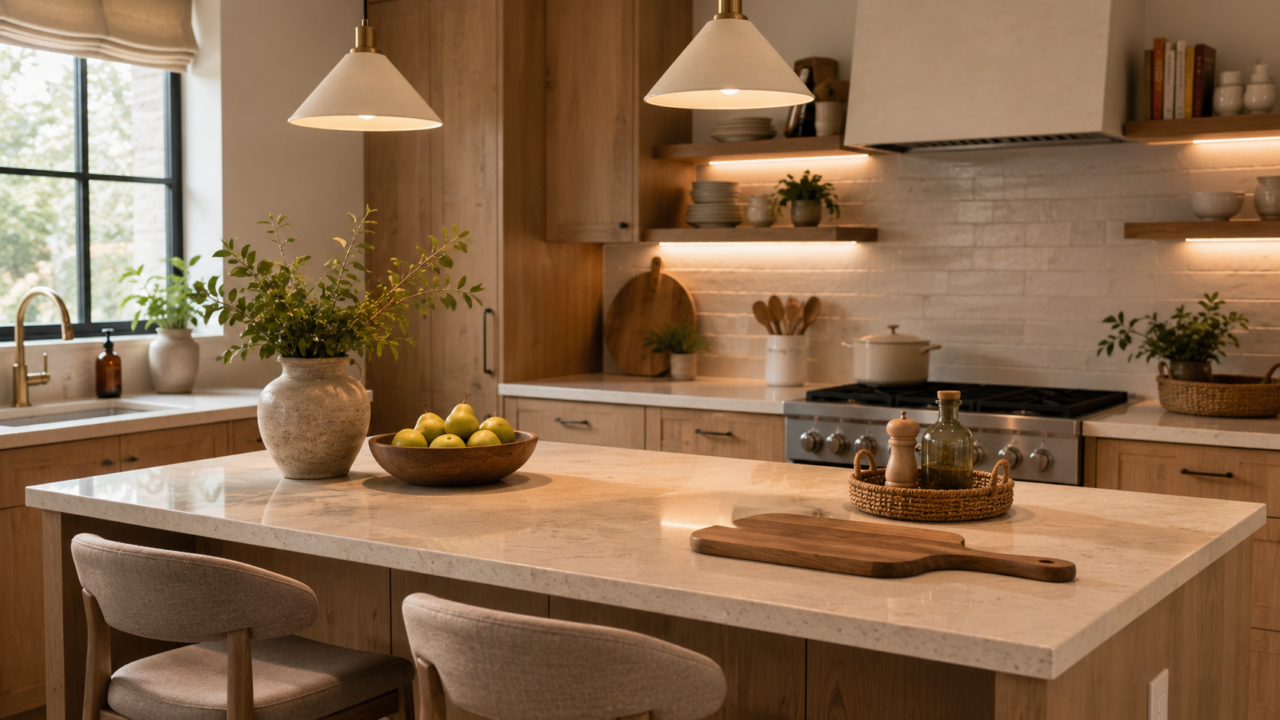
A kitchen island can look strangely unfinished when it is completely bare, but it can become frustrating when every inch is covered with bowls, vases, appliances, and decorative objects.
The best kitchen island decor sits somewhere between those two extremes.
Your island is probably one of the hardest working surfaces in the kitchen. It may be used for chopping vegetables, serving food, eating breakfast, sorting groceries, helping children with homework, or simply gathering with family. Decorating it means working around those activities rather than pretending the countertop is a display table.
The island also has a major visual role. Because it often sits in the center of the kitchen, small choices in its lighting, seating, materials, color, and countertop styling can affect how the entire room feels.
A useful approach is to decorate the island in layers: establish its function first, choose one visual anchor, add one or two supporting elements, and deliberately leave usable space around them.
Start With What Your Kitchen Island Needs to Do
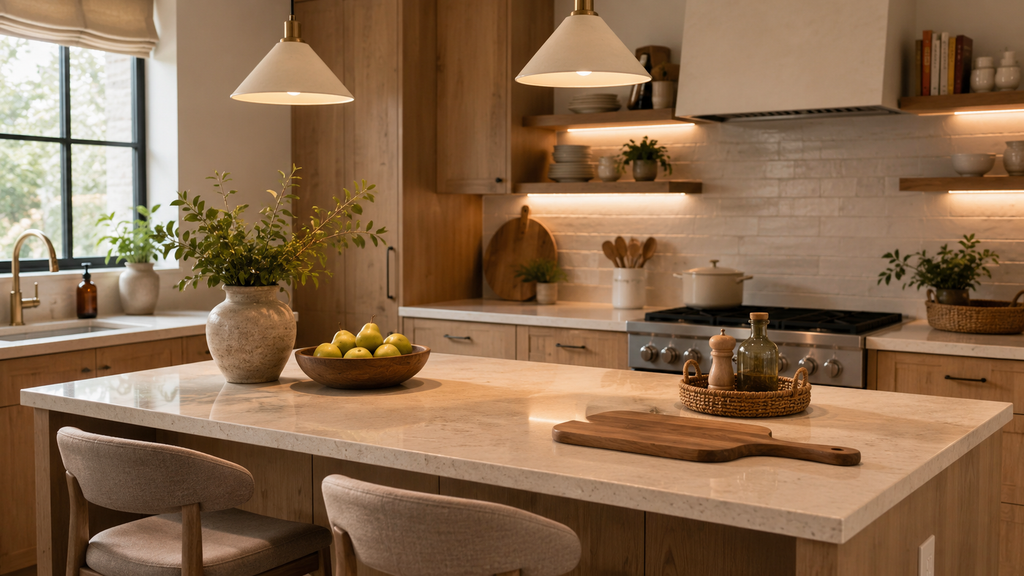
Before buying a centerpiece or decorative tray, decide how you actually use the island.
If the island is primarily a food preparation surface, it needs considerably more clear countertop space than an island used mainly for breakfast and entertaining.
If it is a dining zone, seating becomes an important part of the visual composition. If it contains drawers, cabinets, a sink, or appliances, those functions should also influence what you place above and around it.
Current kitchen design guidance increasingly emphasizes zones rather than treating the kitchen as a collection of decorative surfaces. The National Kitchen & Bath Association’s updated planning guidelines specifically organize kitchen planning around activity zones, work areas, storage, seating, lighting, and electrical planning.
That principle is useful even if you are not remodeling.
Think about the island as having different purposes:
- Prep zone: Keep the main working area open.
- Serving zone: Use a bowl, tray, or serving board that can be moved easily.
- Dining zone: Let stools and lighting provide much of the visual interest.
- Display zone: Use a small area for decorative objects.
- Storage zone: Use drawers, shelves, or baskets for items that need to stay nearby.
Once the function is clear, decorating becomes much easier.
Kitchen Island Decor Ideas That Actually Work
1. Use One Strong Centerpiece
A single substantial object can often do more than five small decorations.
A large ceramic bowl, sculptural vase, wooden vessel, or simple arrangement of branches can provide a visual focal point without making the island feel crowded.
Height can also help draw the eye upward. Professional styling guidance commonly recommends introducing some vertical variation rather than keeping every object at the same level.
Place the centerpiece toward one side if you regularly use the opposite side for preparation.
2. Style a Decorative Tray
A tray is one of the most practical pieces of island decor because it groups several objects into one visual unit.
For example, a tray might contain:
- A ceramic oil bottle
- A small vase
- A salt cellar
- A candle
- A wooden utensil holder
The benefit isn’t just appearance. You can move the entire group when you need the countertop.
Recent kitchen styling guidance also recommends trays as a way to group countertop objects and keep the surface visually organized.
Choose a tray that fits the island rather than one that consumes a large percentage of the working surface.
3. Add a Bowl of Fruit
Fruit is one of the easiest ways to make an island look lived in.
A wooden bowl filled with apples, pears, lemons, or seasonal produce adds color without looking like purely decorative clutter.
It also has an obvious everyday purpose.
The trick is to keep the bowl proportional to the island. An enormous bowl overflowing with fruit can become visually heavy, while a small bowl can disappear on a large countertop.
4. Use a Ceramic Vase or Vessel
A simple ceramic vase can provide height, texture, and shape without introducing another complicated color.
You don’t need an elaborate flower arrangement.
A few branches, seasonal stems, or even an empty sculptural vessel can work.
If the kitchen already contains several natural materials such as wood, stone, and woven fibers, ceramic adds a useful contrast without making the palette feel disconnected.
5. Bring in Greenery
A small plant can soften a kitchen filled with hard surfaces.
Consider a compact herb planter, trailing plant, or small leafy plant depending on the available light and how much maintenance you want.
Keep plants away from areas where they interfere with food preparation or create a practical nuisance.
The goal is not to turn the island into an indoor garden. One well placed plant can be enough.
6. Display Useful Everyday Objects
Some of the best island accessories are things you actually use.
A wooden cutting board leaning against the backsplash, a ceramic utensil holder, a beautiful serving bowl, or a frequently used cookbook can function as both equipment and decoration.
This approach is particularly effective because the objects naturally belong in the kitchen.
The result feels less staged than an arrangement made entirely from decorative accessories.
7. Add Cookbooks Carefully
Cookbooks can give an island personality, particularly when the kitchen opens into a dining or living area.
Stack two or three books horizontally or place a small group vertically on an island shelf if one exists.
Avoid turning the countertop into a bookcase.
If you cook frequently, keep your most used books accessible and store the rest elsewhere.
8. Use a Cutting Board as Functional Decor
A large wooden cutting board can add warmth to a stone countertop while remaining completely practical.
Lean it against the backsplash or place it flat in a location that doesn’t interfere with preparation.
Natural wood is especially useful in kitchens dominated by white, gray, or other cool finishes because it introduces warmth and texture.
9. Make the Island Lighting Part of the Design
Pendant lights are one of the strongest decorative elements associated with a kitchen island.
They provide illumination while establishing the island as a visual focal point.
Current kitchen design coverage continues to treat island lighting as both functional and decorative, with pendants, woven fixtures, chandeliers, and other statement options appearing prominently in contemporary kitchens.
The important consideration is proportion.
Oversized fixtures can dominate a modest island. Tiny fixtures can disappear over a large one.
The Department of Energy’s residential lighting guidance also recognizes pendants as useful task lighting over freestanding counters and islands, while recommending a combination of task and ambient lighting rather than relying on a single lighting source.
10. Give the Island a Strong Color or Material Connection
The island doesn’t have to match every cabinet in the kitchen.
A contrasting island can become an intentional focal point. Two tone kitchens remain popular because changing the island finish can introduce visual depth without requiring every surface to be redesigned.
For example:
- Warm wood island + painted perimeter cabinets
- Muted green island + natural oak cabinetry
- Dark island + light stone countertop
- Cream island + warm wood stools
- Natural wood island + neutral cabinetry
Repeat the island’s material or color somewhere else in the kitchen so the contrast feels deliberate.
How to Style a Kitchen Island Without Losing Prep Space
This is where many attractive kitchens fail.
A countertop photograph may look beautiful because the island contains a vase, fruit bowl, tray, cutting board, candles, books, flowers, and decorative objects. But if you cook regularly, that arrangement may become annoying within a day.
Instead, divide the island mentally into display space and working space.
Keep the main preparation area clear.
Put decorative items toward one end, especially if the island is long enough to accommodate separate zones.
For example:
One end: Large ceramic vase and small tray
Center: Clear preparation surface
Other end: Fruit bowl near seating
This gives the island visual balance without covering its entire surface.
Another useful test is the move test: can you clear the decorative items quickly when preparing a meal?
If the answer is yes, your styling is probably practical.
If clearing the island requires moving eight separate objects into different rooms, there is probably too much on it.
Kitchen Island Decor for Small Kitchens
A small island needs restraint.
When countertop area is limited, decoration should either be compact or perform another useful function.
A small ceramic bowl can hold fruit. A narrow tray can organize frequently used items. A single vase can provide height. A cutting board can add warmth while remaining useful.
Avoid large decorative arrangements that consume the only available prep surface.
You can also shift decoration upward.
Pendant lights, wall shelves, artwork, or a decorative backsplash can provide visual interest without taking up countertop space.
If the island has an open shelf underneath, use it carefully. A few baskets or neatly stacked cookbooks can make the lower portion attractive while providing useful storage.
The key is accessibility.
Frequently used items should remain easy to reach. Rarely used decorative pieces should not occupy prime working space.
Choose Island Seating That Complements the Room
Bar stools are part of the island’s decor whether you think of them that way or not.
Their shape, material, color, and visual weight can dramatically change the appearance of the kitchen.
For a warm kitchen, consider:
- Natural wood stools
- Woven seats
- Upholstered neutral stools
- Simple metal frames
- Rounded back designs
- Mixed wood and fabric
Avoid choosing stools based purely on appearance.
The seat height must match the counter, and the seating area needs adequate knee and leg room.
The NKBA’s kitchen planning guidance gives recommended knee space dimensions for different counter heights and notes that local codes may also apply.
For an everyday kitchen, also think about how often people will actually sit there.
If the island is used for family breakfasts, homework, or casual meals, comfort matters more than simply finding the most visually striking stool.
Use the Island’s Base for Storage and Decoration
The countertop isn’t the only part of the island worth styling.
The island base can provide useful visual and organizational opportunities.
If there are open shelves, consider:
- Woven baskets
- Cookbooks
- Serving bowls
- Cutting boards
- Textiles
- A few attractive kitchen tools
Closed cabinetry is better for items that create visual noise.
This creates a useful distinction between display storage and concealed storage.
Open storage works best for objects you don’t mind seeing. Closed storage is useful for appliances, cleaning supplies, packaging, and miscellaneous kitchen equipment.
This balance is increasingly important as modern kitchens move toward calmer, more integrated appearances. Current design discussions emphasize zoning and concealed storage as ways to keep busy kitchen functions from overwhelming the visual space.
Kitchen Island Decor by Style
Modern Kitchen Island Decor
Keep the composition restrained.
Try a sculptural ceramic object, one large bowl, simple stools, and clean lined pendants.
Repeat one material, such as black metal, natural oak, or warm stone, to create cohesion.
Warm and Cozy Kitchen Island Decor
Use natural materials.
Wooden boards, woven baskets, ceramic vessels, linen napkins, warm lighting, and greenery can make a neutral kitchen feel less sterile.
Farmhouse Kitchen Island Decor
Look for practical objects with character rather than excessive rustic accessories.
A wooden cutting board, ceramic pitcher, woven basket, vintage style stool, and simple floral arrangement can create the look without turning the kitchen into a themed display.
Minimalist Kitchen Island Decor
Choose one or two objects and stop.
A single vase, fruit bowl, or carefully selected tray can be enough.
Minimal styling depends heavily on negative space, so the empty countertop becomes part of the design.
Organic Modern Kitchen Island Decor
Combine warm wood, natural stone, ceramic, linen, and greenery.
Keep shapes simple but introduce variation through texture and height.
Current 2026 kitchen design coverage increasingly highlights warmer materials, softer forms, natural finishes, and furniture like islands rather than kitchens dominated entirely by hard, uniform surfaces.
Budget Friendly Kitchen Island Decorating Ideas
You can make a noticeable difference without replacing the island.
No Cost
Start by removing things.
Clear unnecessary appliances and miscellaneous objects from the island. Then group the useful items that remain.
Rearranging existing stools, boards, bowls, plants, or cookbooks can completely change the composition.
Low Cost
Look for one useful decorative piece rather than a collection.
Examples include:
- Ceramic bowl
- Wooden tray
- Small plant
- Linen runner
- Woven basket
- Simple vase
- Secondhand stool
Moderate Investment
If the island itself feels visually dated, consider a more substantial change such as:
- New cabinet hardware
- Refinished island cabinetry
- New pendant lights
- Updated stools
- A different countertop accessory scheme
- Open shelving where appropriate
You don’t necessarily need to remodel the entire kitchen to make the island feel different.
Higher Investment
If you’re already renovating, the island can become a major design feature through its cabinetry color, countertop material, seating arrangement, lighting, storage, or integrated functions.
But don’t make the island larger simply because there is technically room for it.
An island should improve the kitchen’s flow rather than consume it.
Common Kitchen Island Decor Mistakes
Covering the Entire Countertop
The island is a workspace. Leave enough clear area for actual use.
Using Too Many Small Objects
A collection of tiny accessories can create more visual noise than one substantial object.
Choosing Decor That Doesn’t Relate to the Kitchen
A decorative piece may be beautiful but still look out of place if its material, color, or scale has no relationship to the rest of the room.
Ignoring the Stools
Seating occupies a large visual area around the island. Mismatched or poorly proportioned stools can undermine otherwise good styling.
Choosing Oversized Lighting
Pendant lights should have enough presence to be noticed without overwhelming the island.
Treating the Island as a Permanent Display
Your kitchen changes throughout the day.
Groceries arrive. Meals are prepared. Children sit down. Dishes are served.
Good styling should accommodate that reality.
Decorating Before Solving Storage
If the island is constantly covered with appliances and kitchen supplies, adding decorative objects won’t solve the underlying problem.
Look at what is occupying the surface and determine whether those items can be relocated first.
Forgetting Traffic Flow
A beautiful island is not successful if people have to squeeze around it.
The NKBA planning guidelines specifically address passageways, activity centers, seating, storage, electrical planning, and lighting as interconnected parts of kitchen design.
A Simple Formula for Styling Your Kitchen Island
If you want a straightforward starting point, use this formula:
1. Clear the island.
Remove everything that doesn’t need to stay.
2. Identify the working area.
Protect the portion you use for preparation, serving, or daily activities.
3. Choose one anchor object.
Use a bowl, vase, tray, cutting board, or another substantial piece.
4. Add one supporting element.
A plant, cookbook stack, small vessel, or useful kitchen object is enough.
5. Introduce texture.
Wood, ceramic, woven fiber, linen, or another natural material can keep the composition from feeling flat.
6. Check the height.
If everything is low and flat, a taller object can add visual interest.
7. Look at the stools and lighting.
These elements are part of the island’s overall composition.
8. Leave empty space.
Don’t add another object simply because the countertop isn’t full.
9. Test it for a normal day.
Prepare breakfast, make coffee, unpack groceries, or cook dinner. If the decor constantly gets in the way, simplify it.
This approach works because it treats decoration as part of the kitchen rather than something placed on top of it afterward.
Final Takeaway
Good kitchen island decor doesn’t require a countertop covered with accessories.
The strongest islands usually have a clear sense of purpose. A bowl of fruit can provide color. A wooden board can add warmth. A ceramic vase can create height. A tray can organize useful objects. Pendant lights can establish the focal point, while stools can connect the island to the rest of the kitchen.
What matters most is the relationship between those elements and the way you actually use the room.
Start with function. Protect the working surface. Choose one visual anchor. Repeat materials or colors from elsewhere in the kitchen. Then stop before the island becomes crowded.
The result should look finished when you walk into the kitchen—and still work when it is time to cook.
FAQ
What should I put on a kitchen island?
Useful options include a fruit bowl, ceramic vase, wooden cutting board, decorative tray, small plant, cookbook stack, or attractive everyday kitchen tools. Choose only what fits the island’s available working space.
How do I decorate a kitchen island without cluttering it?
Keep the main preparation area clear and group decorative objects toward one end. Use one larger centerpiece rather than many small accessories, and make sure the objects can be moved easily when you need the full surface.
What is a good centerpiece for a kitchen island?
A large ceramic bowl, wooden bowl, sculptural vase, simple floral arrangement, or decorative tray can work well. The right choice depends on the island’s size and the kitchen’s existing materials and colors.
Should a kitchen island have decor?
It doesn’t have to. A completely functional island can look attractive when its materials, lighting, cabinetry, and seating are well designed. If you add decor, it should improve the visual balance without interfering with how the island is used.
How can I decorate a small kitchen island?
Use compact, multipurpose objects such as a small fruit bowl, narrow tray, cutting board, or small plant. Keep most of the countertop clear and use lighting, stools, cabinetry, or nearby wall space to add visual interest instead.
How do I make a kitchen island look expensive without spending a lot?
Focus on proportion and restraint rather than quantity. Clear unnecessary items, use natural materials such as wood and ceramic, coordinate the island with the surrounding kitchen, and choose one strong centerpiece instead of many inexpensive decorations.
What should I put under a kitchen island?
If the island has open shelving, consider baskets, cookbooks, serving bowls, cutting boards, or attractive kitchen textiles. Closed cabinets are better for appliances and miscellaneous items that create visual clutter.
How many pendant lights should go over a kitchen island?
The appropriate number depends on the island’s size, the fixture dimensions, the ceiling, and the lighting needs. Rather than choosing a fixed number, aim for even useful illumination and a visually balanced arrangement. Pendants can provide both task lighting and a decorative focal point.