Minimalist interiors can be surprisingly difficult to decorate.
Remove too much and a room can feel cold, unfinished, or uncomfortable. Add too many accessories and the clean visual quality disappears. The challenge is not simply owning fewer things. It is deciding which pieces genuinely improve the room and which ones are only taking up space.
Minimalist home decor essentials are therefore less about a strict shopping list and more about choosing a small number of useful, visually compatible pieces.
A minimalist interior commonly relies on clean lines, restrained decoration, limited furniture, natural materials, and storage that keeps unnecessary visual clutter under control. But minimalist design does not require every room to be white, empty, or completely devoid of personality.
The most successful approach is to make every visible item earn its place.
What Minimalist Home Decor Actually Means
Minimalism in a home is best understood as intentional selection.
You do not need to throw away everything you own or replace your furniture with expensive designer pieces. A family home can be minimalist. A rental can be minimalist. A small apartment can be minimalist without looking like a showroom.
The underlying idea is to reduce unnecessary visual competition.
A minimalist living room might contain a sofa, rug, coffee table, lamp, artwork, and a few carefully chosen accessories. Those pieces do not have to be identical or expensive. What matters is that they work together.
Color, proportion, storage, furniture placement, texture, and empty space all contribute to the effect.
Research on household clutter also suggests that the relationship between possessions, the home environment, and well-being is more complicated than simply saying “less stuff is always better.” Studies have found associations between clutter and perceptions of the home and well-being, while research on household organization emphasizes that organization itself is an important part of the home environment.
That is why minimalist decorating should be approached as a practical design system rather than a competition to own the fewest objects.
The 10 Essential Categories for a Minimalist Home
A Quality Sofa or Main Seating
In a living room, the main seating usually has more influence on the room than decorative accessories.
Choose a sofa or seating arrangement based on the room’s actual size, household needs, and layout rather than selecting the smallest possible piece simply because minimalism is the goal.
A family may need a deeper or larger sofa. Someone living alone may prefer a compact sofa and an occasional chair.
Look for:
- A shape that suits the room
- A color that works with existing finishes
- Comfortable proportions
- Durable upholstery appropriate for your household
- Enough seating for normal use
You do not need several small chairs just to fill empty floor space.
If the sofa already provides visual weight, let the surrounding furniture remain relatively restrained.
A Simple Rug
A rug can help visually connect furniture and define a seating area.
In a minimalist room, a rug does not need a complicated pattern. Texture, subtle variation, or a restrained geometric design can be enough.
Choose the rug according to the furniture arrangement rather than treating it as an isolated decorative object.
A rug that is too small can make a room’s furniture appear disconnected. Conversely, an appropriately scaled rug can visually anchor the seating area.
Neutral does not have to mean plain. Natural texture can provide interest without introducing another strong visual element.
Functional Lighting
Lighting is one of the most important categories of minimalist home decor because it affects both function and atmosphere.
Rather than filling a room with decorative lamps, consider the different lighting tasks the room needs.
A living room might require:
- General room lighting
- Reading or task lighting
- Softer evening lighting
A bedroom may need bedside lighting as well as general illumination.
Choose fixtures with shapes and finishes that complement the rest of the room. A single sculptural lamp can sometimes have more impact than several small decorative lights.
The goal is not to make lighting invisible. It is to make it purposeful.
Curtains or Window Treatments
Bare windows can work in some interiors, but window treatments often add softness, privacy, and visual balance.
For a minimalist look, simple curtains or restrained shades are generally easier to integrate than highly decorative treatments.
Consider how the window treatment interacts with:
- Wall color
- Flooring
- Furniture
- Natural light
- Privacy needs
A quiet fabric can add texture without becoming another focal point.
One Strong Focal Point
Minimalism does not mean every surface has to be visually silent.
In fact, one strong focal point can make a restrained room more interesting.
This could be:
- A large piece of artwork
- A sculptural light
- A distinctive chair
- A beautiful piece of furniture
- A large mirror
- An architectural feature
The important word is one.
If every wall, shelf, table, and corner contains something demanding attention, the room loses the calm quality associated with minimalist design.
A large artwork can often work better than a collection of tiny decorative pieces because it gives the eye a clear destination.
Practical Storage
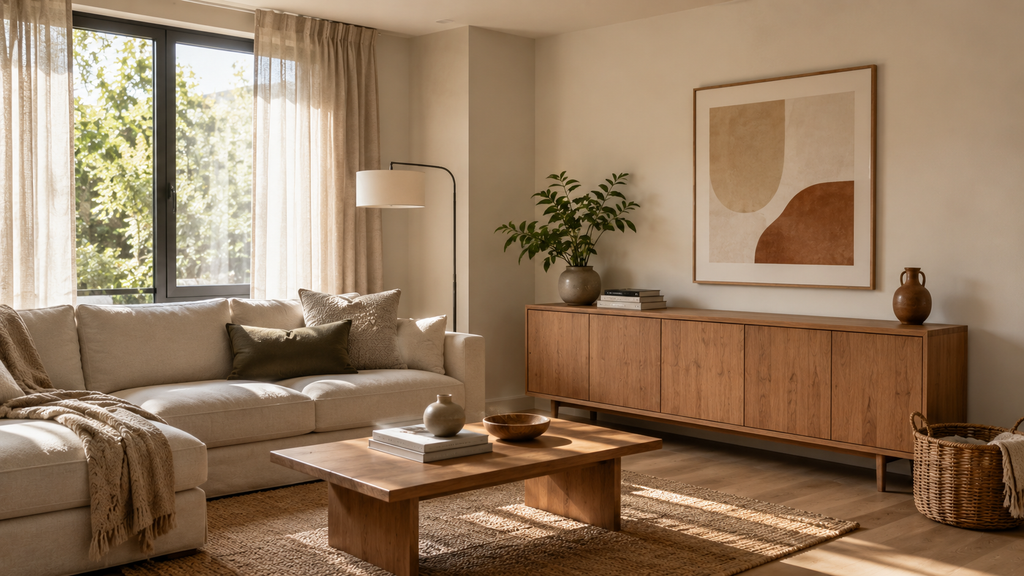
Storage is one of the most overlooked minimalist home decor essentials.
A room cannot maintain a simple appearance if everyday objects have nowhere to go.
Closed storage can be particularly useful for items that are necessary but visually distracting. IKEA’s small-space design guidance, for example, highlights vertical storage and selective use of open versus closed storage as ways to make limited space work harder.
Useful options can include:
- Closed cabinets
- Storage ottomans
- Drawers
- Baskets
- Sideboards
- Built-in storage
- Under-bed storage
- Wall-mounted storage
The best storage is not necessarily the largest.
It is the storage that is easy to access and suited to the things you actually need to put away.
Natural Textures
A room with a restricted color palette can become visually flat if every surface has the same finish.
Texture solves that problem without requiring more color.
Consider combinations such as:
- Wood
- Linen
- Cotton
- Wool
- Woven fibers
- Stone
- Ceramic
- Matte finishes
The idea is to create subtle variation.
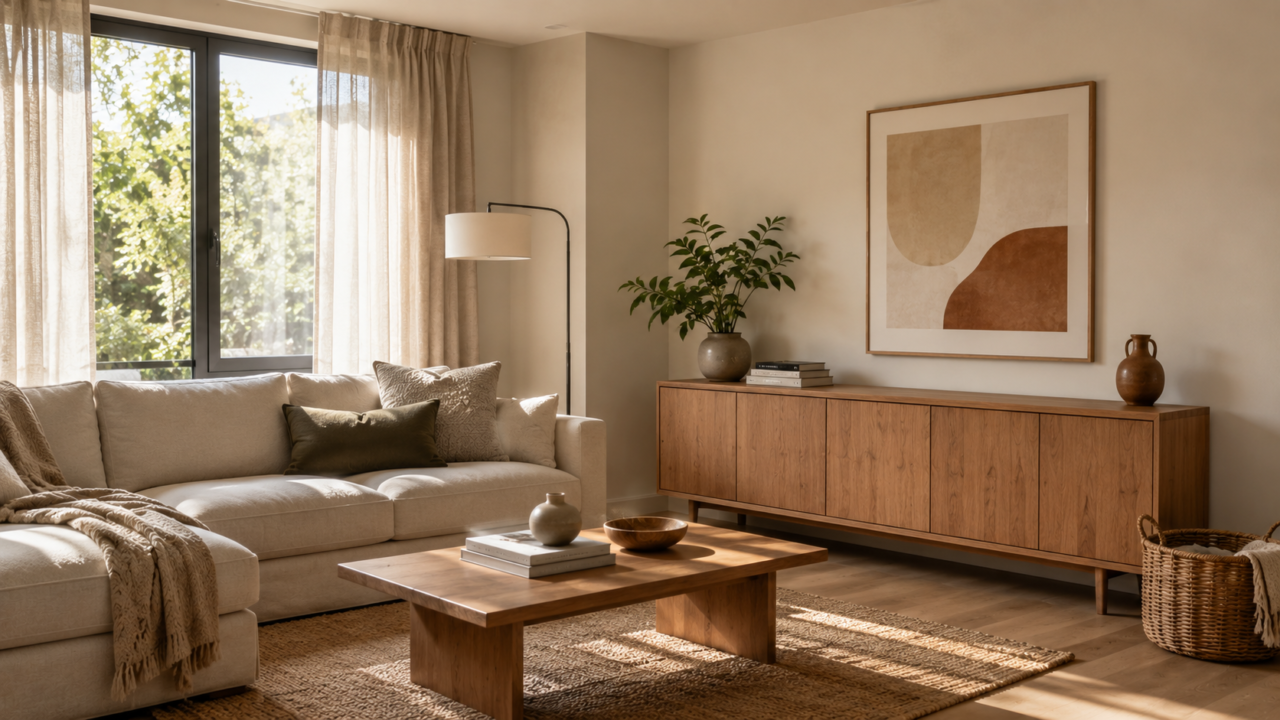
For example, a neutral sofa can become more interesting when paired with a textured rug, wooden furniture, woven basket, and ceramic accessories.
This gives the room character without requiring dozens of decorative objects.
A Small Collection of Decorative Objects
Decorative objects still have a place in minimalist interiors.
The difference is selection.
Instead of putting something on every available surface, choose a few pieces that have visual or personal value.
A coffee table might need only:
- A tray
- One book
- A small plant or vessel
A console might need a mirror, lamp, and one decorative object.
The exact number is not important. The principle is.
Decor should support the room rather than compete with it.
Mirrors
A mirror can serve both a functional and decorative role.
It can be particularly useful in:
- Entryways
- Bedrooms
- Small living rooms
- Narrow hallways
- Areas with limited natural light
The frame should work with the overall room rather than becoming an unrelated accent.
In a small space, a mirror can also provide another visual surface without requiring additional furniture.
But placement matters. A mirror reflecting a cluttered countertop or messy storage area simply duplicates the visual problem.
Greenery
Plants can add color, organic shapes, and texture to an otherwise restrained room.
You do not need a jungle.
One larger plant can sometimes provide more visual interest than several tiny plants scattered across different surfaces.
If maintaining live plants is impractical, choose decor according to your household’s needs rather than adding plants simply because minimalist interiors frequently feature them.
How to Choose Minimalist Decor Without Making Your Home Feel Empty
The biggest mistake is confusing minimalism with deprivation.
A room can have relatively few objects and still feel warm.
The difference usually comes from proportion, texture, lighting, and personal elements.
Imagine a living room containing only a sofa, coffee table, rug, lamp, and artwork. If everything is stark white, glossy, and perfectly symmetrical, the room may feel sterile.
Change the rug to a textured natural material, introduce warm wood, add a soft throw, and display one meaningful piece of artwork. The number of objects has barely changed, but the room now has more visual depth.
This is why minimalism works best when you edit rather than simply remove.
Before buying something, ask:
- Does the room actually need it?
- Does it serve a practical purpose?
- Does it add texture, color, or personality?
- Does it work with something I already own?
- Where will it live?
- Would removing something else make more sense?
That last question is especially useful.
Sometimes the best way to improve a room is not to add another object but to remove an unnecessary one.
Minimalist Decor by Room
Living Room
Prioritize the major visual elements first:
- Sofa
- Rug
- Coffee table
- Lighting
- Curtains
- Storage
- Artwork
Keep everyday items such as remote controls, chargers, children’s toys, and books contained in designated locations.
Open shelving can work, but it should be edited carefully. IKEA’s design guidance recommends being selective about what is displayed when using open storage, rather than treating every shelf as storage space.
Bedroom
The bedroom should be particularly easy to maintain.
Useful essentials include:
- Comfortable bed
- Simple bedside tables
- Functional bedside lighting
- Appropriate clothing storage
- Curtains or blinds
- One or two decorative elements
- A rug if appropriate
Avoid turning the bedside table into a storage station.
Keep the objects you use every night within reach and move everything else elsewhere.
Kitchen and Dining Area
Minimalist kitchen decor should not interfere with cooking.
Keep frequently used tools accessible, but avoid leaving every appliance and utensil on the counter.
Useful visual elements include:
- A simple fruit bowl
- Attractive everyday dishes
- One plant
- A restrained centerpiece
- Natural wood accessories
The kitchen should remain a working space first.
Entryway
A minimalist entryway needs a system for the things people actually bring home.
Think about:
- Shoes
- Keys
- Bags
- Coats
- Umbrellas
Closed shoe storage and a small designated tray can often do more for the appearance of an entryway than several decorative accessories.
For families, accessible storage is particularly important. IKEA’s small-family hallway examples combine closed storage for items that need hiding with accessible open storage for frequently used belongings.
Bathroom
Bathroom minimalism is largely about reducing visual noise.
Keep daily toiletries accessible but avoid displaying every product you own.
Use:
- Simple containers where practical
- Closed cabinets
- Trays for frequently used items
- Coordinated towels
- One or two decorative elements
Do not sacrifice convenience simply to achieve a completely empty countertop.
Open vs. Closed Storage for Minimalist Homes
Both have a place.
| Storage Type | Best For | Main Advantage | Main Limitation |
|---|---|---|---|
| Closed storage | Everyday clutter, paperwork, miscellaneous items | Keeps visual noise hidden | Requires opening doors or drawers |
| Open shelves | Books, artwork, attractive objects | Easy access and display | Requires regular editing |
| Baskets | Soft goods, toys, accessories | Flexible and visually softer | Contents can become mixed |
| Drawers | Small frequently used items | Easy categorization | Limited by drawer size |
| Vertical storage | Small rooms and narrow areas | Uses wall height | Can become visually heavy if overfilled |
A minimalist home does not need one storage type everywhere.
Use closed storage for things you do not want constantly visible and open storage for items worth displaying.
How Color, Texture, and Empty Space Work Together
Minimalist color schemes are often associated with white, beige, gray, black, and natural wood.
But there is no requirement to use only neutrals.
A restrained palette simply makes it easier to create visual consistency.
For example, a room might use:
- Warm white walls
- Medium wood furniture
- Olive green accents
- Cream textiles
- Black lighting details
The colors are varied, but the palette remains controlled.
Empty space is equally important.
Do not automatically fill an empty wall or shelf because it looks “unfinished.”
Sometimes the empty area is doing useful visual work by separating one important element from another.
Minimalist design often depends on this sense of breathing room. Architectural Digest describes minimalist interiors through clean lines, limited ornamentation, restrained furniture, natural materials, and uncluttered storage.
What Not to Buy
A minimalist home becomes difficult to maintain when every trend becomes a shopping opportunity.
Be cautious with:
- Small decorative objects with no clear home
- Furniture that is too large for the room
- Multiple nearly identical accessories
- Storage containers purchased before decluttering
- Decorative pieces that duplicate something you already own
- Extremely trendy items that do not suit the rest of the room
- Open shelving when you dislike visual maintenance
The objective is not to create an empty house.
It is to prevent unnecessary possessions from controlling the appearance and function of the house.
Minimalist Decor on a Budget
Minimalist decorating can actually work well with a modest budget because the style rewards editing.
Start with what you already have.
No-Cost Changes
- Remove unnecessary accessories
- Rearrange furniture
- Clear visual clutter
- Move decorative items between rooms
- Restyle shelves
- Group similar objects together
- Remove furniture that blocks circulation
Low-Cost Improvements
- Cushion covers
- Simple artwork
- Secondhand mirrors
- Basic lamps
- Baskets
- Plants
- Hardware
- Textiles
Larger Investments
Spend more carefully on pieces that are difficult to replace or that influence the entire room:
- Sofa
- Bed
- Dining table
- Wardrobe
- Storage furniture
- Quality lighting
Minimalism makes poor purchases more noticeable, so it is often better to buy fewer pieces that genuinely fit the room than to constantly replace inexpensive decor.
How to Maintain a Minimalist Look
Minimalism is easier to maintain when the home has clear storage rules.
Give everyday categories a home.
For example:
- Keys go in one tray.
- Throws return to one basket.
- Remote controls stay in one location.
- Mail has one temporary sorting area.
- Children’s toys have designated storage.
- Frequently used kitchen items stay near the relevant work zone.
This is more sustainable than repeatedly cleaning a room without changing where things live.
The same principle applies to decorative objects.
When you buy something new, decide where it belongs before bringing it home.
If there is no suitable location, that is useful information.
It may mean the item is not necessary.
For families, the goal should also be realistic rather than perfectionistic. Research into household organization distinguishes multiple dimensions of organization and disorganization rather than treating a home as simply “organized” or “messy.”
A minimalist home still needs to function as a home.
A Note About Decorative Candles
Candles can work beautifully as minimalist decor, but they should be treated as open flames rather than ordinary accessories.
The National Fire Protection Association recommends keeping burning candles at least 1 foot (30 cm) away from anything that can burn, placing them on sturdy, uncluttered surfaces, and extinguishing them when leaving the room or going to bed.
If a candle’s placement creates a safety concern, a flameless alternative may be more appropriate.
Final Takeaway
The best minimalist home decor essentials are not the objects that appear most frequently in minimalist interiors online.
They are the pieces that make your own home function better while giving it a clear visual identity.
Start with the major elements: comfortable furniture, useful lighting, appropriate storage, window treatments, textiles, and one or two meaningful focal points. Then add texture and personality selectively.
Do not measure minimalism by how empty your shelves look.
Measure it by how easily you can use the room, find what you need, maintain the space, and enjoy the things you have chosen to keep.
A well-designed minimalist home can still contain books, photographs, children’s belongings, plants, artwork, souvenirs, and everyday life.
The difference is that those things have been given a place rather than allowed to compete for every available surface.
FAQ
What are the most important minimalist home decor essentials?
The most useful categories include comfortable main furniture, a suitable rug, functional lighting, window treatments, practical storage, natural textures, one or two focal pieces, mirrors, greenery, and a limited selection of personal accessories.
Does minimalist home decor have to be white?
No. Minimalist interiors can use warm neutrals, earthy colors, darker tones, or carefully selected accent colors. The important consideration is visual restraint and consistency rather than a specific color.
How do I make a minimalist home feel cozy?
Use texture, warm lighting, natural materials, comfortable textiles, wood, rugs, and personal objects. Minimalism does not require removing everything that makes a room comfortable.
How many decorative items should a minimalist room have?
There is no universal number. Instead, consider whether each object contributes something useful or meaningful. If several objects compete for attention, removing some may create a stronger overall composition.
Is minimalist decor good for small apartments?
It can work particularly well in small spaces because restrained furniture and controlled visual clutter can leave more usable floor and wall space. However, small homes still require sufficient storage for everyday possessions.
Should minimalist homes use open shelving?
Open shelving works best when you are comfortable keeping the displayed items organized. Use it for attractive books, artwork, ceramics, or frequently used objects, and consider closed storage for visually messy categories.
How can I decorate minimally on a budget?
Begin by editing what you already own and rearranging the room. Then prioritize a few high-impact purchases such as lighting, textiles, artwork, or useful storage instead of buying many small accessories.
Can a family home be minimalist?
Yes. Family minimalism should focus on practical systems rather than having very few possessions. Accessible storage, designated homes for everyday items, and realistic routines are more important than maintaining an empty-looking room.