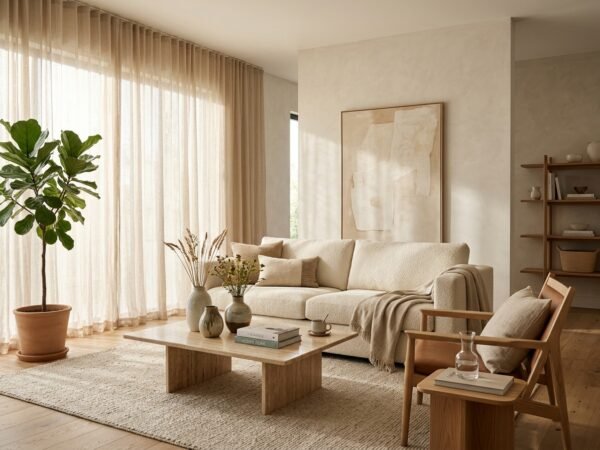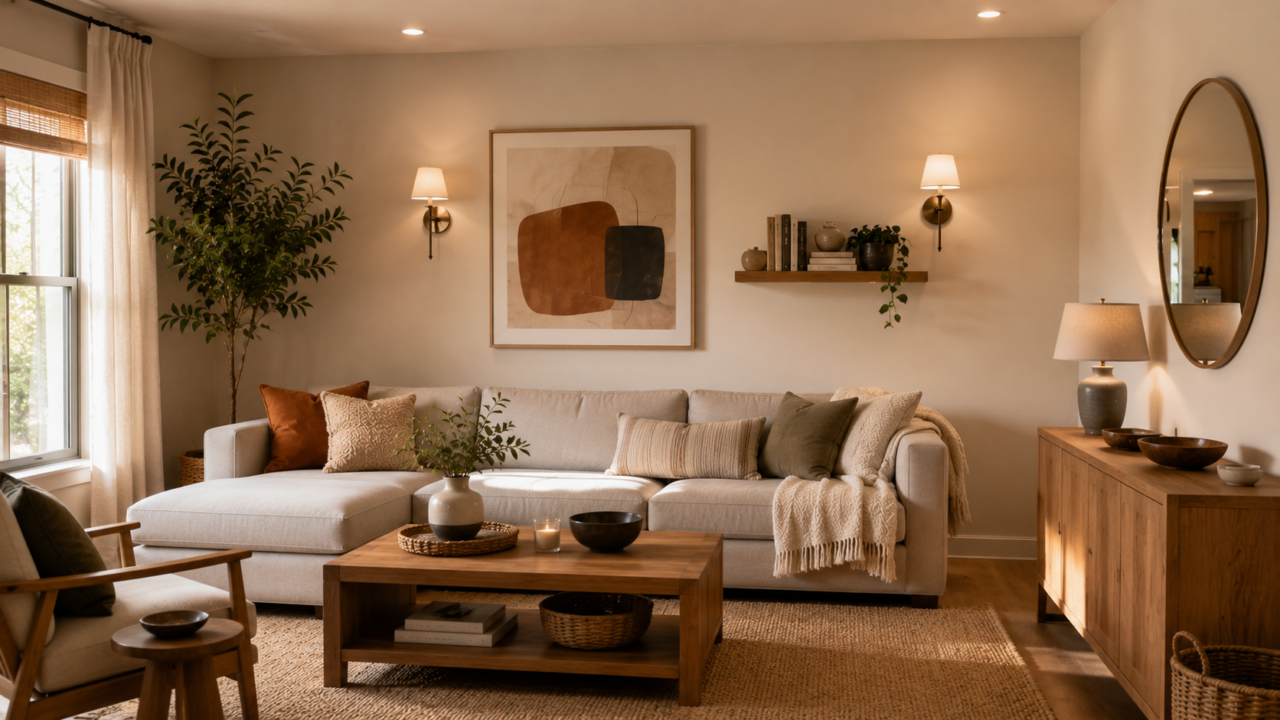
A blank living room wall can be surprisingly difficult to decorate. The problem usually isn’t a lack of available ideas. There are too many: oversized artwork, gallery walls, mirrors, floating shelves, sconces, woven pieces, wallpaper, paneling, and decorative objects can all work—but not necessarily on the same wall.
The easiest way to get a better result is to stop treating the wall as an empty rectangle that needs to be filled.
Look at the furniture around it first.
A large sofa may need one substantial piece of artwork rather than six small frames. A narrow wall beside a window may work better with a vertical mirror or wall sconce. A long, empty wall may benefit from shelving or a carefully planned gallery arrangement. In a small room, leaving part of a wall empty can actually make the space feel calmer.
Good living room wall decor supports the room’s existing proportions, colors, furniture, and function.
Before buying anything, ask:
- What is the wall’s main purpose?
- Is there furniture underneath it?
- Does the room already have a strong focal point?
- Does the wall need storage as well as decoration?
- How much visual activity is already present?
- Does the room need more color, texture, light, or simply a finished focal point?
That short assessment can prevent the most common decorating mistake: buying several attractive pieces that don’t work together.
Living Room Wall Decor Ideas That Make the Biggest Difference
1. Hang One Large Statement Artwork
One substantial painting, photograph, print, or abstract artwork can be enough to finish an entire living room wall.
This approach works particularly well above a sofa because the artwork creates a clear visual relationship with the furniture beneath it. Architectural Digest’s designers similarly emphasize the usefulness of statement art above sofas and recommend considering the artwork and sofa as connected elements rather than separate objects.
The key is scale.
An undersized frame floating over a large sofa can make both pieces look disconnected. A larger artwork usually feels more intentional when the wall and furniture can support it.
You don’t necessarily need expensive original art. A meaningful photograph, vintage print, textile, illustration, or affordable reproduction can work if its size, frame, and colors make sense with the room.
2. Build a Balanced Gallery Wall
Gallery walls are useful when you have several pieces you genuinely want to display.
They can include:
- Family photographs
- Art prints
- Botanical illustrations
- Vintage drawings
- Small paintings
- Travel memories
- Textile pieces
- Decorative plates
- Personal objects
The important part is creating a visual connection between the pieces.
That connection might come from similar frame finishes, a shared color palette, a common subject, or consistent spacing.
Architectural Digest notes that gallery walls can combine different media while still feeling cohesive when there is a common visual language.
Before putting holes in the wall, arrange the pieces on the floor. Photograph the arrangement and adjust the spacing until the overall shape feels balanced.
For a more relaxed arrangement, mix sizes and orientations. For a cleaner look, use more consistent frames and spacing.
3. Use a Large Mirror
A mirror is one of the most useful alternatives to artwork.
It adds decoration while also reflecting light and visually extending the room. This can be particularly helpful in smaller living rooms or rooms with limited natural light.
A large round mirror above a console can soften a room filled with straight lines. A rectangular mirror can reinforce the architecture of a long wall.
Don’t automatically center a mirror on the wall itself. Center it according to the furniture beneath it.
4. Add Floating Shelves
Floating shelves work when the wall needs both personality and useful display space.
Use them for a small collection rather than filling every inch.
A shelf might hold:
- A few books
- A ceramic vase
- One framed photograph
- A small plant
- A sculptural object
- A candle or decorative vessel
The empty areas matter just as much as the objects.
If every shelf is completely full, the wall begins to feel like storage rather than decoration. A few carefully selected objects usually create a stronger composition.
Shelving can also be useful in small living rooms because it takes advantage of vertical wall space without requiring another floor standing cabinet.
5. Try Wall Mounted Lighting
Wall sconces can turn a plain wall into a functional feature.
Place them beside artwork, a fireplace, a reading chair, or a console. They are especially useful when you want additional lighting without adding another floor or table lamp.
Architectural Digest highlights sconces as a way to add visual interest around artwork while also contributing additional illumination.
If you rent, plug in sconces can provide a similar visual idea without permanent electrical changes, depending on the property and installation requirements.
6. Bring in Woven or Textile Wall Decor
Not every wall needs framed artwork.
Woven baskets, textile panels, tapestries, macramé, and handmade fabric pieces can add softness to rooms dominated by hard surfaces.
This is particularly useful when the living room already contains wood, stone, glass, or metal and needs another tactile material.
A large woven piece can also work as a focal point above a sofa without introducing a highly saturated color.
7. Use Decorative Objects as Wall Art
Think beyond conventional frames.
A collection of decorative plates, vintage objects, sculptural pieces, or even carefully selected baskets can become wall decor.
The trick is repetition.
Three related objects often feel more intentional than several unrelated objects scattered around the room. You can repeat a material, color, shape, or theme to create a visual relationship.
This works particularly well in homes where the goal is a collected, personal appearance rather than a perfectly matched interior.
8. Add Architectural Detail
Sometimes the wall itself should become the decoration.
Depending on your home and budget, possibilities include:
- Pictureframe molding
- Wainscoting
- Wood slats
- Paneling
- Textured plaster
- Wallpaper
- Painted geometric shapes
- Decorative trim
Current design coverage is also moving toward more dimensional wall treatments, including textured surfaces, wood paneling, plaster, and other tactile finishes.
You don’t have to cover an entire room. One feature wall can be enough.
For a quieter look, choose a wall treatment with subtle texture rather than a high contrast pattern.
How to Decorate the Wall Above a Sofa
The wall above the sofa is often the first place people notice when something feels wrong with a living room.
A common issue is scale.
A tiny picture centered over a wide sofa can make the arrangement look unfinished. On the other hand, an oversized collection can make the seating area feel visually heavy.
As a practical starting point, artwork or a mirror above a sofa often looks more balanced when its overall width is roughly two thirds to three quarters of the sofa’s width. Architectural Digest cites approximately 60–75% as a useful proportion for art or mirrors above a sofa.
The vertical relationship matters too.
You don’t want the artwork floating several feet above the sofa. You also don’t want people brushing against it when they sit down.
A commonly recommended gap above furniture is around 6–12 inches, although the exact placement depends on the artwork, furniture height, ceiling, and overall composition.
For a sofa wall, consider:
One large artwork: Best for a simple, confident focal point.
Two or three coordinated pieces: Useful when you want symmetry without a full gallery wall.
Gallery wall: Best when you have multiple pieces and want a more collected appearance.
Large mirror: Useful when you want reflection and visual openness.
Shelf with artwork: Good when you want the flexibility to change smaller objects over time.
Living Room Wall Decor for Large Blank Walls
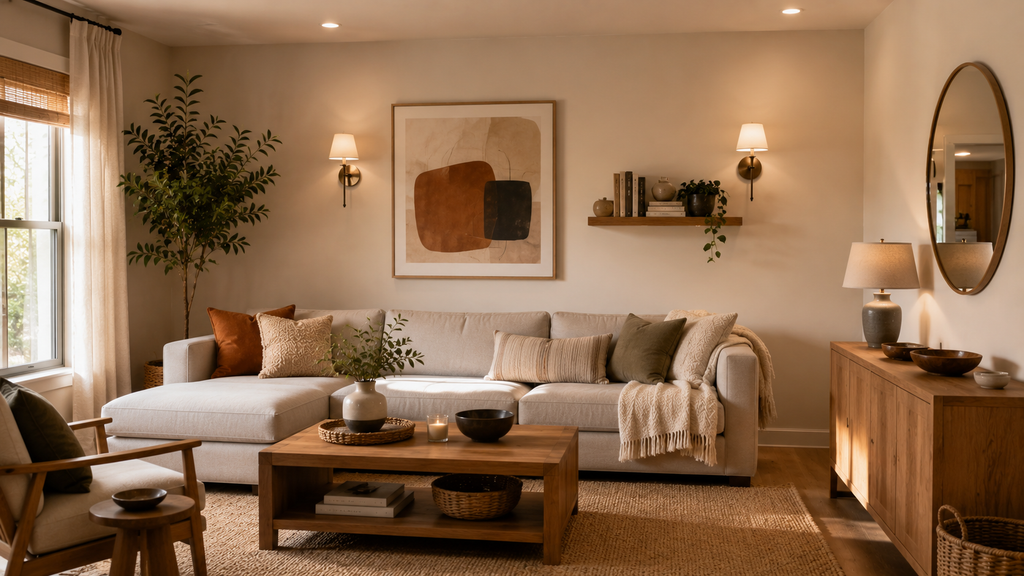
Large walls create a different problem: small decorations can disappear.
If you have a wall stretching several meters behind a sofa or across an open plan room, several strategies can work.
Use One Oversized Piece
A large painting or photograph can establish proportion without requiring dozens of accessories.
Architectural Digest’s guidance on large walls similarly emphasizes that a single large artwork can provide enough visual weight while allowing the architecture to remain visible.
Create a Horizontal Composition
For a very long wall, use several pieces arranged horizontally.
This might be:
- Three framed artworks
- A long picture ledge
- A combination of shelves and art
- A low console with artwork above it
- A sequence of matching frames
Use Furniture as Part of the Wall
A blank wall doesn’t necessarily need to be solved entirely with wall mounted objects.
A long console, low bookcase, or built in shelving can occupy the lower portion of the wall while artwork, lighting, or shelving handles the upper portion.
This creates a relationship between horizontal and vertical elements instead of leaving one enormous empty surface.
Don’t Fill the Entire Wall
Large walls benefit from breathing room.
If the rest of the living room already contains a patterned rug, colorful sofa, decorative lighting, and numerous accessories, a completely filled wall can make the room visually exhausting.
Leaving some negative space is often what makes the decorated areas feel intentional.
Small Living Room Wall Decor Ideas
Small rooms need decoration, but they don’t have to carry a lot of it.
The first priority is preserving visual space.
A large mirror can help reflect the room. Wall mounted shelves can provide display space without using floor area. Sconces can replace some table or floor lighting. A single large artwork can sometimes work better than a collection of small pieces.
For narrow rooms, consider vertical emphasis.
A tall artwork, vertical shelving arrangement, or elongated mirror can draw the eye upward without extending too far across the room.
Another useful strategy is to combine decoration with function.
For example, instead of hanging purely decorative shelves, use them for a few books and meaningful objects. Instead of adding another decorative table, install a slim wall shelf that can hold keys, a lamp, or small accessories.
The goal isn’t to make every wall useful. It’s to make sure the pieces you do add earn their space.
Use Color, Texture, and Materials to Give Walls More Depth
Wall decor doesn’t have to introduce a completely new color into the room.
Instead, look at the colors already present.
If the sofa is beige and the rug contains muted green, artwork with subtle green and warm neutral tones can connect the two.
If the furniture is mostly wood, a woven wall hanging can reinforce the natural material palette.
If the room is monochromatic, artwork can provide the main accent color.
Texture matters as well.
A room containing smooth painted walls, glass tables, polished metal, and sleek furniture may benefit from something tactile such as:
- Linen
- Woven fiber
- Natural wood
- Ceramic
- Textured paper
- Plaster
- Fabric art
Current wall design discussions increasingly emphasize tactile and natural materials rather than relying exclusively on flat painted surfaces.
You don’t need every material at once. Two or three repeated materials are usually enough to establish a visual language.
Budget Friendly Living Room Wall Decor
You don’t need a large decorating budget to improve a blank wall.
No Cost Options
Start with things you already own.
Move artwork from another room. Reframe a photograph. Rearrange bookshelves. Group existing objects into a more deliberate display.
Sometimes the biggest improvement comes from removing rather than adding.
Low Cost Options
Consider:
- Affordable art prints
- Simple frames
- Secondhand mirrors
- DIY picture ledges
- Thrifted baskets
- Repainted frames
- Personal photographs
- Fabric remnants mounted as textile art
Moderate Cost Improvements
If you have some budget, consider investing in one strong element rather than several small decorations.
For example:
- A better quality large frame
- A substantial mirror
- A statement light fixture
- A larger artwork
- A well made floating shelf
- Simple wall molding
The principle is straightforward: spend more on the element that needs to carry the visual weight.
How to Create a Gallery Wall Without Making It Look Messy
A gallery wall becomes difficult when there is no hierarchy.
Start by choosing one piece that will act as the visual anchor. It can be the largest artwork, the most colorful piece, or simply the item with the strongest personal significance.
Then build around it.
Use a shared element to connect the collection. That might be:
- Similar frame colors
- Repeated warm wood
- Black and white photography
- Botanical subjects
- Similar matting
- A limited color palette
You can still mix different artwork styles. The goal is not perfect uniformity.
Architectural Digest’s gallery wall guidance also recommends establishing a common visual language while mixing media and sizes.
Spacing should feel deliberate. Don’t place one frame almost touching another while leaving a huge gap elsewhere.
Lay the entire arrangement on the floor before hanging it. Take a photograph from a distance, because a composition that looks good close up may feel too small or too crowded once viewed from across the room.
Common Living Room Wall Decor Mistakes
Choosing Decor Before Considering Scale
A beautiful small print can still be the wrong choice for a huge wall.
Think about the wall and furniture proportions first.
Hanging Everything Too High
Artwork that floats near the ceiling creates a disconnected appearance.
Use the furniture underneath it as the reference point whenever possible.
Decorating Every Wall
A room needs quiet areas.
If every wall competes for attention, nothing becomes a focal point.
Mixing Too Many Styles
Eclectic doesn’t mean random.
Different styles can work together, but there should usually be some connection through color, material, period, shape, or subject.
Filling Shelves Completely
Open shelving requires negative space.
If every square inch contains a vase, book, frame, plant, and sculpture, the shelf loses its visual breathing room.
Ignoring Lighting
A beautifully decorated wall can disappear at night if the room has poor lighting.
Consider how daylight and evening lighting affect the artwork and wall surfaces.
Following Trends Too Literally
A wall treatment that is fashionable today may not suit your home’s architecture or your personal taste.
Current design coverage increasingly favors personalized spaces and more expressive combinations rather than rooms that look identical to a trend photograph.
Choose trends selectively.
A Simple Process for Styling Your Living Room Walls
If you’re unsure where to start, use this sequence.
1. Remove unnecessary items.
Start with a blank or simplified wall. This lets you see what the room actually needs.
2. Identify the focal point.
Decide whether the sofa, fireplace, television, window, or another feature should remain the visual anchor.
3. Choose the largest element first.
Select the artwork, mirror, shelf, or wall treatment that will establish the scale.
4. Check the furniture relationship.
Make sure the wall decor feels connected to the furniture beneath or beside it.
5. Introduce one supporting layer.
Add a smaller artwork, shelf, plant, sconce, textile, or decorative object.
6. Repeat one or two materials or colors.
This creates cohesion without making everything match.
7. Step back.
Look at the entire room rather than standing directly in front of the wall.
8. Stop before the wall feels full.
If you keep adding objects because the wall still feels “empty,” give yourself a day before buying anything else. Sometimes the negative space is exactly what the composition needs.
Final Takeaway
The best living room wall decor doesn’t simply fill empty space.
It helps establish scale, creates a focal point, introduces personality, improves lighting, adds useful storage, or gives the room texture. The right solution depends on what the wall—and the room around it—actually needs.
For one living room, that might mean a large artwork above the sofa. For another, it could be a gallery wall, a mirror, floating shelves, sconces, woven artwork, or a subtle architectural treatment.
Start with the furniture, proportions, colors, and function of the room. Then choose fewer pieces with more intention.
A decorated wall should look like it belongs to the people who live there—not like every available inch had to be filled.
FAQ
What should I put on a living room wall?
The best choice depends on the wall’s size and what furniture is nearby. Large artwork, mirrors, gallery walls, floating shelves, sconces, textiles, and architectural treatments can all work. Start by considering scale and the room’s existing colors and materials.
How do I decorate a large blank living room wall?
Use enough visual weight to relate to the wall’s size. One oversized artwork, a wide gallery arrangement, long shelving, a console with artwork, or architectural paneling can work well. You do not need to cover the entire wall.
What should I put above my sofa?
A large artwork, mirror, gallery wall, or coordinated group of smaller pieces are common choices. The overall arrangement should relate to the sofa’s width and should not sit excessively high above it. A useful starting point is roughly 60–75% of the sofa’s width for artwork or a mirror.
How do I make a gallery wall look organized?
Choose a visual connection between the pieces, such as similar frames, colors, subjects, or materials. Plan the arrangement on the floor first and maintain intentional spacing between frames.
What can I use instead of wall art?
Consider mirrors, floating shelves, woven baskets, textiles, wall mounted lighting, decorative plates, architectural molding, wallpaper, wood paneling, or sculptural objects.
How can I decorate living room walls on a budget?
Start with items you already own. Rearrange existing artwork, reframe photographs, use secondhand mirrors or frames, create simple picture ledges, or turn fabric and personal objects into wall displays.
Should every living room wall be decorated?
No. Leaving some walls relatively quiet can improve visual balance. A room with several decorated surfaces often benefits from negative space elsewhere.
How high should artwork be hung above furniture?
There is no single measurement that works for every room, but a gap of roughly 6–12 inches between furniture and artwork is a useful starting point. Adjust based on the furniture, artwork size, ceiling height, and overall composition.