A kitchen can be perfectly functional and still feel unfinished.
The cabinets work. The appliances work. There is enough counter space to prepare dinner. Yet the room may lack warmth, personality, or a clear visual direction.
That is where thoughtful kitchen decor ideas can make a difference.
You do not necessarily need new cabinets, expensive countertops, or a complete renovation. A kitchen can look noticeably better through smaller changes: replacing dated hardware, adding a runner, improving lighting, introducing artwork, styling a shelf, or giving everyday objects a deliberate place.
The important distinction is that kitchen decor has to coexist with cooking, cleaning, storage, and everyday traffic.
The best looking kitchen is not the one with the most decoration. It is the one where useful and decorative elements work together.
Start With the Kitchen You Already Have
Before buying anything, look at the kitchen as it exists.
Identify the elements that are staying:
- Cabinet color and style
- Countertop material
- Flooring
- Backsplash
- Appliances
- Lighting
- Dining furniture
- Available wall space
- Open shelving
- Existing storage
Then decide what actually feels wrong.
If the cabinets are fine but the room feels dated, hardware and lighting may be enough.
If the walls feel empty, artwork or a carefully selected display may solve the problem.
If the counters feel chaotic, the answer may be organization rather than decoration.
This approach prevents a common mistake: buying decorative accessories before understanding what the room needs.
Current kitchen design is also moving toward spaces that feel more connected to the rest of the home, with warmer materials, expressive details, furniture like elements, and decorative touches that make kitchens feel less purely utilitarian.
Kitchen Decor Ideas That Make the Biggest Visual Difference
Refresh Cabinet Hardware
Changing cabinet knobs or pulls is one of the simpler ways to alter the character of a kitchen.
The hardware acts almost like jewelry for the cabinetry, so its shape, finish, and scale affect the overall appearance.
For a quieter kitchen, choose simple hardware with a finish that relates to existing fixtures.
For a more traditional space, cup pulls or classic knobs may work better.
For a contemporary kitchen, streamlined pulls can reinforce the clean geometry of the cabinets.
Before buying anything, check the existing hole spacing if you are replacing pulls. Choosing hardware that fits the existing installation can make the project much simpler.
Also consider the other metals in the room. You do not necessarily need every finish to match perfectly, but several unrelated finishes can make a small kitchen feel visually disjointed.
Add a Kitchen Runner
A runner can introduce softness and color to a kitchen dominated by hard surfaces.
It works particularly well in:
- Long galley kitchens
- Kitchens with an island
- Areas between the sink and cabinets
- Transitional spaces between the kitchen and dining area
Choose the size based on the actual walking area rather than buying a rug simply because you like its pattern.
A subtle pattern can be practical in a busy household because it is generally more forgiving visually than a completely plain surface.
If the runner tends to move, prioritize a suitable non slip solution and follow the flooring and rug manufacturer’s guidance.
Use Artwork Instead of Generic Kitchen Signs
Not every piece of kitchen wall art needs to say “EAT,” “COFFEE,” or “BAKERY.”
Artwork that is not specifically about food can make the kitchen feel more like part of the home.
Consider:
- Abstract prints
- Botanical artwork
- Vintage inspired illustrations
- Framed photography
- Small paintings
- Textile pieces
- Family photographs
- Graphic prints
Choose artwork according to the wall’s scale.
A small print can disappear above a large cabinet run, while an oversized piece can overwhelm a narrow wall.
If the kitchen already has strong backsplash pattern or colorful cabinetry, quieter artwork may create better balance.
Style Open Shelves Carefully
Open shelves can make a kitchen feel lighter and provide an opportunity to display attractive everyday items.
But they also expose everything.
A useful approach is to combine practical items with a few decorative pieces:
- Everyday plates
- Bowls
- Mugs
- Glassware
- Cookbooks
- Ceramic vessels
- Small plants
Avoid treating every shelf as a display cabinet.
Leave some empty space.
Recent designer guidance similarly emphasizes that open shelving works best when the objects share some visual relationship in color, material, or purpose rather than becoming a collection of unrelated items.
If you dislike regularly restyling shelves, closed cabinets may be the better solution.
Add Warmth With Wood and Natural Materials
Kitchens contain many hard surfaces: stone, tile, glass, metal, and cabinetry.
Introducing natural materials can soften the overall appearance.
Consider:
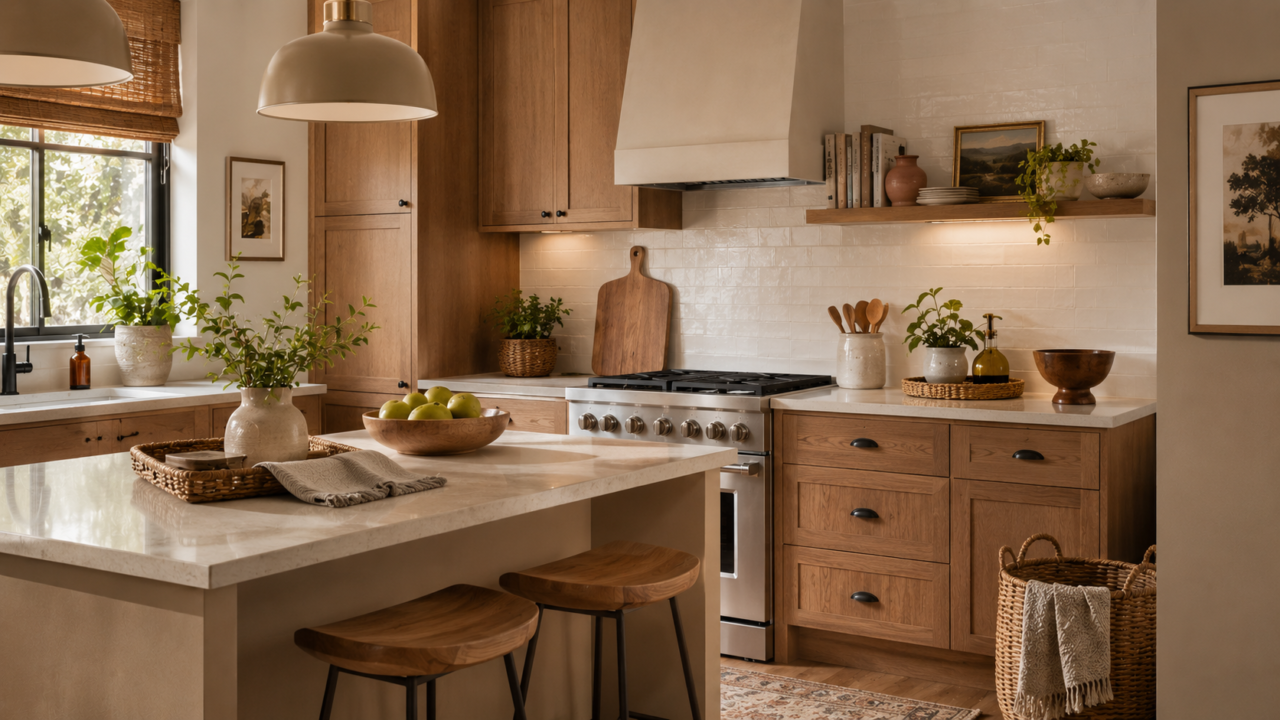
- Wooden cutting boards
- A wood stool
- Woven baskets
- Rattan or cane details
- Linen textiles
- Ceramic vessels
- Wooden serving boards
These materials do not need to be everywhere.
One or two repeated natural textures can be enough to connect different parts of the room.
Improve the Lighting
Lighting deserves more attention than it usually receives in kitchen decorating.
A single ceiling fixture may provide general illumination but leave work surfaces poorly lit or make the kitchen feel flat at night.
A more flexible approach uses different layers:
- Ambient lighting for general illumination
- Task lighting where food preparation and other work takes place
- Accent lighting to highlight artwork, shelving, architectural details, or decorative areas
The U.S. Department of Energy’s residential lighting guidance describes ambient, task, and accent lighting as distinct functions, while its kitchen guidance specifically recommends positioning overhead and under cabinet fixtures to reduce shadows over work areas.
Under cabinet lighting can therefore be both a practical improvement and a decorative one.
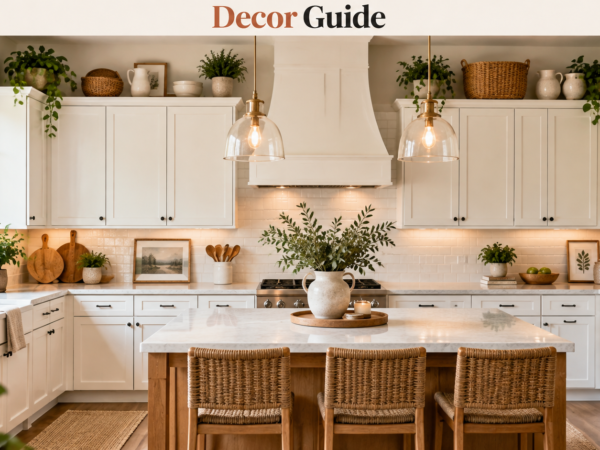
Pendant lights over an island or dining area can also introduce shape and personality without adding objects to the countertop.
Create a Useful Countertop Display
Countertops should remain usable.
Instead of decorating every available section, create one or two intentional groupings.
For example, a corner might contain:
- A wooden board
- A ceramic container
- A small plant
- A bowl
Another area might contain a coffee setup with the items you genuinely use.
The key is to decorate around real routines.
If you cook frequently, leave preparation space clear.
If an appliance is used every morning, its position should reflect that rather than being hidden solely for appearance.
Bring in Greenery
Plants can add life to a kitchen without requiring a major design change.
Depending on available light and your ability to maintain plants, consider a small herb planter, a compact potted plant, or a larger plant placed away from cooking areas.
Greenery can also help break up long stretches of cabinetry.
Avoid placing plants where they interfere with food preparation, heat, water, or normal movement.
Use a Decorative Tray
A tray can turn several unrelated countertop objects into one visual grouping.
For example, a tray might hold:
- Olive oil
- Salt and pepper
- A small utensil container
Or it could create a coffee station with mugs and a sugar bowl.
The advantage is not that trays magically organize everything. It is that they establish a visual boundary.
When the objects are contained within one area, the countertop can look more intentional.
Give the Island or Dining Area More Personality
If your kitchen has an island, stools are an important part of the visual composition.
Rather than choosing stools independently of the room, consider how their:
- Shape
- Height
- Material
- Color
- Back style
relate to the cabinets, flooring, lighting, and surrounding furniture.
Current kitchen design is also seeing more islands treated as furniture rather than purely as built in work surfaces, including more sculptural shapes, mixed materials, and furniture like pieces.
You do not need a dramatic custom island to use the idea.
Even changing stools or adding a simple centerpiece can make the island feel more intentional.
Kitchen Wall Decor Ideas
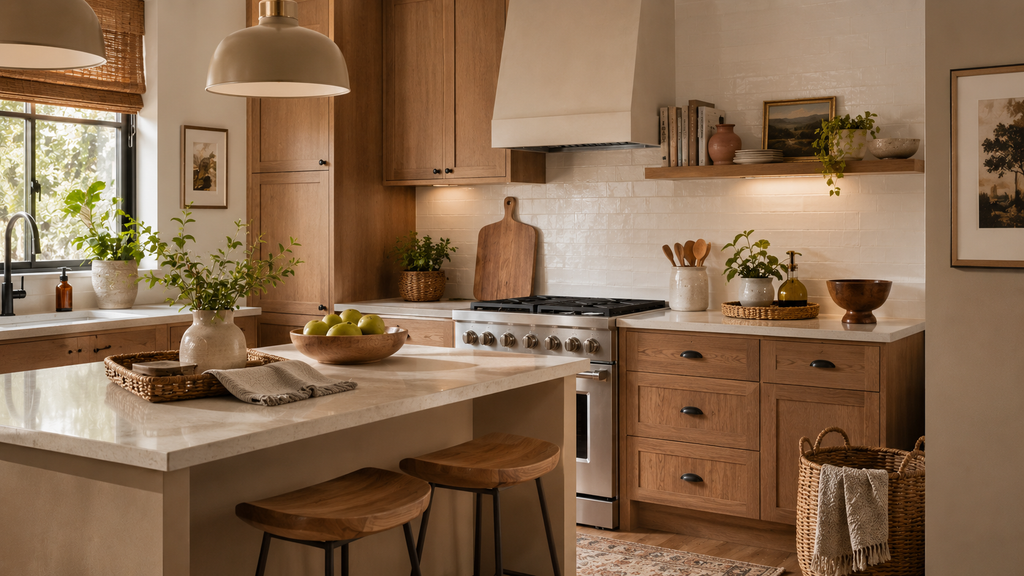
Walls are often underused in kitchens.
The best wall for decoration is usually one that does not compete with cabinets, windows, doors, or important work areas.
Good possibilities include:
A Large Artwork
One larger piece can provide a stronger visual anchor than several tiny prints.
A Small Gallery Arrangement
Use a small group of related frames rather than filling the entire wall.
Repeating one element—such as frame color or artwork style—helps the collection feel intentional.
A Decorative Mirror
A mirror can work in an appropriate location where it will not create awkward reflections or interfere with cooking.
A Narrow Display Shelf
A shallow shelf can hold a few books, ceramics, or framed pieces without requiring a large furniture installation.
A Textile or Woven Piece
Textiles can introduce softness into a room dominated by cabinetry and hard surfaces.
Choose placement carefully because kitchens are exposed to heat, moisture, grease, and food splashes.
Kitchen Countertop Decor Without Creating Clutter
Countertop styling is where many otherwise attractive kitchens go wrong.
The easiest rule is to decorate the areas that are not needed for active work.
Start by removing everything that does not belong on the counter.
Then group what remains into functional zones.
For example:
Coffee zone:
Machine, mugs, coffee container, and one small decorative object.
Cooking zone:
Frequently used oils, utensils, or cutting boards.
Display zone:
A bowl, plant, artwork, or ceramic vessel.
This approach creates visual order without pretending the kitchen is never used.
A clear counter is also valuable because clutter often comes from things that lack a designated home. If the same objects repeatedly accumulate in one area, the problem may be storage rather than styling.
Small Kitchen Decor Ideas
Small kitchens require more discipline because every decorative object competes with functional space.
Start with vertical and underused areas.
A narrow wall can accommodate a small shelf.
The side of a cabinet may provide space for a carefully selected wall mounted solution.
A small section of countertop can become a deliberate coffee or breakfast station instead of collecting unrelated objects.
Choose decor that performs more than one role when possible.
Examples include:
- Attractive storage jars
- A wooden cutting board that can also be displayed
- A stylish wall rail for frequently used utensils
- A stool that provides seating and can be moved when needed
- A decorative tray that contains everyday items
Avoid adding storage products simply because the kitchen is small. If a storage solution creates another obstacle or makes the room visually busier, it may not be solving the right problem.
In compact kitchens, accessibility matters as much as capacity.
Budget Friendly Kitchen Decor Ideas
You can make meaningful changes without remodeling the room.
No Cost Changes
Start here.
- Remove unnecessary countertop objects
- Rearrange existing decor
- Restyle open shelves
- Move artwork from another room
- Group similar items together
- Clear the refrigerator door
- Reconsider where appliances are stored
- Remove decorative pieces that no longer suit the space
Sometimes the kitchen improves simply because the strongest elements become easier to see.
Low Cost Changes
Consider:
- New cabinet hardware
- Tea towels
- A runner
- Small artwork
- A plant
- Baskets
- Ceramic containers
- Shelf brackets
- A decorative tray
Moderate Improvements
If the budget allows, consider:
- New pendant lighting
- Under cabinet lighting
- A new faucet
- Fresh wall paint
- Updated stools
- A larger piece of artwork
Larger Investments
For a substantial renovation, prioritize elements that affect both function and appearance:
- Cabinetry
- Countertops
- Lighting infrastructure
- Flooring
- Backsplash
- Island design
- Storage systems
Do not spend heavily on decorative accessories while fundamental problems with layout, lighting, or storage remain unresolved.
How to Decorate a Kitchen Without Making It Look Cluttered
The simplest method is to create visual hierarchy.
Choose one or two things that should attract attention.
Everything else should support them.
For example, if the backsplash is strongly patterned, keep countertop decor relatively restrained.
If the cabinets are a bold color, artwork can be quieter.
If a sculptural pendant is the main feature, there may be no need for an elaborate shelf display directly beneath it.
Negative space matters too.
An empty section of countertop or wall is not necessarily unfinished. It can give the eye a place to rest.
Current designer guidance similarly emphasizes preserving visual breathing room, using meaningful artwork, and reducing unnecessary countertop clutter.
Common Kitchen Decorating Mistakes
Decorating Every Surface
A kitchen needs working space. Empty counters are useful, not wasted opportunities.
Buying Decor Before Solving Storage Problems
If the kitchen is overflowing with objects, another basket may simply hide the symptoms temporarily.
Using Too Many Finishes
Mixing wood, brass, black metal, colorful tile, patterned textiles, and several unrelated colors can make a small room feel fragmented.
Overloading Open Shelves
Open storage requires editing. If every shelf is full, the kitchen may look busier rather than more spacious.
Choosing Decor That Interferes With Cooking
A beautiful object that gets moved every time you prepare dinner is probably in the wrong location.
Following Trends Too Literally
Trends can provide inspiration, but your kitchen still needs to suit the home’s architecture and the people using it.
Design coverage for 2026 shows considerable interest in expressive details, traditional touches, texture, furniture-like islands, and kitchens that feel connected to living spaces. These are useful sources of inspiration, but they are not requirements for a successful kitchen.
How to Combine Different Materials, Colors, and Finishes
A kitchen does not need everything to match.
It needs relationships between elements.
One practical approach is to repeat a few materials.
For example:
- Wood cutting boards
- Wooden stools
- Woven basket
create a subtle material connection.
Or:
- Black cabinet hardware
- Black pendant fixtures
- Black picture frames
can create visual repetition.
Color works similarly.
A muted green plant, green artwork detail, and green textile can feel more deliberate than three completely unrelated accent colors.
The goal is not perfect matching.
It is repetition without monotony.
A Simple Kitchen Decorating Plan
If you are unsure where to start, work in this order.
First: Remove.
Take unnecessary objects off counters, shelves, and walls.
Second: Fix the functional problems.
Determine whether poor storage, awkward lighting, or difficult workflow is contributing to the mess.
Third: Choose the visual focal point.
This might be artwork, lighting, cabinetry, an island, or a backsplash.
Fourth: Add one layer of warmth.
Use wood, textiles, plants, ceramics, or another natural texture.
Fifth: Style the useful areas.
Keep frequently used objects accessible while grouping them deliberately.
Sixth: Stop before the room feels full.
You can always add something later. Removing unnecessary purchases is harder.
This sequence is more reliable than starting with a shopping list.
Final Takeaway
Good kitchen decor does not compete with the kitchen’s job.
It works around it.
Start by understanding what your room actually needs. Clear unnecessary visual noise, improve the lighting where useful, introduce a few materials that add warmth, and give the most important wall or surface a clear focal point.
Then choose decorative pieces that belong naturally in the space.
A kitchen can have artwork, plants, books, baskets, ceramics, textiles, and attractive everyday objects without becoming cluttered. The difference is thoughtful placement and restraint.
The strongest kitchen decorating ideas are often surprisingly simple: one good light, one well chosen piece of artwork, better hardware, a useful display, a little texture, and enough empty space to let the room breathe.
FAQ
How can I decorate my kitchen without remodeling it?
Start with removable or low disruption changes such as cabinet hardware, artwork, runners, lighting, plants, textiles, countertop styling, and shelf arrangements. These can change the room’s appearance without replacing the major kitchen elements.
What should I put on my kitchen countertops for decoration?
Use a small number of objects that either serve a purpose or add meaningful visual interest. A tray, wooden board, plant, ceramic vessel, fruit bowl, or coffee station can work well. Keep the main food preparation areas clear.
How do I make a small kitchen look nicer?
Reduce visual clutter first, then use vertical space, simple artwork, appropriate lighting, coordinated materials, and a few multipurpose decorative pieces. Avoid filling every available surface.
What are some kitchen decor ideas on a budget?
Rearrange existing objects, restyle shelves, remove unnecessary items, update cabinet hardware, add a runner, introduce a plant, display artwork, or change inexpensive textiles. These often create a larger visual difference than buying many small accessories.
Should kitchen shelves be open or closed?
Neither is universally better. Open shelves are useful for attractive items and frequently used dishes but require more visual maintenance. Closed cabinets are better for categories that tend to look messy or need to be stored out of sight.
How do I decorate kitchen walls?
Choose artwork, a small gallery arrangement, a mirror, a narrow shelf, or a suitable textile based on the wall’s size and its relationship to cabinets and windows. One appropriately scaled piece is often stronger than many small decorations.
What colors work well for kitchen decor?
The best color depends on the existing cabinets, flooring, countertops, lighting, and architecture. Warm neutrals, natural wood tones, muted greens, blues, and earthy shades can all work, but the goal should be a cohesive palette rather than following a fixed color trend.
How do I make my kitchen feel cozy?
Use warm or layered lighting, natural materials, textiles, artwork, plants, wood, and a few personal objects. Cozy does not require filling the kitchen with decorations; texture and lighting can provide warmth without creating clutter.