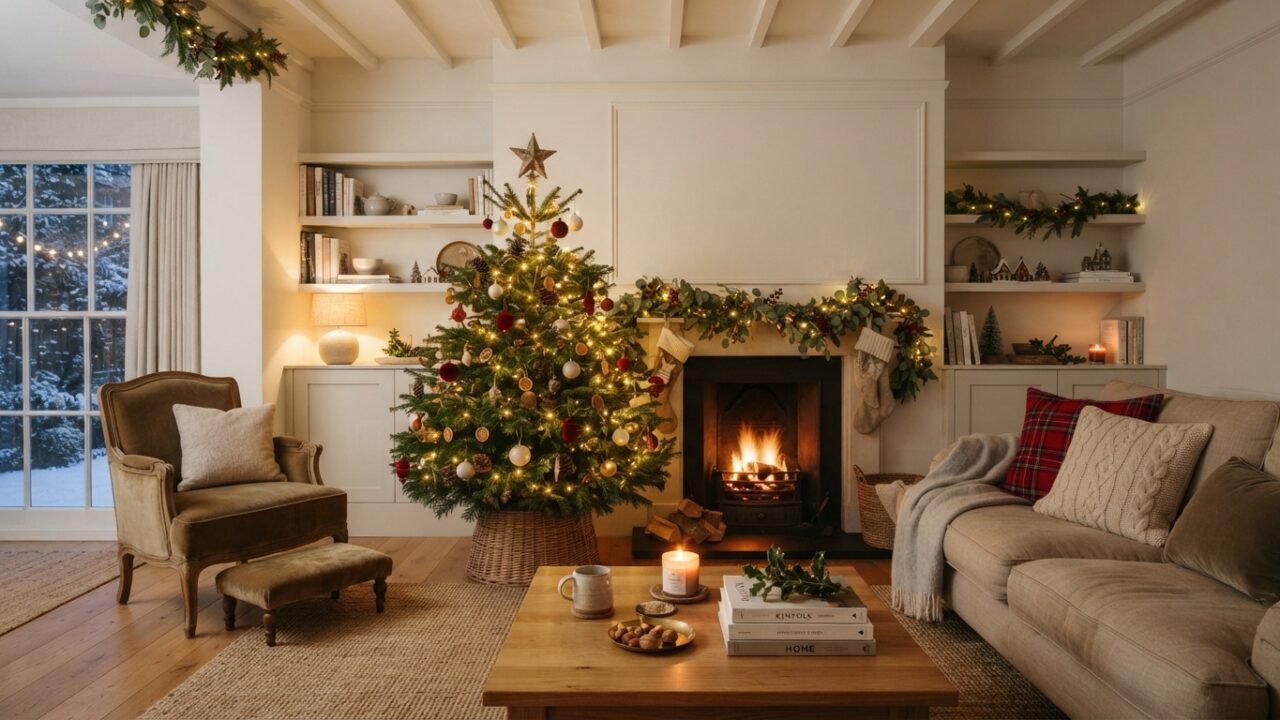
The best decorating ideas living room for Christmas start with the space you already have. Begin by choosing a simple color palette, clear unnecessary items, and create one main Christmas focal point. Then layer in greenery, warm lighting, pillows, throws, ornaments, and a few personal decorations. If your living room is small, use vertical surfaces, the mantel, shelves, windows, and the coffee table instead of filling every open area. The goal is not to add as many decorations as possible. It is to make the room feel festive while keeping it comfortable and easy to use.
1. Start With the Living Room Before Decorating
Before bringing out the Christmas boxes, look at the room as it is.
Remove everyday items that you do not need during the holiday season. This could include decorative objects on shelves, extra cushions, tabletop accessories, or anything that makes the room feel visually busy.
You do not necessarily need more space. You often need fewer competing items.
Walk around the room and identify:
- The main seating area
- The television or entertainment unit
- The coffee table
- Shelves or bookcases
- Windows
- Doorways
- Fireplace or mantel, if you have one
- Empty wall space
- Corners that could hold a tree or floor decoration
This gives you a decorating map.
Choose one main focal point
Most living rooms look better when one Christmas feature gets the most attention.
That could be:
- A Christmas tree
- A decorated mantel
- A large window
- A Christmas display on an entertainment unit
- A decorated console table
Once you choose the focal point, the rest of the room can support it instead of competing with it.
For example, if the Christmas tree is the main feature, you can keep the coffee table and shelves relatively simple.
2. Choose a Christmas Color Scheme
A color scheme helps different decorations look like they belong together.
You do not need to replace all your existing decor. Instead, choose two or three Christmas colors that work with the room.
Classic red and green
Red and green create a traditional Christmas look.
Use red through:
- Cushions
- Ribbons
- Small ornaments
- Stockings
- Throws
Keep larger furniture and everyday pieces in their existing colors.
Neutral Christmas
For a calmer living room, use:
- White
- Cream
- Beige
- Natural wood
- Soft green
This works especially well when the room already has neutral furniture.
Metallic accents
Gold, silver, or other metallic details can add a more decorative feel.
Use them as accents rather than covering the entire room. A few ornaments, candle holders, ribbons, or small decorative objects can be enough.
A simple rule for mixed decor
If you already own many Christmas decorations in different colors, group similar colors together instead of spreading everything randomly around the room.
This makes the collection look more intentional.
3. Decorate the Christmas Tree First
If you have a Christmas tree, make it the starting point for the rest of the room.
The tree usually has more visual weight than individual decorations, so it can establish the overall style.
Start with the lights if you use them. Then add larger ornaments before filling smaller gaps.
A useful decorating sequence is:
- Position the tree.
- Check that it does not block walking paths.
- Add lights.
- Add larger ornaments.
- Add medium and small ornaments.
- Add ribbon or garland if desired.
- Finish with a tree topper.
- Step back and check the balance.
Do not decorate only the front if the tree is visible from several sides.
Keep the tree connected to the room
Repeat one or two colors from the tree somewhere else.
For example, if the tree has green and gold decorations, a small gold detail on the coffee table or shelf can connect the room without making everything match exactly.
4. Add Greenery Around the Room
Greenery can make a living room feel festive without requiring a large collection of Christmas objects.
Depending on your space, you can use:
- Garlands
- Wreaths
- Small branches
- Potted greenery
- Artificial Christmas foliage
Place greenery where it naturally fits.
A garland can work on a mantel, shelf, console, or media unit. A wreath can become a wall or window focal point.
Avoid putting greenery everywhere
This is a common mistake.
If every shelf, table, window, and corner contains greenery, the room can quickly become crowded.
Instead, choose a few locations and leave some surfaces clear.
That contrast gives the decorations more impact.
5. Make the Fireplace or Mantel a Christmas Feature
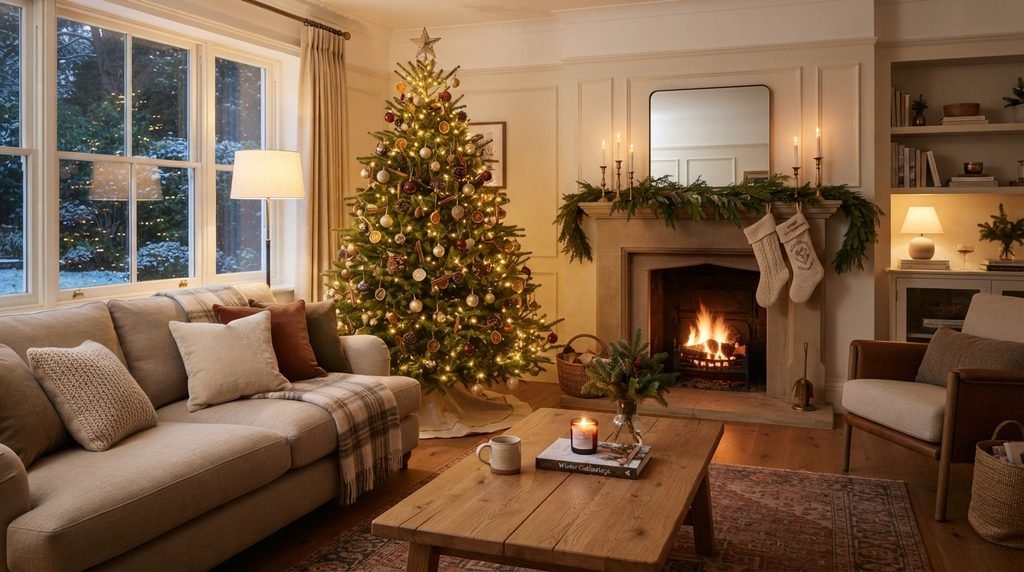
If your living room has a fireplace, the mantel is an obvious place for holiday decorating.
Start with one long piece such as a garland. Then add a few objects of different heights.
You could use:
- Candles
- Small trees
- Stockings
- A wreath
- Decorative houses
- Christmas ornaments
- A framed seasonal print
Do not fill every inch.
Leave some breathing room between groups of decorations. A mantel generally looks more organized when objects are arranged in small groups rather than placed at equal intervals.
No fireplace? Use a substitute focal point
You can create a similar effect on:
- A console table
- TV unit
- Floating shelf
- Bookcase
- Sideboard
The important part is creating a horizontal Christmas display rather than copying a fireplace exactly.
6. Use Christmas Lighting to Change the Mood
Lighting can make a major difference in a living room at Christmas.
If your main room lighting is bright, decorative lights can add a softer evening atmosphere.
Consider:
- String lights
- Battery powered lights
- Lanterns
- Table lamps
- Candles where appropriate
Place lights around the main areas rather than randomly throughout the room.
For example, lights around a mantel or tree can establish a warm focal point while normal room lighting keeps the space functional.
Always follow the manufacturer’s safety instructions for decorative electrical lighting and candles.
7. Make the Sofa Part of the Christmas Decor
Your sofa takes up a large visual area, so small changes can make the whole room feel more festive.
Instead of replacing your normal cushions, add a few seasonal pieces.
Good options include:
- Christmas patterned cushions
- Red or green cushions
- Neutral winter textures
- A festive throw
- Plaid accents
- Soft knitted textiles
The key is balance.
If the sofa already has several cushions, adding many more can make it uncomfortable. Swap some everyday covers for Christmas ones instead.
Layer the throw naturally
A Christmas throw does not have to be perfectly folded.
Place it over an arm or across part of the sofa where people can easily reach it.
The decoration should still support everyday living.
8. Decorate the Coffee Table Without Losing Usable Space
Coffee tables are easy to overdecorate.
You still need room for drinks, books, remotes, and everyday activities.
A simple Christmas coffee table arrangement could include:
- A tray
- A small vase or greenery
- A candle
- A few ornaments
- A seasonal book
A tray is useful because you can move the entire arrangement when you need the table.
For homes with children or pets, keep fragile or potentially unsafe decorations out of easy reach.
9. Use Shelves for Small Christmas Displays
Shelves are particularly useful when floor space is limited.
Instead of filling each shelf with Christmas decorations, replace selected everyday items with seasonal pieces.
For example:
Shelf 1: Books + small greenery
Shelf 2: Small Christmas trees + neutral decor
Shelf 3: Everyday objects + one seasonal ornament
This approach keeps the room connected to your normal style.
Create height variation
A shelf display can look flat when everything is the same height.
Mix:
- Tall objects
- Medium objects
- Small objects
- Horizontal items
You can also stack a few books to raise a small decoration.
10. Decorate the Windows
Windows are often forgotten during Christmas decorating.
Depending on the room, you could add:
- A simple wreath
- Small hanging ornaments
- String lights
- Seasonal greenery
Keep window decorations light enough that they do not interfere with opening, closing, cleaning, or normal use of the window.
For a small room, window decorating can be especially useful because it adds festive detail without taking floor space.
11. Bring Christmas Into Empty Corners
An empty corner does not always need a large decoration.
Depending on the size of the space, consider:
- A small Christmas tree
- A basket with greenery
- A floor lantern
- A decorative chair with a throw
- A narrow Christmas display
If the corner is part of a walking path, keep the decoration compact.
A beautiful corner decoration is not useful if everyone has to walk around it.
12. Use Vertical Space in a Small Living Room
Small living rooms need a different decorating strategy.
The floor is valuable, so look upward.
Use:
- Walls
- Shelves
- Windows
- Door frames
- Tall furniture
- Vertical tree shapes
A slim Christmas tree can provide the traditional focal point while taking less floor space than a wide tree.
Wall mounted wreaths and lightweight decorations can also create visual interest without taking furniture space.
Keep the floor visually open
Avoid adding small decorative objects to every available surface.
Instead, concentrate decoration in a few vertical areas.
This makes the room feel more organized and gives the eye clear places to rest.
13. Choose Open or Closed Storage for Christmas Decor
Christmas decorations need storage before and after the season.
If you have open shelves, they make frequently used decorations easy to see and access. However, open storage also shows visual clutter.
Closed storage keeps decorations hidden when they are not needed and can make a small living room look cleaner.
For holiday storage:
Open storage works well for:
- Attractive baskets
- Decorative boxes
- Frequently used items
Closed storage works well for:
- Extra ornaments
- Lights
- Wrapping supplies
- Seasonal accessories
Choose based on what needs to be stored rather than buying storage first.
14. Add Personal Christmas Decorations
A living room should not look like a generic showroom.
Use decorations that have meaning to your household.
These might include:
- Handmade ornaments
- Family Christmas photos
- Children’s artwork
- Older ornaments
- Travel souvenirs used as seasonal decorations
- Handmade stockings
Mixing personal pieces with newer decorations gives the room more character.
You also do not need to display every sentimental item at once. Rotate collections from year to year if you have a large amount.
15. Create a Christmas Reading or Relaxing Corner
If you have an unused chair or small corner, turn it into a simple seasonal area.
Add:
- A comfortable throw
- One cushion
- A small side table
- A lamp
- A small Christmas decoration
This is especially useful in larger living rooms where one area feels disconnected from the main seating arrangement.
In a small living room, however, avoid adding furniture just for decoration.
Use a space that already exists.
16. Christmas Decorating Ideas on a Budget
You do not need a large shopping list to change the room.
Free
Start with what you already own.
Try:
- Rearranging existing decor
- Moving greenery from another room
- Displaying existing ornaments differently
- Creating a new shelf arrangement
- Using existing baskets and trays
- Removing unnecessary everyday decorations
Sometimes removing items creates more impact than adding them.
Low cost
Focus on small changes:
- Seasonal cushion covers
- Ribbon
- Simple greenery
- Small ornaments
- A festive table runner
- DIY paper decorations
Choose pieces that can be reused in different arrangements.
Higher cost
If you want to invest in Christmas decor, prioritize pieces that establish the overall look.
For example:
- A quality artificial tree
- A reusable garland
- Durable storage containers
- A statement wreath
- Long lasting decorative lighting
Buy according to the space you have. A large statement piece can be more useful than many small decorations.
17. A Simple Step by Step Decorating Method
If you are not sure where to begin, follow this order.
Step 1: Declutter
Remove everyday objects that you do not need.
Step 2: Choose the focal point
Usually the tree, mantel, or main display.
Step 3: Pick your colors
Choose a small palette that works with the existing room.
Step 4: Add lighting
Place Christmas lights around the main focal point.
Step 5: Add greenery
Use garlands, wreaths, or small greenery in selected areas.
Step 6: Decorate the sofa
Swap in seasonal cushions or add one festive throw.
Step 7: Style surfaces
Decorate the coffee table, shelves, console, or media unit.
Step 8: Add personal pieces
Bring in sentimental ornaments and family decorations.
Step 9: Check the walking space
Make sure decorations do not block doors, windows, walkways, or seating.
Step 10: Remove one or two unnecessary items
This final step is surprisingly useful. If something makes the room feel crowded, take it away.
18. Common Christmas Decorating Mistakes
Decorating every surface
A room can become visually noisy when every shelf and table has decorations.
Better approach: Leave some surfaces intentionally empty.
Using too many colors
A mixture of red, green, gold, silver, blue, white, and other colors can make the room feel disconnected.
Better approach: Choose a simple palette and repeat it.
Ignoring the existing furniture
Christmas decor should work with your sofa, rug, curtains, walls, and other permanent pieces.
Better approach: Use your existing room as the foundation.
Blocking movement
Large baskets, trees, and floor decorations can interfere with walking paths.
Better approach: Map the main routes through the room before placing large decorations.
Buying before measuring
A decoration may look attractive online but overwhelm your room.
Better approach: Check the available space before buying anything.
Making everything perfectly symmetrical
Christmas decorating does not need to look mathematically balanced.
Better approach: Use visual balance through different heights, textures, and groups.
19. How to Keep the Room Organized During Christmas
Christmas decorating can create clutter because new items enter the room while normal items remain.
Use a simple swap system.
When you add a Christmas cushion, remove one everyday cushion.
When you decorate a shelf, store one everyday object.
When you add a table display, move the existing accessories somewhere else.
Keep Christmas decorations together when they are not being used.
At the end of the season, pack decorations by category rather than throwing everything into one box.
For example:
- Tree ornaments
- Lights
- Garlands
- Table decorations
- Textile covers
- Outdoor items
This makes next year’s decorating easier.
20. Small Space Christmas Decorating Checklist
For a compact living room, focus on decoration that adds visual impact without taking much floor space.
Use:
- A slim tree
- Wall wreaths
- Shelf displays
- Window decorations
- Vertical greenery
- Small tabletop arrangements
- Seasonal cushion covers
- A single festive throw
- Warm decorative lighting
Avoid filling every corner.
A small living room usually benefits from fewer, larger visual moments rather than dozens of tiny decorations.
21. Final Christmas Living Room Check
Before you finish, stand at the entrance and look at the entire room.
Ask:
- What do I notice first?
- Does the Christmas tree or main display feel like the focal point?
- Are the colors connected?
- Can people move comfortably?
- Is the sofa still comfortable?
- Are important surfaces still usable?
- Does the room feel festive without feeling crowded?
- Are fragile decorations placed safely?
- Are the decorations consistent with the room’s existing style?
If the answer to most of these questions is yes, stop decorating.
You do not need to keep adding things.
The strongest Christmas living rooms usually have a clear focal point, a consistent color story, comfortable seating, useful surfaces, and enough empty space to let the decorations stand out.
FAQs
What is the easiest way to decorate a living room for Christmas?
Start with the Christmas tree or another main focal point. Then add greenery, lighting, seasonal textiles, and a few decorations around the room. Remove some everyday decor first so the Christmas pieces have space.
How can I make a small living room look festive without making it crowded?
Use vertical space instead of adding more floor decorations. A slim tree, wall wreath, shelf decorations, window lights, and a few seasonal textiles can create a Christmas look while preserving walking space.
Should Christmas decorations match the living room?
They do not need to match perfectly. However, repeating one or two colors from your existing furniture or room decor can make the Christmas decorations feel more connected.
How can I decorate for Christmas if I do not have a fireplace?
Use a console, media unit, bookcase, floating shelf, or sideboard as your main horizontal display. Add greenery, lights, stockings, ornaments, or other seasonal pieces to create a similar focal area.
How do I decorate a living room when I have a lot of Christmas decorations?
Do not display everything at once. Choose the pieces that fit your current color scheme and room layout, then store the rest for another year. Rotating decorations also keeps the room easier to manage.
What should I do with Christmas decorations after the holidays?
Group them by type and store them in clearly labeled containers. Keeping ornaments, lights, greenery, and tabletop decorations separate makes them easier to find when you decorate again.