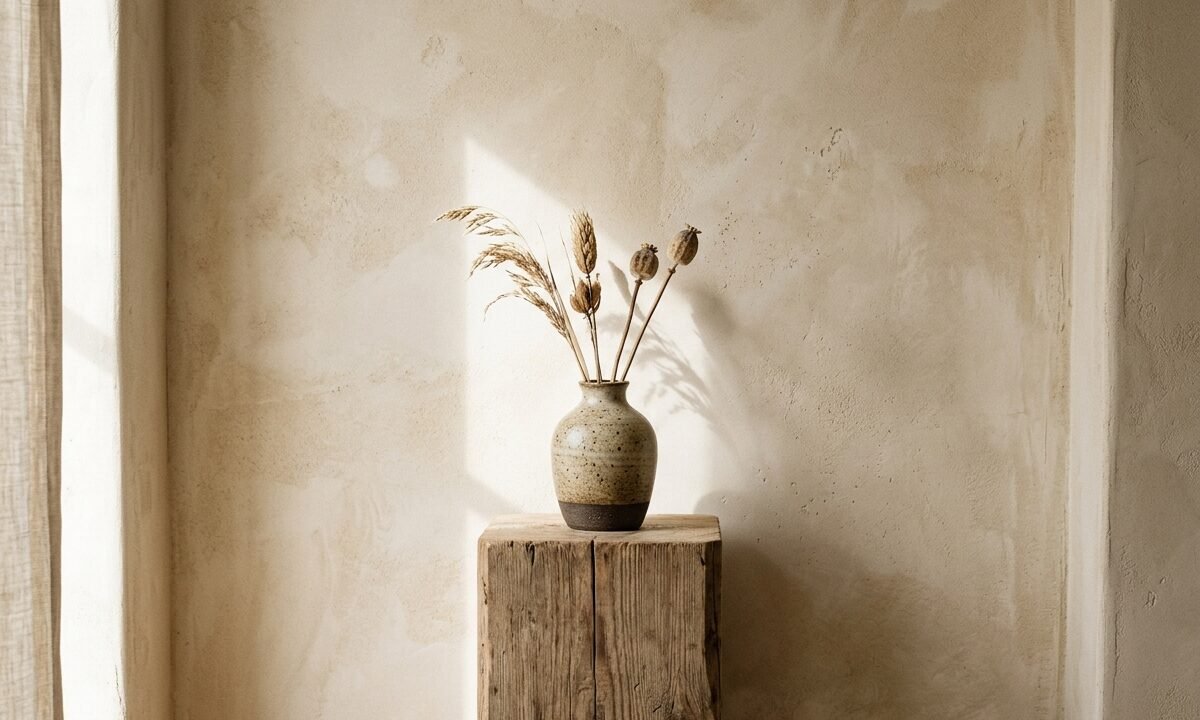
Lime wash is one of humanity’s oldest decorative finishes, dating back to ancient Roman villas. Today, it has made a dramatic resurgence in contemporary interior design thanks to its velvety, non-uniform texture that interacts dynamically with changing daylight.
Tools & Materials Required
- High-potency mineral lime wash paint
- Dedicated mineral acrylic primer (ensures even porosity)
- 4-inch to 6-inch natural bristle masonry block brush
- Painter tape, drop cloths, and clean spray mist bottle
Step 1: Priming for Uniform Porosity
Standard drywall absorbs moisture unevenly. Applying a specialized mineral primer provides the micro-texture and uniform suction required for lime crystals to bloom evenly across the entire surface.
Step 2: The Cross-Hatch (X-Stroke) Application Technique
Dip only the tips of your block brush into the lime paint. Apply in loose, overlapping ‘X’ or figure-eight strokes. Work continuously across the wall from corner to corner without stopping mid-wall to prevent dry lap lines.
Step 3: The Second Coat & Clouding Effect
Allow the first coat to dry for at least 8 hours. As the second coat dries, the calcium hydroxide reacts with atmospheric carbon dioxide, crystallizing into natural limestone and creating the signature cloudy, suede-like patina.