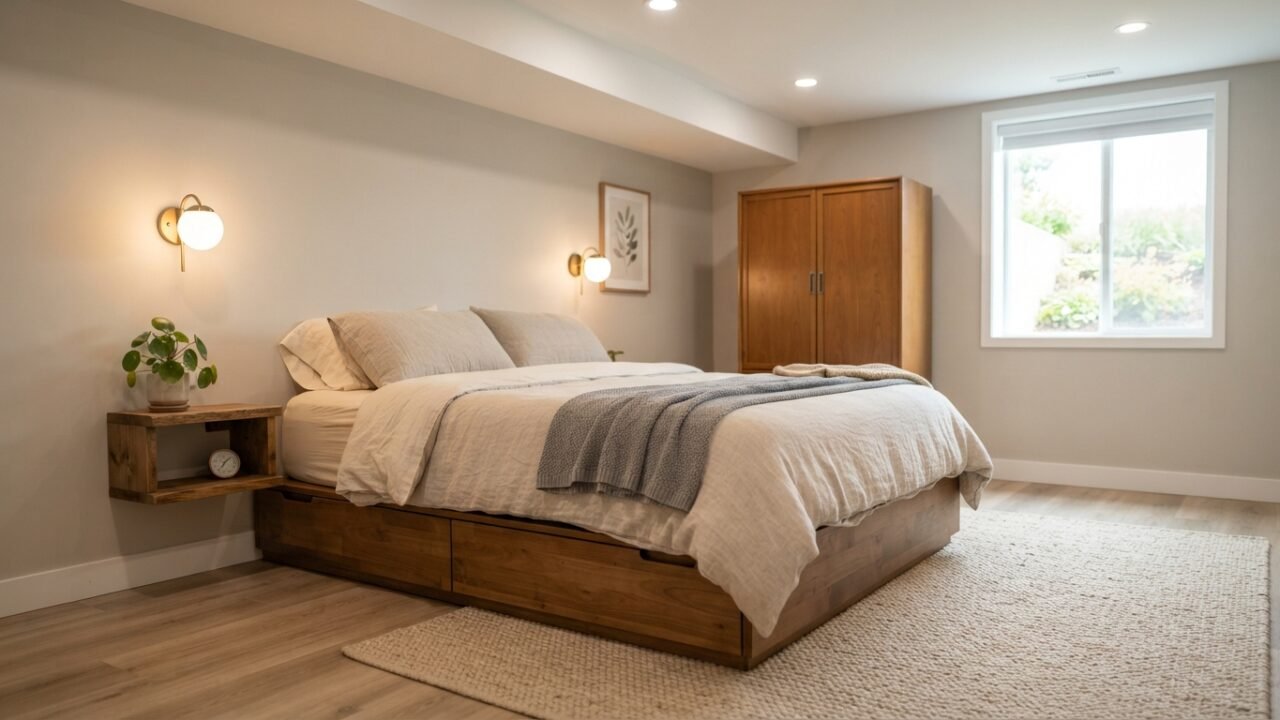
A basement bedroom has three built in disadvantages: little natural light, cooler surfaces, and more moisture risk than the rest of the house. Most disappointing basement rooms come from ignoring these and putting all the effort into decor. The best basement bedroom ideas work with the space’s limits: layer your light, insulate what you touch, choose a layout that hides the low ceiling, and make sure the room is safe to sleep in before anything else.
This article follows that order. Start with the checks that decide whether a bedroom is possible, then work through lighting, warmth, layout, color, storage, and upkeep, with options at different budgets.
Check these four things before you pick paint or furniture
Decor is the last step. If any of these checks fail, fix the problem first or reconsider using the space as a bedroom.
Egress
In most of the United States, a basement room used as a bedroom needs an emergency escape and rescue opening: a window or door that a person can get out of, and a firefighter can get in through. The International Residential Code, which many jurisdictions adopt with local changes, sets minimum sizes: a net clear opening of at least 5.7 square feet (5 square feet for some ground floor openings), at least 24 inches high and 20 inches wide, with a sill no higher than 44 inches from the floor. If the window is below ground level, a window well of a required size, with a ladder or steps where it’s deep enough, is also part of the requirement.
Local codes differ, so confirm with your building department. A room that lacks compliant egress may not legally count as a bedroom, which can matter for insurance and resale. Bedrooms without an escape route are also a genuine fire risk. If your basement has no suitable window, adding one usually means cutting into the foundation wall, so get quotes early, before you plan the rest of the budget.
Moisture and air quality
Damp is the most common reason basement bedrooms turn unpleasant. Look for water stains, efflorescence (a white, powdery residue on masonry), peeling paint, a musty smell, or condensation on cold pipes and windows. Fix water entry at the source: gutters, downspout discharge, and grading that slopes away from the foundation are the cheapest places to start. Interior finishes will not solve a leak.
The U.S. Environmental Protection Agency advises keeping indoor humidity below about 60 percent, ideally between 30 and 50 percent, to limit mold growth. A basic hygrometer costs little and tells you what the room is actually doing across seasons. If readings stay high, a dehumidifier sized for the space is a practical fix.
Also test for radon. It’s a naturally occurring radioactive gas that can seep into homes through the foundation, and basements tend to have the highest levels. The EPA recommends fixing a home when levels reach 4 pCi/L or higher. Home test kits are inexpensive, and testing is worth doing before you invest in finishing.
Alarms, ceiling height, and permits
Bedrooms should have working smoke alarms, and carbon monoxide alarms should be installed according to local requirements and manufacturer instructions, particularly if the basement contains a furnace, water heater, or other fuel burning appliance. Check the alarms’ expiry dates rather than assuming they’re fine.
Ceiling height matters too. The IRC generally calls for at least 7 feet in habitable rooms, with allowances for beams and ducts, though local rules vary. If the ceiling is lower, the room may not qualify as a bedroom, however nice it looks. Finishing work such as framing, electrical, and plumbing often needs permits. Doing it without them can cause trouble when you sell.
Lighting: the biggest difference you can make
A basement bedroom can look flat and gloomy with only one overhead fixture, even with pale paint. The solution is layered light at several heights, which makes the room feel bigger and less enclosed.
Start with ambient light. Recessed fixtures are common in basements because they don’t reduce headroom. Warm color temperatures (around 2700K to 3000K) read as cozy in a bedroom, and dimmers let the room shift from bright for cleaning to soft for evening. Plan the fixtures so they wash walls with light as well as pooling it on the floor.
Add task and accent lighting on top:
- Wall sconces or plug in swing arm lamps beside the bed free up nightstand space and add light at eye level.
- A table lamp on a dresser puts a second light source at a different height.
- LED strips behind a headboard or above wardrobes create a soft glow without taking up floor space.
If there are windows, keep them clear. Skip heavy drapes that block the little daylight available. Sheer or light filtering shades preserve privacy while letting light in, and mounting the rod higher and wider than the frame makes small windows look larger. In rooms with no windows, a well placed large mirror opposite a light source bounces brightness around, but it can’t replace daylight, so treat it as a supplement.
A note on sleep: a room with no daylight can make it harder to wake up. A dimmable bedside lamp or a sunrise style alarm light can help with that, and getting outside in the morning does the rest.
Warmth: floors, walls, and bedding
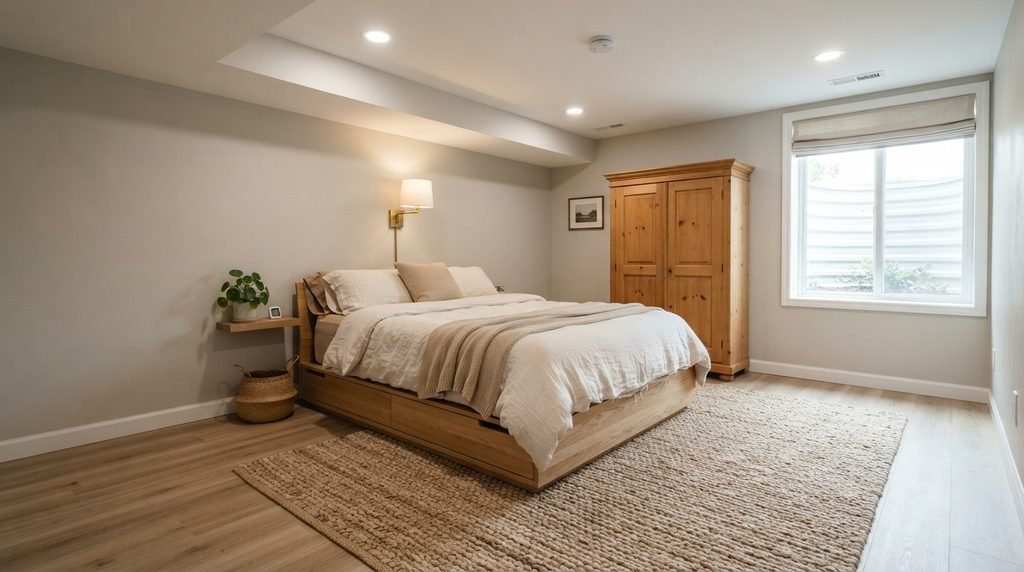
Concrete slabs and foundation walls stay cool, and cold floors are what people notice first. You have options at every level.
Flooring. Bare concrete is the coldest choice. Floating floors with a moisture barrier underneath, such as luxury vinyl plank or engineered products rated for below grade use, are popular because they tolerate humidity better than solid hardwood. Check the manufacturer’s documentation for basement suitability, since installation requirements differ between products. Carpet tiles are a good option if you want softness, because a single damaged or damp tile can be replaced without redoing the room. An underlayment or a raised subfloor panel system adds some insulation and a moisture break, at the cost of a little ceiling height.
Rugs. A large rug under the bed and extending past both sides is the fastest way to make a cold floor comfortable. Choose a rug with a breathable pad, and lift a corner occasionally to check that nothing damp is trapped underneath.
Walls. Insulation and vapor control in basement walls depend on your climate and foundation, so follow local code guidance or ask a contractor rather than copying what worked in a different house. Once the walls are done, textiles help with the feel of the room: a padded or upholstered headboard, wall hung fabric, or a thick curtain on the coldest wall.
Bedding. Layering is the low cost fix. A quality mattress protector, a flannel or wool blanket at the foot of the bed, and a duvet with a lighter throw let you adjust through the seasons.
Layout ideas for common basement problems
Low ceilings
Keep the eye moving horizontally instead of drawing attention upward. Choose a low profile bed frame, or a platform bed with drawers underneath, and skip tall canopy or four poster frames. Wide, low dressers work better than tall chests. Paint the ceiling a light color, matching or slightly lighter than the walls, so it doesn’t feel like a lid. Hang curtains as close to the ceiling as the space allows to add apparent height. Mount lights flush, and avoid pendants that hang into the sightline.
Few or tiny windows
Put the bed where its occupant faces the light source or can see daylight from the pillow. Keep furniture below the window sill so it doesn’t block what little light there is. Keep the area under the window clear for the egress route, which means no wardrobe, bookshelf, or storage stack under it. For rooms with no windows at all, think about the ventilation: a bedroom should have a supply of fresh air, and heating and cooling should reach the room, so check with an HVAC professional if the space has no vents.
Open, undefined floor plans
Many basements are one large room with a sleeping corner. Define the area rather than dropping a bed in the middle. A bookcase used as a divider, a freestanding wardrobe, or a ceiling mounted curtain track can separate the bed from the rest of the room, and a large rug sets the zone visually. Position the head of the bed against a solid wall, not floating in the open, and leave a walkway to the bathroom and the egress window. If part of the room is a laundry or furnace area, keep the bed away from it for noise and air quality.
Color, texture, and decor that work underground
Light colors reflect the most light, so warm whites, soft greys, muted greens, and pale blue greys tend to work well. Very dark colors can look rich in a basement, but they need good artificial lighting to avoid feeling like a cave, and they make small rooms look smaller. If you want a dark accent, limit it to a single wall behind the bed and keep the others light.
Texture is what stops a basement bedroom from feeling like a utility space. Combine a woven rug, linen or cotton bedding, wood tones in the furniture, and a few matte ceramics. Avoid a lot of shiny or cold surfaces like glass and chrome, which emphasize the chill.
Real plants are harder in low light, since most need some daylight. Snake plants and pothos tolerate dim rooms, but they still need some light, and overwatering adds humidity, so don’t overdo it. Good quality artwork or a large framed print can serve as a “window” to give the room a focal point.
Open shelving looks nice but shows dust and holds humidity less well than closed storage. In a basement, keep books and decor on shelves away from exterior walls, where humidity and cold are the highest.
Storage when there’s no closet
Basement bedrooms often have no closet, and adding one may affect egress or need a permit. Plan storage around what you actually need to store.
Start by sorting the clothing and belongings the person will keep in the room. Store everyday items within easy reach, and move seasonal and rarely used items elsewhere in the house so the room doesn’t fill up. Then choose furniture based on that volume:
- Freestanding wardrobe or armoire. Adds hanging space with no construction. Anchor tall units to the wall for safety, and keep them off the window wall.
- Platform bed with drawers. Uses dead space under the mattress. Drawers are easier to reach than lidded bins, but check that they open fully without hitting other furniture.
- Wall mounted rails and shelves. A clothing rail on a solid wall works as an open closet. Leave a gap behind clothing so air can circulate.
- Under bed storage. Plastic bins with lids keep dust out, but avoid packing fabric in tightly on a concrete floor or a damp area. Use breathable containers for textiles.
- Dresser plus over door hooks. For guest rooms, a small dresser and a few hooks are often enough.
Keep stored items off the bare floor. Lifting bins onto shelving or low feet on furniture allows air movement and lets you spot any water early.
Budget tiers: what to do at each spending level
No cost. Rearrange furniture to open sightlines to the window. Move the bed away from cold exterior walls. Take down heavy curtains to let in more light. Clear anything stored in front of the egress window.
Low cost. Buy a hygrometer, a large rug, warm white LED bulbs, a couple of plug in lamps or sconces, a mattress protector, and a small dehumidifier if readings run high. Paint the walls and ceiling a light color.
Moderate. Install dimmable recessed lighting, a floating floor rated for basements, and carpet tiles or a proper underlayment. Add a platform bed with storage and a freestanding wardrobe.
Higher investment. Address the structure: exterior drainage, wall insulation, a code compliant egress window and well, HVAC changes, and subfloor systems. These are also the items most likely to require permits and a professional, and they protect everything else you put in the room.
Common mistakes
- Decorating before fixing damp. Fresh paint over a moisture problem will peel, and mold can develop behind furniture and finishes.
- Blocking the egress window. A dresser or bed under the window may look tidy but defeats the purpose of the opening.
- Relying on a single ceiling light. It flattens the room. Three light sources at different heights is a better minimum.
- Choosing solid hardwood or thick carpet with no moisture barrier. Products that aren’t rated for below grade use can warp or hold moisture.
- Buying furniture too tall for the ceiling. Measure ceiling height at the lowest point, including ducts and beams, before buying.
- Cramming in too much. A basement bedroom feels better with fewer, lower pieces and clear floor space.
- Skipping ventilation. A closed room with no airflow gets stale and humid quickly.
Keeping the room fresh long term
Basement bedrooms need a little routine maintenance. Check the hygrometer weekly at first, then monthly once you know how the room behaves through the seasons. Empty and clean the dehumidifier reservoir, or confirm that its drain hose is clear. Every few months, pull the bed and dresser a few inches from exterior walls to check for stains, mildew, or condensation. Wash bedding regularly and air out the mattress, since less airflow means more moisture in fabrics. Test smoke and carbon monoxide alarms on the schedule the manufacturer recommends, and test again for radon if you’ve changed the foundation or made major repairs.
If you notice a persistent musty smell, visible mold, or repeated water intrusion, treat it as a building problem to be diagnosed and repaired. Scenting the room or running a fan won’t fix it.
FAQ
Can any basement room be a legal bedroom?
No. It generally needs compliant egress, adequate ceiling height, working alarms, and heating, and it must meet any permit requirements. Rules vary, so check with your local building department.
How do I make a basement bedroom with no windows feel less closed in?
Use layered, dimmable warm lighting, light wall colors, and a large mirror opposite a light source. Be aware that a bedroom without any window may not meet code, so confirm before you invest.
What flooring is best for a basement bedroom?
It depends on moisture levels. Luxury vinyl plank and carpet tiles are common choices for below grade rooms, but check each product’s manufacturer documentation for basement use and required moisture testing.
Do I need a dehumidifier?
If your hygrometer regularly shows humidity above about 50 to 60 percent, yes, it’s often worthwhile. The EPA suggests keeping indoor humidity between 30 and 50 percent.
Is a basement bedroom safe for kids?
It can be, provided the egress, alarms, moisture, and radon checks pass. Younger children may also need a way to reach the escape route on their own, so consider whether a basement is the right location.
What colors make a basement bedroom look bigger?
Light, warm neutrals and soft muted tones reflect the most light. Using the same color on walls and ceiling can help low ceilings feel less pronounced.
How can I add storage without a closet?
Use a freestanding wardrobe, a platform bed with drawers, and wall mounted rails. Keep items off the floor and away from the egress window.
Should I put a rug on a concrete floor?
Yes, it makes the floor warmer and quieter. Use a breathable pad and check underneath periodically for damp.