A room can feel unfinished without actually needing more furniture. Sometimes the problem is an empty wall, an outdated side table, plain storage, mismatched accessories, or a corner that has never had a clear purpose.
That is where DIY home decor can be useful.
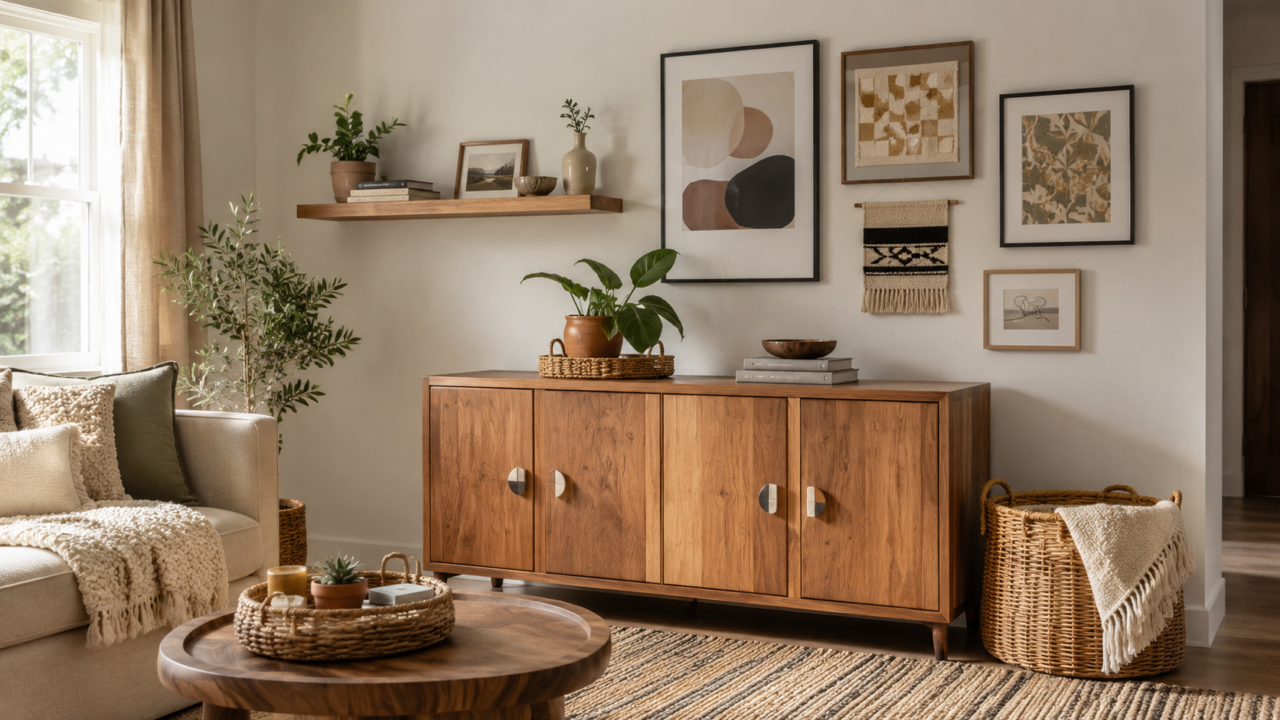
The best DIY projects are not simply things you make because you can. They solve a specific problem while adding personality to the room. A tired cabinet can become a focal point. Leftover wallpaper can become framed artwork. An ordinary shelf can become a display area. Even storage can become part of the room’s design instead of something you try to hide.
DIY also gives you more control over color, size, materials, and style than buying everything ready-made.
The key is to decorate deliberately. Before buying craft supplies, look at the room and decide what actually needs changing.
DIY Home Decor That Looks Good and Works Hard
Good DIY decor sits somewhere between decoration and function.
A decorative tray on a coffee table can collect remotes and small objects. A pegboard can organize tools while becoming part of a home office wall. A refurbished cabinet can provide storage while giving the room a stronger visual focal point.
This approach is particularly useful in smaller homes. Every item occupies physical and visual space, so a project is more worthwhile when it improves both.
It is also worth considering what you already own. Repurposing furniture, fabric, leftover materials, frames, baskets, and unused decorative objects can often produce a more personal result than buying another mass-produced accessory.
Repurposing existing materials has also become an important part of DIY decorating, particularly for people trying to control costs and reduce unnecessary purchases. Architectural Digest has highlighted projects using leftover wallpaper, scrap wood, and other materials that might otherwise sit unused.
Before Starting a DIY Decor Project
Choose the Problem First
Start with the room rather than Pinterest, social media, or the craft aisle.
Ask:
- What looks unfinished?
- What looks dated?
- What is creating visual clutter?
- Is there furniture that could be reused?
- Is there an empty wall that needs purpose?
- Is storage part of the problem?
- Which area do I notice every day?
For example, if your entryway constantly collects keys, bags, and mail, a decorative wall hanging alone will not solve the problem. A small entryway station with hooks, a shelf, and a container for incoming mail would be more useful.
Likewise, if a bedroom feels crowded, adding decorative baskets everywhere may make it worse. The better project could be improving existing storage first.
Work With What You Already Have
Before purchasing materials, make a short inventory of potential DIY supplies:
- Old frames
- Unused baskets
- Spare fabric
- Leftover paint
- Scrap wood
- Old furniture
- Mirrors
- Wallpaper remnants
- Decorative boxes
- Empty jars or containers
- Unused hardware
This also helps establish the style of the room. Reusing several related materials can make separate DIY projects feel like they belong together.
15 Practical DIY Home Decor Ideas
1. Create Oversized Wall Art
Large artwork can be expensive, but the basic idea is simple enough to recreate yourself.
One option is to create an abstract canvas using a limited palette that already exists in the room. Another is to frame an attractive piece of fabric, wallpaper, textile, or even a carefully composed collection of smaller prints.
The important part is scale.
A tiny piece placed alone on a large empty wall can look accidental. A larger artwork—or a carefully arranged group of smaller pieces—usually gives the wall a clearer visual purpose.
You do not need complicated painting skills. Shapes, texture, layered materials, or restrained colors can create a finished-looking piece.
2. Refresh an Old Piece of Furniture
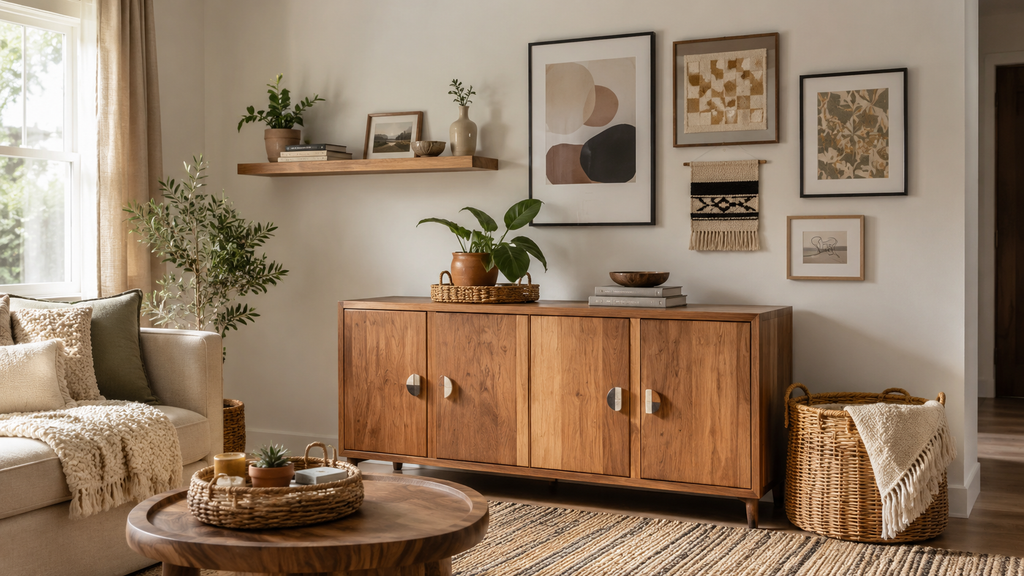
Before replacing a side table, dresser, stool, or small cabinet, consider whether the basic structure is still useful.
A furniture makeover might involve:
- Cleaning the piece thoroughly
- Lightly preparing the existing surface where appropriate
- Painting it
- Replacing outdated handles
- Adding new legs
- Applying removable decorative film
- Replacing damaged fabric
- Styling the finished piece differently
Hardware is particularly useful because changing handles or pulls can alter the character of an otherwise ordinary cabinet without rebuilding it.
For rentals or temporary homes, removable surface treatments can also provide more flexibility. Rental decorating examples frequently use reversible wallpaper, temporary finishes, textiles, and replaceable hardware rather than permanent structural changes.
3. Turn Fabric Into Decorative Panels
Have an attractive textile that is too good to leave folded in a drawer?
Use it as wall decor.
A fabric panel can add color and texture without requiring a complicated painting project. It can work especially well behind a bed, sofa, desk, or dining area.
Choose fabric that complements something already present in the room rather than introducing an unrelated color.
This is also an easy way to change the appearance of a rental without committing to permanent wall treatments.
4. Make a Simple Gallery Wall
A gallery wall does not need to contain expensive artwork.
Combine:
- Family photographs
- Prints
- Children’s drawings
- Vintage-style illustrations
- Small mirrors
- Fabric pieces
- Personal memorabilia
Before putting holes in the wall, arrange everything on the floor.
Look at the overall composition from a distance. If every frame is the same size and evenly spaced, the result will feel orderly. If different sizes and shapes are mixed, keeping one element consistent—such as frame color or spacing—can help the arrangement feel intentional.
The goal is not to fill every inch of wall.
Leave enough breathing room for individual pieces to remain visible.
5. Upgrade Plain Storage
Storage does not have to look purely functional.
A plain shelving unit can become part of the decor through paint, baskets, coordinated boxes, books, artwork, and carefully selected objects.
But avoid filling every shelf.
A useful arrangement usually combines practical storage with a smaller number of visible decorative objects. Closed boxes can hide visually messy items, while open shelves can display books, plants, framed photographs, or favorite objects.
The result is more useful than buying decorative objects simply to fill empty shelves.
6. Create a Decorative Entryway Station
An entryway often becomes a dumping ground because there is nowhere obvious for small everyday items to go.
A simple DIY station can combine:
- Hooks for bags or keys
- A small shelf
- A tray
- A container for mail
- A mirror
- A small decorative object
The important principle is assigning each category a home.
If keys always go on the hook and incoming mail always goes into one tray, the arrangement becomes an organization system rather than just an attractive wall.
7. Repurpose Leftover Wallpaper
Wallpaper remnants can become surprisingly useful decor material.
Instead of storing a half-used roll indefinitely, use it for:
- Framed artwork
- Drawer interiors
- The back of open shelving
- A small furniture accent
- A removable decorative panel
- A temporary backsplash where the material is appropriate
Architectural Digest has documented using leftover removable wallpaper for decorative applications, emphasizing that the surface should be clean and suitable for adhesion.
Always check the manufacturer’s instructions before using a particular wallpaper in a location exposed to moisture, heat, or frequent cleaning.
8. Build a Simple Display Shelf
A small shelf can solve two problems at once: an empty wall and a lack of display space.
Use it for a limited collection of items rather than general storage.
For example, a bedroom shelf might hold a framed photograph, small plant, and a favorite book. A kitchen shelf could display attractive dishes or frequently used items.
If you are renting, check your lease before drilling and choose installation methods appropriate for the wall and load.
9. Make New Cushion Covers
Changing textiles is one of the easiest ways to change the visual character of a room.
Instead of replacing an entire sofa or chair, make or modify cushion covers.
Use one fabric as the main pattern and introduce one or two complementary solids or textures. This gives you a coordinated look without making every surface identical.
Removable covers are particularly practical because they can be changed seasonally or washed according to the fabric manufacturer’s care instructions.
10. Create a Decorative Mirror Arrangement
Mirrors can be functional and decorative at the same time.
Instead of one large mirror, consider arranging several smaller mirrors in a controlled composition.
Use the same frame finish for a cohesive appearance, or deliberately mix frames if the room already has an eclectic style.
Avoid placing mirrors where they reflect an unattractive pile of clutter. Think about what the mirror will reflect before choosing its final position.
11. Give Small Hardware a New Look
Cabinet knobs, drawer pulls, hooks, and handles are small details, but they are also relatively easy to change.
You can use coordinated hardware across several pieces of furniture to make mismatched items feel more connected.
This is especially useful when decorating a rental or refreshing inexpensive furniture.
Before changing hardware, check the existing hole spacing and attachment method so you know whether the replacement will fit without additional modification.
12. Make a Functional Pegboard
Pegboards are useful beyond workshops.
A small, neatly arranged pegboard can organize:
- Craft supplies
- Office stationery
- Gardening tools
- Kitchen accessories
- Children’s creative materials
- Small electronics
Paint or frame the board so it fits the room.
The trick is not to cover the entire surface with objects. Leave some empty space so the system remains easy to use and visually calm.
13. Style an Awkward Corner
An unused corner does not automatically need a chair and side table.
Consider what the household actually needs.
The space might become:
- A compact reading area
- A plant display
- A small home office
- A charging station
- A vertical storage area
- A children’s activity corner
In a small home, the best decor often begins with identifying an unused area and giving it a specific function.
14. Create a Renter-Friendly Accent
Renters have plenty of options that do not involve permanent renovation.
Depending on your lease and the surface involved, possibilities include:
- Removable wallpaper
- Temporary artwork
- Freestanding shelving
- Textiles
- Replaceable hardware
- Decorative lighting that does not require rewiring
- Large rugs
- Freestanding mirrors
Rental decorating examples show how temporary materials and portable furniture can make a rental feel substantially more personalized without treating the property like a permanent renovation project.
Always confirm what your lease allows before painting, drilling, changing fixtures, or applying adhesive products.
15. Turn Everyday Objects Into Decor
Some of the most successful DIY decor does not look like a craft project.
A wooden cutting board can become part of a kitchen display. A vintage tray can organize coffee-table objects. Interesting books can become part of a shelf composition. A collection of baskets can provide both storage and texture.
The goal is to give useful objects an intentional place.
That is often more effective than adding decorative objects that have no purpose.
How to Make DIY Decor Look Intentional
A DIY project can be technically successful and still look out of place.
Three principles help.
Repeat something.
Repeat a color, material, shape, or finish elsewhere in the room.
Create hierarchy.
Not everything should compete for attention. Give the room one or two obvious focal points.
Leave empty space.
An organized shelf, wall, or tabletop does not need to be completely filled.
Think about visual balance as you would think about physical organization. If one side of the room is heavy with furniture, dark colors, and accessories, the opposite side may need more visual breathing room.
This is why copying a trend exactly can be less effective than adapting the idea to your own room. Design publications have increasingly emphasized personal interpretation and practicality over blindly reproducing viral decorating trends.
DIY Home Decor on Different Budgets
No-Cost
Start with what you own.
Rearrange furniture, rotate artwork between rooms, restyle shelves, repurpose containers, or create a new display using objects that are currently scattered around the house.
Low-Cost
Focus on small changes with visible impact:
- New cushion covers
- Basic frames
- Simple artwork
- Hardware
- Paint
- Fabric
- Baskets
- Removable decorative materials
Moderate Budget
This is where DIY furniture projects and larger wall treatments become practical.
You might refresh a cabinet, create a larger feature wall, build custom-looking storage from modular furniture, or improve an entire entryway.
The important rule at every budget level is the same:
Do not buy storage or decor until you know exactly what problem you are solving.
Common DIY Decorating Mistakes
Starting With Materials Instead of a Plan
Buying paint, baskets, fabric, and craft supplies before deciding what the room needs often produces leftover materials and unfinished projects.
Making Everything a Feature
If every wall is dramatic and every shelf is full, nothing stands out.
Choose a few areas to emphasize.
Ignoring Function
A beautiful storage basket is not helpful if you have to empty half the room to reach what is inside it.
Keep frequently used items accessible.
Over-DIYing Furniture
Not every piece needs to be rebuilt.
Sometimes replacing hardware, changing the arrangement, or improving the styling is enough.
Creating More Clutter
DIY should not become an excuse to manufacture objects that have nowhere to go.
Before starting a decorative project, ask: Where will this live?
If you cannot answer that question, the project may not be necessary.
How to Keep DIY Decor From Becoming Clutter
The easiest way to maintain DIY decor is to treat it like every other possession.
Give every item a location.
Keep decorative displays selective rather than constantly adding to them. When you make a new piece, consider whether something else should be removed, relocated, or replaced.
For families, this becomes particularly important. Children’s artwork, seasonal crafts, souvenirs, and handmade projects can accumulate quickly. Instead of displaying everything permanently, rotate selected pieces and store meaningful items elsewhere.
The same principle applies to seasonal decorations. A project that looks great in December does not need to occupy valuable living-space storage for the remaining eleven months.
And when using candles as part of a decorative display, remember that they are open flames. The National Fire Protection Association recommends keeping candles at least 1 foot (30 cm) away from anything that can burn, using sturdy holders, and extinguishing candles when leaving the room or going to bed.
Final Thoughts
The strongest DIY home decor ideas are not necessarily the most complicated ones.
A refurbished cabinet, a thoughtfully arranged gallery wall, leftover wallpaper turned into artwork, or a small entryway organizer can have more impact than a weekend spent making dozens of decorative objects.
Start with the room.
Identify what looks unfinished, what is inconvenient, and what you already own that could be reused. Then choose a project that improves the space without adding unnecessary clutter.
That approach makes DIY decorating more affordable, more personal, and much easier to maintain.
FAQ
What is DIY home decor?
DIY home decor refers to decorative or functional improvements that you make yourself rather than purchasing as a finished product or hiring someone to complete. Projects can include wall art, furniture updates, textiles, shelving, storage, and decorative accessories.
What are the easiest DIY home decor projects for beginners?
Beginner-friendly options include creating simple wall art, changing furniture hardware, making cushion covers, arranging a gallery wall, repurposing frames, styling shelves, and refreshing small furniture pieces.
How can I decorate my home cheaply?
Start by rearranging and repurposing items you already own. After that, focus spending on high-impact changes such as paint, textiles, artwork, hardware, and carefully selected storage rather than buying many small accessories.
What DIY decor ideas work well for renters?
Removable wallpaper, textiles, freestanding furniture, temporary artwork, rugs, replaceable hardware, and portable storage can work well for renters. Always check the lease before making changes to walls, fixtures, or finishes.
How do I make DIY decor look expensive?
Pay attention to scale, consistency, spacing, and materials. Repeating one or two colors or finishes and leaving enough empty space often makes a DIY project look more intentional than filling a room with unrelated decorative items.
Should DIY home decor also provide storage?
It can, and multifunctional projects are particularly useful in smaller homes. Shelves, pegboards, decorative boxes, entryway stations, and refurbished cabinets can combine visual appeal with practical storage.
How do I know if a DIY project is worth doing?
Ask what problem it solves, where the finished project will go, what materials you already have, and whether the result will improve the room’s appearance or function. If the project only creates another object to store, reconsider it.
Is DIY decor better than buying home decor?
Neither is universally better. DIY is useful when you want customization, reuse existing materials, control costs, or work around unusual spaces. Buying can make more sense when you need a particular quality, construction, size, or finish that would be difficult to reproduce yourself.