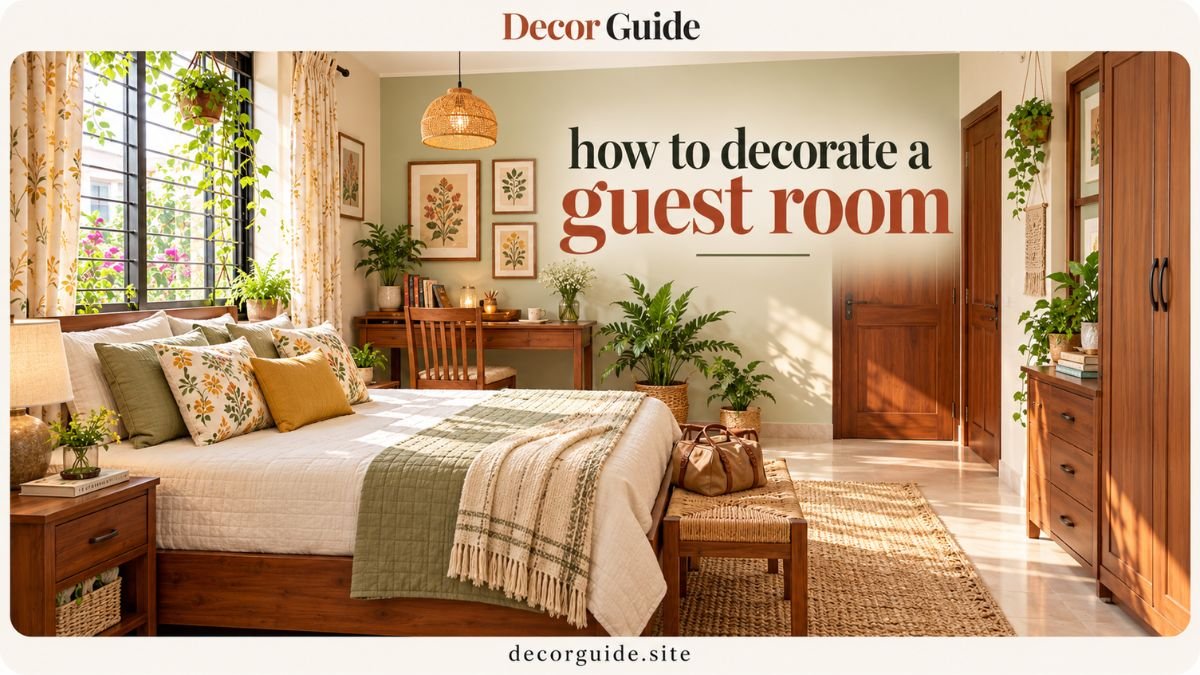
To decorate a guest room, start with the bed and layout, then add useful lighting, simple storage, comfortable bedding, window treatments, and a few personal looking decorative touches. The goal is not to fill every corner. A good guest room should feel clean, comfortable, easy to use, and uncluttered. Choose furniture based on the room’s size and what visitors actually need. Then layer in textiles, artwork, lighting, and small accessories to give the space character without making it difficult to move around.
Start With the Guest Room Layout
Before buying anything, look at the room as an empty space.
Measure the available area and note the position of the door, windows, closets, outlets, radiators, and other fixed features. These details affect where furniture can go.
The bed will usually be the largest piece, so decide where it should sit first. In many rooms, placing the bed against the main wall creates the clearest layout. However, the best position depends on the door and window placement.
Once the bed location is decided, consider what guests need around it.
A useful guest room may need:
- A bed and mattress
- Bedside surface
- Bedside lighting
- Clothing storage
- A place for luggage
- Curtains or blinds
- A mirror
- A small amount of decoration
- An accessible power outlet
- Space to walk comfortably
Avoid placing furniture simply because there is an empty wall. Every piece should have a purpose.
Think About Movement
A guest should be able to enter the room, reach the bed, open storage, and move around without constantly working around furniture.
If the room is small, fewer pieces can actually make it feel more finished. A bed, small bedside table, lamp, and practical storage may be enough.
Choose the Bed as the Main Feature
The bed is normally the visual and practical center of a guest room.
Start with a comfortable mattress and a simple bedding setup. You do not need an elaborate arrangement. Clean sheets, a comfortable blanket or duvet, pillows, and a coordinated cover can make the room feel finished.
For the overall look, choose a bedding color that works with the room’s walls and flooring.
Neutral shades can create a calm appearance, while muted colors can add more personality without making the room visually busy.
If the room already has patterned wallpaper, curtains, or artwork, simpler bedding may work better.
On the other hand, if the walls and furniture are plain, bedding can introduce color or pattern.
Layer the Bedding Carefully
A simple bedding combination can include:
- Fitted or flat sheet
- Duvet or blanket
- Sleeping pillows
- One or two decorative cushions
- A throw at the foot of the bed
There is no need to add every possible decorative layer. Too many cushions or blankets can make the bed harder for guests to use.
Pick a Guest Room Color Scheme
Color has a major effect on how the room feels.
For a guest room, consider colors that are easy to live with and work with the existing furniture. Soft neutrals, muted greens, warm beige, pale blue, and understated earthy tones can all work well.
You do not need to use the same color everywhere.
Instead, create a simple relationship between:
- Walls
- Bedding
- Curtains
- Rug
- Furniture
- Decorative accessories
For example, a neutral wall can work with warmer wood furniture and soft green textiles. A room with darker furniture may benefit from lighter bedding and curtains.
Use One Main Color and Supporting Tones
A simple approach is to choose one main color, then add two or three supporting tones.
This keeps the room cohesive without requiring every item to match exactly.
If you are decorating on a budget, keep the larger permanent elements relatively simple. You can then change smaller items such as cushions, throws, or artwork when you want a different look.
Add Useful Bedside Lighting
Good lighting is one of the most useful features in a guest room.
A bedside lamp gives visitors a convenient light source without requiring them to get out of bed. If two people may use the room, consider whether both sides of the bed need lighting.
The type of lighting should also suit the room.
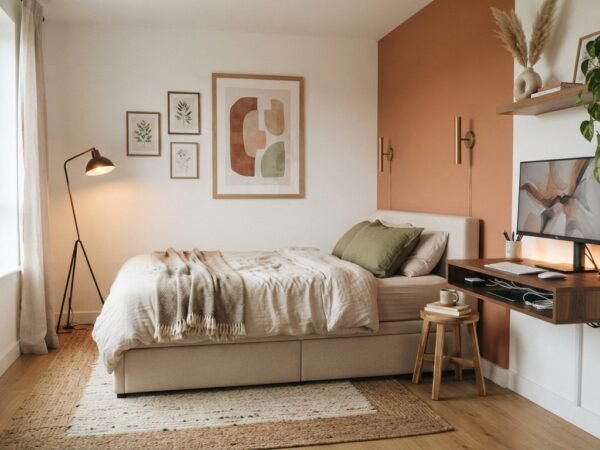
A table lamp works well when there is enough space for a bedside table. Wall mounted lighting can be useful when floor or table space is limited.
Avoid relying entirely on one bright ceiling light. A combination of general lighting and smaller light sources makes the room more flexible.
Consider having lighting near:
- The bed
- The room entrance
- A desk or reading area, if included
Give Guests Enough Storage
A guest room does not necessarily need a large dresser or extensive wardrobe.
Think about what a short term visitor actually needs.
A closet with some clear hanging space can be useful. A few drawers or shelves may also help. If the room has limited storage, an uncluttered surface or designated area for belongings can still make a difference.
The important part is leaving some storage available rather than filling every drawer with your own belongings.
Open vs. Closed Storage
Open storage makes frequently used items easy to see and reach. It can work well for baskets, folded blankets, or decorative items.
Closed storage hides clutter and gives the room a cleaner appearance. It can be better for clothing, personal items, and things that do not need to stay visible.
If the room is small, a combination can work well. Use closed storage for visual clutter and one or two open baskets for practical items.
Create a Place for Luggage
Luggage is easy to overlook when decorating a guest room.
Guests often need somewhere to put a suitcase or bag where it can be opened without blocking the walkway.
If there is enough room, a luggage rack can be useful. A clear bench or sturdy surface may also serve this purpose if it is appropriate for the room.
In a small guest room, do not add a separate piece of furniture just for luggage if it makes movement difficult. Look for furniture that can serve more than one purpose.
For example, a bench at the end of the bed can provide seating while also creating a convenient place for a bag.
Add a Mirror
A mirror can be both decorative and practical.
A full length mirror is useful if there is enough wall space. Otherwise, a smaller mirror can be placed where guests can easily use it.
In a small room, consider positioning a mirror where it can reflect available light. This can make the space feel more open without adding another large piece of furniture.
Choose a frame that works with the rest of the room rather than treating the mirror as an unrelated decoration.
Use Curtains to Finish the Room
Window treatments can make a guest room feel more complete.
Choose curtains or blinds based on the window, existing decor, and the level of privacy the room needs.
If the room receives strong daylight, window coverings can also help guests control the amount of light entering the room.
For a simple design, neutral curtains can blend into the room. If the walls and bedding are plain, patterned curtains can introduce another layer of visual interest.
Avoid choosing a pattern that competes with several other strong patterns already in the room.
Add a Rug Where It Makes Sense
A rug can add warmth and help define the sleeping area.
In a larger guest room, a rug can visually connect the bed and bedside furniture. In a smaller room, a smaller rug may be easier to manage.
Think about the existing flooring before adding one.
If the room already has attractive wood flooring or carpet, a rug is not automatically necessary. Add one because it improves comfort or appearance, not simply because the room has an empty floor.
Decorate the Walls Without Overfilling Them
Wall decor gives a guest room personality, but more is not always better.
A large artwork above the bed can become a focal point. A small group of framed prints can work on a larger empty wall.
You could also use:
- A framed landscape
- Simple botanical artwork
- A decorative mirror
- A small gallery arrangement
- A textile wall hanging
Choose pieces that support the room’s color palette.
Avoid filling every wall. Leaving some open space can make the room feel calmer and more organized.
Add Small Decorative Details
Once the main furniture and functional elements are finished, add a few accessories.
Useful decorative pieces might include:
- A vase
- A small plant
- A decorative bowl
- A few books
- A framed print
- A small tray
- A simple clock
The best accessories are easy to maintain and do not interfere with normal use.
For example, a small tray on a dresser can organize everyday items while also acting as decoration.
Do not use accessories to hide the fact that the room lacks useful storage. Function should come first.
Make the Room Comfortable for Different Guests
A guest room should not be designed only around how it looks in photographs.
Think about what someone needs when staying overnight.
A guest may need:
- Space for clothes
- Somewhere to charge a phone
- A bedside light
- A mirror
- Extra bedding
- A place for luggage
- A way to control privacy and light
If possible, keep commonly needed items easy to find.
You can place spare blankets in a basket or closet and leave some storage space clearly available.
A simple information note can also help if guests need instructions for Wi Fi, heating, cooling, or other household features.
Small Guest Room Decorating Ideas
A small room requires more careful furniture choices.
Instead of trying to fit everything into the space, decide what is genuinely necessary.
Choose Smaller Furniture
A compact bedside table may work better than a large nightstand. A narrow dresser can provide storage without dominating the room.
Use Multi Purpose Pieces
Furniture that serves more than one purpose can save valuable space.
A bench can provide seating and luggage space. A bedside table can provide storage and a surface for lighting. A wall mounted shelf can provide display space without taking up floor area.
Keep the Floor Clear
Floor space has a major visual effect in a small room.
Avoid adding furniture simply to fill gaps. Keep walking routes clear and use walls for storage or decoration when practical.
Use Light Visual Layers
A small room can become visually crowded when every surface contains objects.
Use a limited number of accessories and let the larger elements—bed, curtains, walls, and flooring—create most of the visual structure.
Guest Room Ideas on Different Budgets
You can improve a guest room without replacing everything.
Free or Very Low Cost
Start by working with what you already own.
- Remove unnecessary clutter
- Clear some closet or drawer space
- Rearrange furniture
- Wash and refresh bedding
- Remove unrelated decorative items
- Organize visible surfaces
- Improve the lighting arrangement
- Move artwork from another room if appropriate
These changes can make the room feel noticeably more intentional without purchasing new furniture.
Moderate Budget
If you have some money to spend, prioritize items guests actually use.
Consider:
- New bedding
- Bedside lamps
- Curtains
- A mirror
- Storage baskets
- A rug
- Simple wall artwork
Do not buy all of these at once. Start with the area that needs the most improvement.
Higher Budget
For a larger project, you might consider:
- Repainting the room
- Updating the bed
- Replacing outdated storage furniture
- Installing better lighting
- Adding built in storage
- Updating window treatments
- Improving the overall furniture layout
Even with a larger budget, the same principle applies: solve practical problems before adding decorative features.
Common Guest Room Decorating Mistakes
Filling Every Empty Surface
An empty dresser does not need five decorative objects.
Leave useful surfaces available for guests.
Using Too Many Patterns
Several unrelated patterns can make a room feel visually busy.
If the bedding has a strong pattern, consider keeping the curtains and major accessories simpler.
Choosing Furniture That Is Too Large
Large furniture can make a guest room difficult to move around.
Check the room layout before bringing in another substantial piece.
Forgetting About Lighting
A beautiful room can still be inconvenient if the only light source is a ceiling fixture.
Give guests a practical light source near the bed.
Keeping All the Storage for Yourself
If visitors cannot use the closet or drawers, the storage technically exists but does not function as guest storage.
Clear some space before guests arrive.
Decorating Only for Appearance
A guest room should look good, but it also needs to work.
Do not sacrifice walking space, storage, lighting, or comfort simply to fit another decorative item.
A Simple Guest Room Decorating Order
If you are starting from scratch, use this order:
- Clear the room.
- Decide on the furniture layout.
- Position the bed.
- Add essential storage.
- Create a place for luggage.
- Add bedside surfaces and lighting.
- Choose bedding and textiles.
- Install or arrange window treatments.
- Add a mirror.
- Add wall decor.
- Add a few accessories.
- Remove anything that feels unnecessary.
This order helps prevent you from buying decorative items before solving the practical parts of the room.
Final Guest Room Checklist
Before considering the room finished, walk through it as if you were staying there.
Ask:
- Is the bed easy to access?
- Is there useful light near the bed?
- Is some storage available?
- Is there a clear place for luggage?
- Can guests find a mirror?
- Can they control window coverings easily?
- Is there enough open space to move around?
- Are important surfaces free for personal belongings?
- Does the room have enough decoration without feeling crowded?
- Are spare blankets or other useful items easy to locate?
If the answer to these questions is yes, you have covered the essentials.
The best way to decorate a guest room is to build the space around comfort and practical use first, then add personality through color, textiles, artwork, and accessories. You do not need to fill the room with expensive furniture. A well planned layout, comfortable bed, useful lighting, available storage, and a few thoughtful details can create a welcoming space while keeping it easy to maintain.
FAQs
What should every guest room have?
A guest room should generally have a comfortable bed, suitable bedding, useful lighting, some available storage, a place for luggage, privacy at the windows, and enough space to move around comfortably.
What color is best for a guest room?
There is no single best color. Choose a color that works with the existing room and creates the atmosphere you want. Soft neutrals and muted colors can create a calm appearance, while stronger colors can add personality when used thoughtfully.
How can I decorate a guest room cheaply?
Start with free changes such as decluttering, rearranging furniture, clearing storage, and refreshing existing textiles. If you need to buy something, prioritize practical items such as bedding, lighting, curtains, or storage before decorative accessories.
How do I make a small guest room look bigger?
Keep the floor and walking routes clear, avoid oversized furniture, use multi purpose pieces, limit decorative clutter, and consider mirrors or lighter visual elements where they suit the room.
Should a guest room have a TV?
A TV is optional. If guests commonly use one and the room has enough space, it can be useful. However, it should not take priority over essentials such as comfortable bedding, lighting, storage, and clear walking space.
How do I make a guest room feel welcoming?
Focus on comfort and convenience first. Fresh bedding, practical lighting, available storage, a clear place for luggage, privacy at the windows, and a few carefully chosen decorative details can make the room feel ready for visitors.