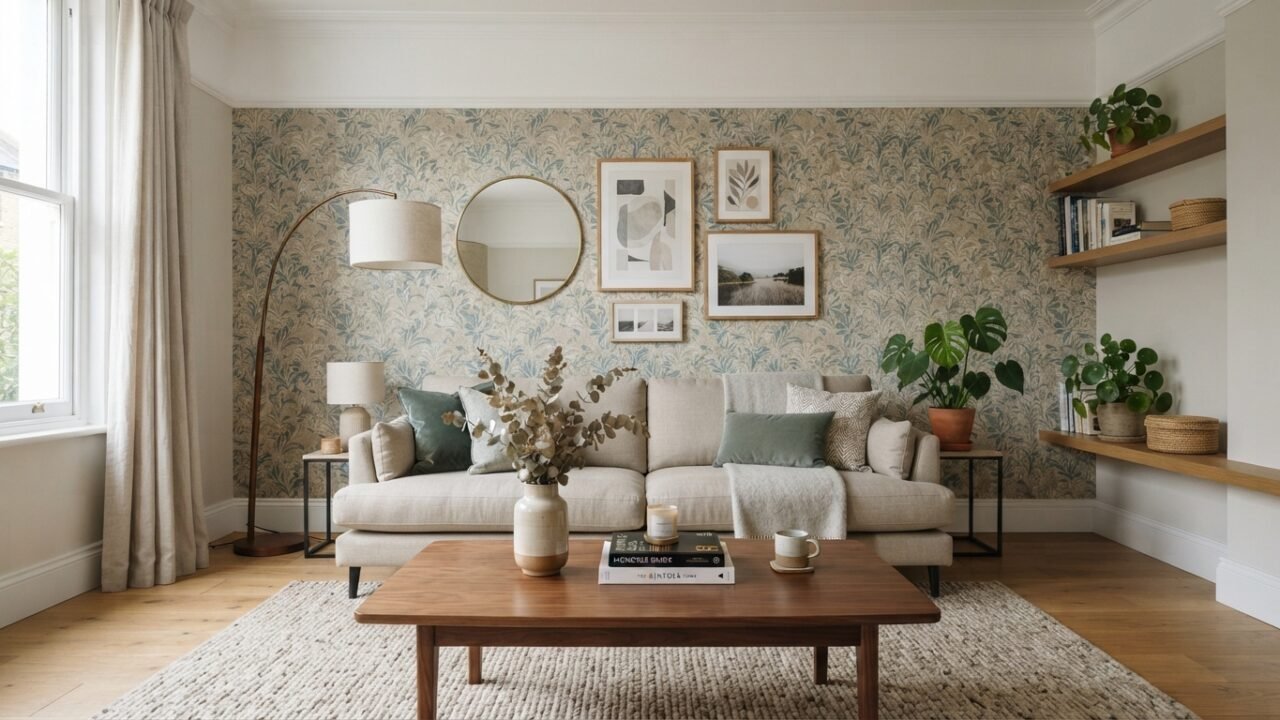
The best living room wallpaper decor starts with the room itself. Look at the furniture, natural light, wall size, and existing colors before choosing a pattern. For a strong focal point, use wallpaper on one feature wall. For a quieter look, choose a subtle pattern across multiple walls. Then coordinate your sofa, curtains, rug, lighting, and accessories with the wallpaper rather than trying to match every detail. In a small living room, lighter colors and restrained patterns can help the space feel open, while a darker or bolder wall can create a deliberate focal point.
1. Start With the Room, Not the Wallpaper
Wallpaper is a large visual element, so choosing it before considering the rest of the room can lead to a mismatched result.
First, examine what you already have.
Look at:
- Sofa color
- Flooring
- Curtains
- Rugs
- Wood finishes
- Lighting
- Existing wall colors
- Artwork
- Shelving
- TV or entertainment unit
Write down the main colors already present.
You do not need to find wallpaper that exactly matches your furniture. Instead, look for wallpaper that works with the room’s existing color family.
For example, if your room has warm wood furniture and cream upholstery, a warm neutral wallpaper may connect the pieces naturally.
If your furniture is simple and neutral, wallpaper can provide more of the visual interest.
2. Decide What You Want the Wallpaper to Do
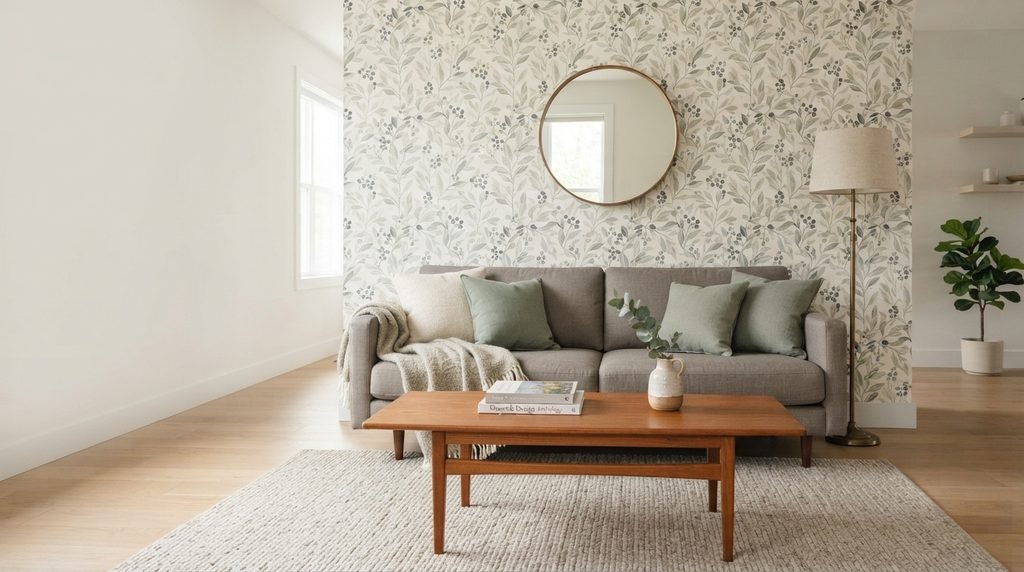
Before choosing a pattern, decide its job.
Wallpaper can:
- Create a focal wall
- Add color
- Add pattern
- Make a plain room feel more finished
- Define a seating area
- Highlight an architectural feature
- Add texture or visual depth
- Give a room a stronger design identity
This decision makes the rest of the process easier.
If your living room already has several decorative elements, wallpaper may need to stay relatively quiet.
If the room is very plain, wallpaper can become the main decorative feature.
3. Choose Between One Wall and All Walls
One of the biggest decisions is how much of the room to cover.
Feature wall
A feature wall is useful when you want wallpaper to become a focal point without making the entire room highly patterned.
Good locations include:
- Behind the sofa
- Behind the television
- Behind a fireplace
- The wall facing the entrance
- A naturally prominent architectural wall
A feature wall works particularly well when the other walls remain simple.
Multiple walls
Using wallpaper on several walls creates a more immersive look.
This can work well when the pattern is relatively subtle and the room has enough visual balance.
It is also useful when you want the wallpaper to feel like part of the architecture rather than a single decorative panel.
Which should you choose?
Choose a feature wall when the wallpaper is bold or the room already has plenty of visual detail.
Consider multiple walls when the wallpaper is quieter and you want a more continuous appearance.
4. Pick the Right Wallpaper Pattern
Wallpaper patterns can completely change how a living room feels.
Think about the scale of the pattern as well as its color.
Large patterns create a strong visual statement.
Small patterns tend to feel more understated.
Geometric designs can give the room a structured appearance, while botanical patterns can introduce a softer natural feeling.
Stripes can emphasize direction and create a different sense of height or width depending on how they are arranged.
Abstract designs can work well when you want something decorative without a traditional floral or geometric theme.
The important point is to choose a pattern based on the room’s existing visual language.
5. Use Neutral Wallpaper for a Calm Living Room
Neutral wallpaper does not mean boring wallpaper.
Cream, beige, soft gray, warm white, taupe, and similar shades can add detail without overwhelming the room.
Look for:
- Subtle geometric patterns
- Fine botanical designs
- Textured effects
- Soft organic shapes
- Gentle tonal patterns
Neutral wallpaper works especially well when you want your furniture, artwork, or lighting to remain important.
It is also easier to update the room around later because it does not demand a specific color scheme.
6. Create a Bold Feature Wall
If your living room feels too plain, a bold wallpaper feature wall can provide the missing focal point.
Consider stronger:
- Greens
- Blues
- Deep neutrals
- Earthy tones
- Rich patterns
A bold wall does not require bold furniture.
In fact, simple furniture can help the wallpaper stand out without making the room feel overloaded.
If the wallpaper already contains several colors, choose furniture and accessories from one or two of those colors rather than introducing many unrelated shades.
7. Coordinate Wallpaper With the Sofa
The sofa is usually one of the largest pieces in a living room, so it should work with the wallpaper.
The colors do not have to be identical.
Instead, look for relationships.
A neutral sofa can support a patterned wallpaper.
A colorful sofa may work better with a quieter wallpaper.
If both the sofa and wallpaper are highly patterned, the room can quickly become visually busy.
In that situation, keep cushions, curtains, and rugs simpler.
8. Use Wallpaper Behind the TV Carefully
The TV wall is often already visually strong.
Wallpaper can make this wall more attractive, but too much pattern behind the screen may compete with the television.
If you are decorating behind the TV, consider:
- Subtle textures
- Small scale patterns
- Neutral colors
- Simple geometric designs
Keep cables, media equipment, and other practical elements organized so the wallpaper remains part of the design instead of becoming a background for clutter.
A floating or streamlined entertainment setup can also help the wall look cleaner.
9. Highlight a Fireplace Wall
A fireplace naturally creates a focal point.
Wallpaper can reinforce that feature rather than compete with it.
If the fireplace has strong architectural details, consider a wallpaper pattern that supports rather than overwhelms them.
You can also use wallpaper around the fireplace while keeping the mantel relatively simple.
This creates a layered look:
Architecture → wallpaper → fireplace → carefully selected decor
You do not need a large collection of accessories on the mantel if the wall itself is already decorative.
10. Add Texture Without Overdecorating
Wallpaper can provide visual texture even when it does not have a strong pattern.
This is useful when you prefer simple decor.
A textured or subtly patterned wall can work with:
- Plain sofas
- Natural wood
- Simple rugs
- Soft lighting
- Minimal accessories
This approach is particularly useful for people who want a finished room without filling every surface with decorative objects.
11. Think About Natural Light
Light changes how wallpaper appears.
A color can look different in strong daylight compared with evening lighting.
Before committing to a wallpaper, consider:
- Which direction the windows face
- How much natural light enters
- Whether the room is bright or shaded
- How the wallpaper looks under your existing lights
If possible, look at a sample in the actual room at different times of day.
Do not judge wallpaper only from a small screen image.
12. Consider the Ceiling and Floor
Wallpaper does not exist separately from the rest of the room.
The ceiling, flooring, and wall finish all affect the final result.
If your floor already has a strong pattern or visual texture, a quieter wallpaper may create better balance.
If the floor is simple, you have more freedom to use wallpaper as a stronger decorative element.
The same principle applies to the ceiling.
A simple ceiling allows more attention to move toward the wallpapered wall.
13. Use Wallpaper to Define a Seating Area
Open plan homes can use wallpaper to visually define different areas.
For example, a wallpapered wall behind the sofa can help identify the living room within a larger open space.
You do not necessarily need physical dividers.
The wallpaper creates a visual boundary.
This works especially well when the living room shares space with a dining or work area.
Keep the transition intentional. The wallpaper should connect with at least one color or material used elsewhere in the open space.
14. Living Room Wallpaper Decor for Small Spaces
Small living rooms need careful visual planning.
Wallpaper can work very well, but the goal should be balance rather than simply making the room look bigger.
Consider:
- Lighter wallpaper colors
- Subtle patterns
- One feature wall
- Vertical patterns where appropriate
- Minimal competing wall decor
- Clear floor space
Avoid covering the wallpaper with too much furniture or artwork.
Let the wall remain visible.
Use vertical space
In a compact room, vertical wallpaper patterns can draw attention upward.
You can support this effect with:
- Tall curtains
- Vertical shelving
- Tall lamps
- Higher artwork placement
The result is a room where the eye moves upward rather than focusing only on limited floor space.
15. Combine Wallpaper With Shelving
Wallpaper can provide a decorative background for open shelving.
However, the shelves should not become overloaded.
If the wallpaper is patterned, keep the shelf styling relatively simple.
Use a mix of:
- Books
- Small plants
- Decorative objects
- Baskets
- A few personal pieces
Leave some visible wallpaper between objects.
That negative space helps the wall pattern remain part of the overall design.
16. Use Artwork With Wallpaper
Artwork can work beautifully with wallpaper, but you need to consider visual competition.
A busy wallpaper and a large, colorful painting may both demand attention.
If the wallpaper is strong, choose simpler artwork.
If the wallpaper is subtle, you can use artwork as a stronger focal element.
Frames can also connect the two.
For example, wood frames can repeat wood furniture, while dark frames can connect with darker wallpaper details.
17. Keep Curtains Simple When Wallpaper Is Busy
Curtains occupy a large area, just like wallpaper.
If both are heavily patterned, the room can feel crowded.
A simple curtain in a color taken from the wallpaper is often easier to coordinate.
This does not mean every curtain must be plain.
Subtle texture can add interest without competing with the wall.
The same principle applies to rugs and cushions.
18. Build the Room Around Three Main Elements
A practical way to organize the design is to identify three main visual elements.
For example:
- Wallpaper
- Sofa
- Rug
Then make smaller items support those three.
Cushions, lamps, artwork, and decorative objects should not each introduce a completely different design direction.
This makes decorating easier because you have a clear hierarchy.
19. Budget Friendly Living Room Wallpaper Decor
Wallpaper does not have to mean a complete room makeover.
Free
Start by rearranging what you already have.
Move furniture so the intended wallpaper wall becomes more visible.
Remove unnecessary wall art.
Simplify shelves.
Rearrange lamps and accessories.
This helps you understand what the room actually needs before spending money.
Lower cost approach
If you want to change the wall without decorating the entire room, focus on one feature wall.
You can then keep most existing furniture and accessories.
Use the wallpaper’s colors to guide small changes such as cushion covers or decorative objects.
Higher cost approach
A larger wallpaper project may involve covering several walls and coordinating additional elements.
If you choose this route, think about the entire room before purchasing materials.
The wallpaper should work with the flooring, furniture, lighting, window treatments, and permanent features.
20. What to Store Before Decorating
Wallpaper decorating often involves moving furniture and clearing walls.
Before you start, decide where temporary items will go.
Store:
- Wall art
- Decorative accessories
- Small electronics
- Breakable objects
- Loose cables
- Small furniture that needs to be moved
If you already have storage containers, use them.
Do not buy storage products simply because you are decorating.
First determine what actually needs to be stored and where it will be used.
For small homes, stackable or closed storage can be useful for temporary clutter because it keeps the room visually clean.
21. Open vs. Closed Storage With Wallpaper
Wallpaper changes how storage looks against the wall.
Open storage keeps objects visible and allows the wallpaper to remain part of the background. It works best when the items are intentionally arranged.
Closed storage hides everyday clutter and lets the wallpaper become the main visual feature.
If your wallpaper is bold, closed storage can help keep the room calm.
If your wallpaper is subtle, open shelving can add more layers of interest.
The choice should depend on how much visual clutter you need to hide.
22. Common Living Room Wallpaper Mistakes
Choosing wallpaper without considering the furniture
A pattern may look attractive on its own but clash with the existing room.
Fix: Look at the wallpaper beside your sofa, flooring, curtains, and major furniture before committing.
Using too many competing patterns
Wallpaper, patterned sofa fabric, patterned curtains, and a busy rug can create visual overload.
Fix: Let one or two elements carry the pattern.
Ignoring lighting
Wallpaper can look very different in daylight and artificial light.
Fix: Check a sample under the room’s actual lighting.
Covering every wall with a bold pattern
A dramatic pattern can become overwhelming when repeated across the entire room.
Fix: Consider using it on one wall.
Adding too much wall decor
Wallpaper already decorates the wall.
Fix: Leave portions of the wallpaper visible and choose artwork carefully.
Buying before planning
Wallpaper is not the only part of the design.
Fix: Decide on furniture placement and the overall color direction first.
23. A Step by Step Wallpaper Decorating Method
Use this process if you are starting from scratch.
Step 1: Clear the wall
Remove artwork, accessories, and unnecessary objects.
Step 2: Study the room
Identify furniture colors, natural light, flooring, and architectural features.
Step 3: Choose the purpose
Decide whether the wallpaper will create a focal point, add subtle texture, or cover several walls.
Step 4: Choose a pattern
Select a pattern that fits the room’s existing visual style.
Step 5: Test the color
Look at a sample in the actual room.
Step 6: Plan furniture placement
Make sure the wallpaper will remain visible and useful as a background.
Step 7: Coordinate textiles
Choose curtains, cushions, and throws that support the wallpaper.
Step 8: Add storage thoughtfully
Hide clutter where needed rather than adding unnecessary storage furniture.
Step 9: Add wall decor
Only add artwork or mirrors where they improve the composition.
Step 10: Step back
Look at the room from the doorway and main seating position.
If one area feels too busy, remove something before adding another item.
24. How to Keep Wallpapered Living Rooms Organized
Good decor still needs to function.
Keep the room organized by giving everyday objects a home.
Use existing storage for:
- Remote controls
- Books
- Blankets
- Games
- Cables
- Small electronics
Keep frequently used items accessible and less attractive clutter hidden.
If the wallpaper is the main feature, clutter becomes more noticeable because there is already a strong visual background.
A simple organization system can therefore make the wallpaper look better without changing the wall itself.
25. Final Checklist
Before finishing your living room wallpaper decor, check the following:
- Does the wallpaper work with the sofa?
- Is the color compatible with the flooring?
- Does the pattern suit the room’s size?
- Is the main focal point clear?
- Is there enough visible wallpaper?
- Are curtains and rugs competing with the pattern?
- Is the wall receiving too much artwork?
- Is everyday clutter hidden?
- Can people move comfortably?
- Does the room still feel like a living space rather than a display?
If the wallpaper looks good but the room is difficult to use, the design needs adjustment.
The best wallpaper decor is not simply about finding an attractive pattern. It is about creating a wall that supports the way the room is actually used.
FAQs
Can wallpaper be used behind a large sectional sofa?
Yes. A wall behind a sectional can work well as a feature wall, especially when the sofa has a simple color or fabric. Keep enough of the wallpaper visible so it remains part of the design.
Should wallpaper go behind a television?
It can, but choose the pattern carefully. Subtle patterns and textures can work better than highly detailed designs when the television is the main object on the wall.
Can I use wallpaper if my living room already has patterned furniture?
Yes. The key is controlling the number of competing patterns. If the furniture has a strong pattern, choose wallpaper with a quieter design or use it on one wall.
How can I make wallpaper work with existing wood furniture?
Look for wallpaper colors that complement the wood’s overall warmth or tone. You do not need an exact color match. Repeating warm or natural tones elsewhere can help connect the room.
Is wallpaper suitable for a rental living room?
It depends on the rental agreement and the type of wallpaper you choose. Always check the property’s rules before making changes to walls.
Should I put furniture directly against a wallpapered wall?
Furniture placement depends on the room layout and the furniture itself. Leave enough space for normal use, access, and maintenance, while keeping the wallpaper visible where it contributes to the room’s design.